
In today’s complex digital ecosystems, downtime is more than an inconvenience—it’s a direct threat to revenue, compliance, and customer trust. For enterprise IT leaders, reducing mean time to repair (MTTR) has become one of the most important indicators of operational resilience and business continuity.
As organizations scale their digital infrastructure, incident volumes are increasing, systems are becoming more distributed, and operational dependencies are growing more complex. In this environment, improving MTTR requires more than reactive troubleshooting. It requires AI-driven observability, automated response workflows, and coordinated incident management across the enterprise.
This guide explains how enterprise IT teams can systematically reduce MTTR using modern tools, automation, and operational discipline.
Understanding MTTR and its business impact
Mean time to repair (MTTR) measures the average time required to resolve an incident after it has been detected. It is one of the most important operational metrics for evaluating the effectiveness of IT incident management.
A lower MTTR indicates that teams can quickly diagnose and resolve incidents before they significantly affect services or users.
For large enterprises, MTTR directly influences:
- Business continuity
- Regulatory compliance
- Customer experience
- Operational costs
Downtime is increasingly expensive. Industry research estimates that the growing complexity of AI-driven infrastructure has increased incident volumes dramatically, costing large enterprises millions annually in operational disruption.
Reducing MTTR is therefore not simply an IT optimization—it’s a strategic resilience objective.
Baseline measurement and prioritization of MTTR
Before improving MTTR, organizations must establish a baseline.
Step 1: Calculate current MTTR
MTTR is calculated as: total incident resolution time ÷ number of incidents
For example:
| Incident | Detection time | Resolution time | Duration |
|---|---|---|---|
| Incident 1 | 10:00 | 10:25 | 25 minutes |
| Incident 2 | 12:30 | 13:15 | 45 minutes |
| Incident 3 | 14:10 | 14:30 | 20 minutes |
MTTR = (25 + 45 + 20) / 3 = 30 minutes
Organizations should also track mean time to detect (MTTD) to understand how quickly incidents are identified.
Step 2: Set service-level objectives (SLOs)
Different services require different MTTR targets. Use service level objectives (SLOs) to set tiered targets based on business impact. Critical, customer-facing applications will have much stricter SLOs than internal, non-essential systems.
These improvements directly contribute to resilience, regulatory compliance, and operational efficiency.
| Service tier | Example services | Target MTTR |
|---|---|---|
| Critical infrastructure | Payment systems, security platforms | < 30 minutes |
| Core applications | ERP, CRM | < 60 minutes |
| Non-critical services | Internal tools | < 2 hours |
Step 3: Prioritize high-impact systems
Focus improvement efforts where they will have the greatest effect:
- High-frequency incidents
- Mission-critical services
- Systems with large downstream dependencies
This prioritization ensures teams see measurable MTTR reductions quickly.
Consolidating telemetry for unified observability
Modern enterprise IT environments generate massive volumes of telemetry.
Telemetry consolidation refers to collecting operational data—metrics, logs, traces, and communications—into a unified observability platform that allows teams to correlate events rapidly. Without consolidation, incident response teams often waste valuable time jumping between tools and manually correlating alerts.
Unified observability platforms improve MTTR by:
- Reducing tool sprawl
- Eliminating “not my system” troubleshooting loops
- Providing full-stack visibility
Key telemetry sources
| Telemetry type | Purpose |
|---|---|
| Metrics | Performance indicators such as CPU usage or latency |
| Logs | System and application event records |
| Traces | End-to-end request tracking across services |
| Communications | Incident collaboration and response history |
Platforms that support natural language queries and AI-assisted analysis further accelerate diagnosis.
Leveraging AI for automated correlation and root cause analysis
AI is rapidly transforming enterprise incident management.
AI-enabled correlation automatically analyzes events across systems and vendors to identify root causes faster than manual investigation. Instead of flooding engineers with dozens of alerts, AI platforms can consolidate them into a single contextual notification.
Key benefits include:
- Automated event correlation
- Root cause identification
- Alert noise reduction
- Faster diagnostic insights
Many enterprises report 40–60% reductions in MTTR after implementing AI-powered observability tools. However, observability tools alone are not enough—teams must also streamline response workflows.
Codifying runbooks and implementing automated remediation
Runbooks transform institutional knowledge into structured response procedures.
Runbooks are documented workflows that define step-by-step actions for resolving specific incident types.
Benefits include:
- Consistent response processes
- Faster onboarding of new engineers
- Reduced dependency on individual experts
Automation can take runbooks even further by executing remediation steps automatically.
Examples include:
- Restarting failed services
- Scaling infrastructure
- Triggering rollback procedures
Best practices include:
- Codifying runbooks for the most common failures
- Implementing automation with rollback controls
- Maintaining version-controlled documentation
Driving operational discipline through SLO’s and incident drills
Technology alone cannot reduce MTTR, operational discipline is equally important. Service level objectives (SLOs) define measurable performance targets that guide incident response. Example SLO framework:
| Service tier | MTTR goal | Escalation threshold |
|---|---|---|
| Critical | 15-30 minutes | Immediate escalation |
| Core | 30-60 minutes | Escalate after 20 minutes |
| Standard | 60-120 minutes | Escalate after 45 minutes |
Organizations should also conduct regular incident drills or “fire drills” to simulate outages and test response readiness. These exercises help teams validate runbooks, identify communication gaps, and Improve cross-team coordination.
Integrating tools and managing platform complexity
Many enterprises deploy dozens of operational tools across monitoring, ticketing, communication, and remediation systems. Ironically, more tools can sometimes slow incident response if they are poorly integrated.
IT leaders should focus on:
- Tool consolidation where possible
- Integration layers that stitch systems together
- Unified incident command platforms
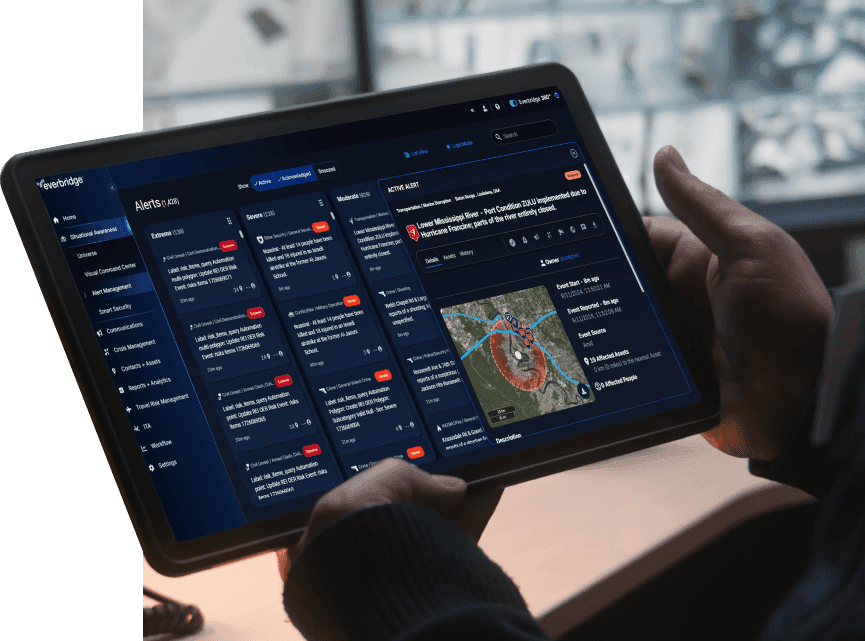
The goal is coordinated context across systems, not necessarily fewer tools. A centralized platform like Everbridge 360™ can unify your ecosystem, orchestrating workflows and communication across your existing ITSM, observability, and collaboration tools.
Communication and collaboration best practices
Incident response is fundamentally a team activity. Fast MTTR requires clear communication and coordinated workflows across:
- IT operations
- security teams
- infrastructure teams
- business stakeholders
Best practices include:
- Integrated alerting across Slack or Microsoft Teams
- Shared incident dashboards
- Real-time collaboration channels
- Structured escalation paths
Centralized incident communication eliminates confusion and ensures the right experts are engaged quickly.
Platforms such as Everbridge 360™ enable automated notifications, real-time coordination, and enterprise-wide incident response orchestration, helping teams resolve disruptions faster while maintaining business continuity.
Continuous learning and knowledge management
Every incident provides an opportunity to improve.
A culture of continuous improvement, built on structured post-incident reviews, is vital for long-term MTTR reduction. These blameless post-mortems should focus on documenting the root cause and identifying ways to improve the response process.
Key practices include:
- Documenting root causes
- Updating runbooks
- Improving monitoring coverage
- Sharing knowledge across teams
Centralized knowledge repositories help engineers resolve future incidents faster by providing access to historical insights. This repository becomes a powerful asset for accelerating future remediation. The insights gained can be used to iteratively update runbooks, refine automation, and even inform the dynamic generation of new playbooks with GenAI-powered tools.
Measuring MTTR reduction and demonstrating ROI
Reducing MTTR should translate into measurable business value.
Organizations should track:
- MTTR trends
- Incident frequency
- Service impact
- Downtime costs
Example ROI calculation:
| Metric | Before optimization | After optimization |
|---|---|---|
| Average MTTR | 75 minutes | 35 minutes |
| Incidents per month | 50 | 50 |
| Downtime cost per minute | 10,000 | 10,000 |
Monthly downtime cost
Before: 75 × 50 × $10,000 = $37.5M
After: 35 × 50 × $10,000 = $17.5M
Potential savings: $20M per month
These improvements directly contribute to resilience, regulatory compliance, and operational efficiency.
Practical considerations and future trends
Looking ahead, MTTR reduction strategies will continue evolving. Key trends include:
AI-native operations
Advanced AI systems will proactively identify and resolve incidents before they impact services.
Agentic AI frameworks
Autonomous agents will coordinate across systems to diagnose and remediate issues.
Secure automation pipelines
Organizations will require stronger governance around automated remediation to maintain compliance.
Data readiness for AI
High-quality telemetry and standardized observability data will become prerequisites for effective AI operations.
However, tools alone cannot deliver results. Meaningful MTTR improvement requires:
- Strong data governance
- Clear operational ownership
- Well-defined incident response processes
Building resilient IT operations with Everbridge
Reducing MTTR is ultimately about organizational resilience. By combining AI-powered observability, automated remediation, and coordinated incident communication, enterprises can resolve disruptions faster and protect mission-critical services.
Everbridge helps organizations achieve this through Everbridge xMatters, a leading digital operations and incident response platform designed to automate and orchestrate IT service reliability at scale. Everbridge xMatters connects monitoring, observability, and ITSM tools into automated workflows that detect incidents early, notify the right responders, and trigger remediation actions in real time.
Unlike traditional alerting systems, Everbridge xMatters enables teams to move directly from signal to action. AI-driven insights provide contextual incident summaries, recommend runbooks and responders, and guide teams through incident resolution while coordinating communications with stakeholders.
As part of Everbridge’s broader resilience platform, Everbridge xMatters also integrates with Critical Event Management capabilities to provide a unified operational picture.
As digital infrastructure continues to evolve, organizations that combine AI-powered observability, automated incident orchestration, and platforms like Everbridge xMatters will be best positioned to reduce MTTR, maintain uptime, and ensure business continuity in increasingly complex IT environments.
Frequently Asked Questions
MTTR (mean time to resolution) measures the average time between detecting an incident and resolving it. Reducing MTTR is critical because enterprise environments are becoming more complex, and prolonged downtime can lead to significant operational, financial, and reputational damage.
Leading strategies include unified observability, AI-powered incident correlation, automation of remediation workflows, structured runbooks, and clearly defined Service Level Objectives.
AI analyzes telemetry data across systems to identify root causes, correlate alerts, and reduce noise, enabling engineers to diagnose and resolve incidents faster.
Effective MTTR reduction often combines observability platforms, incident automation tools, IT service management systems, and collaboration platforms integrated into a unified response workflow.
Best-in-class organizations resolve critical incidents in under 15 minutes, while many enterprises average 45–90 minutes. The right target depends on service criticality and business impact.