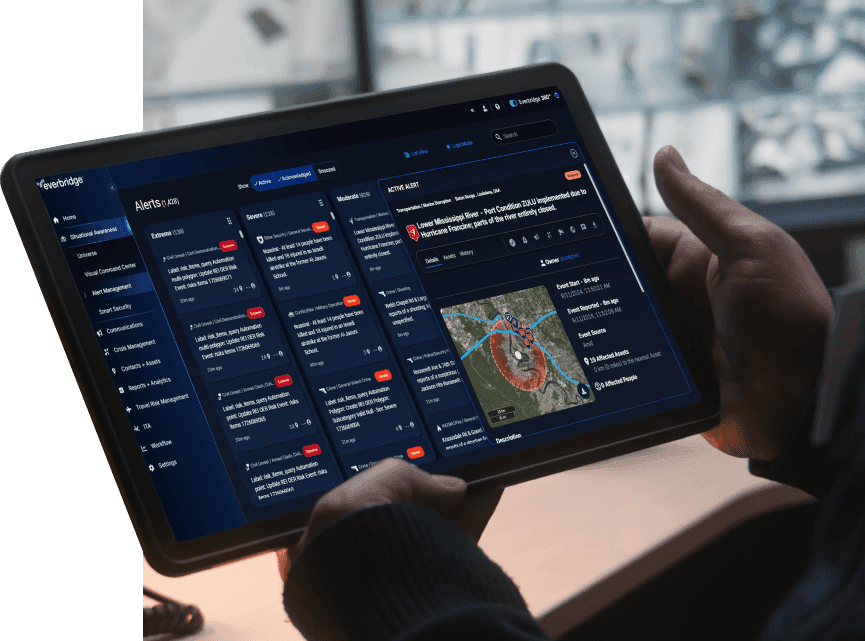
Workplace safety: Defending against terrorism & active assailant threats
Join industry experts as they outline strategies to safeguard your organization and employees from modern-day risks.




Join industry experts as they outline strategies to safeguard your organization and employees from modern-day risks.

Explore how regulatory frameworks boost organizational resilience across multiple sectors. Gain insights into DORA, BoE guidelines, and FFIEC standards.
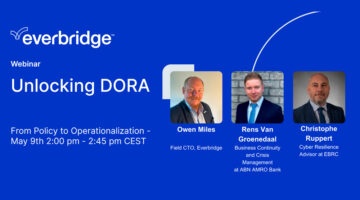
Delve into the challenges and strategies faced by financial institutions in implementing strategies and tactics to comply with Operational Resilience Act (DORA).

Explore how effective communication and safe travel planning have evolved, while businesses embrace risk intelligence to protect employees no matter where they are working.

Join us on our next customer webinar, as we discuss how Everbridge can help you easily visualize, assess, and predict potential threats.
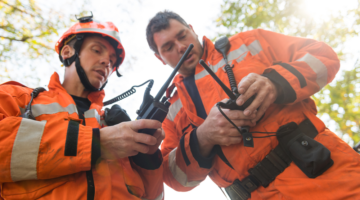
This webinar will discuss benefits of providing consistent communication throughout the recovery phase of a severe weather event.

As businesses across all industries strive to reduce their carbon footprint, extreme conditions are snarling supply chains and operations. Get tips on how to manage the disruption.

This on demand webinar will discuss best practices in responding to severe weather events

Severe weather impacts an entire campus community. Having a plan for communications with students, faculty, staff, and visitors is necessary for safe and quick recovery.

Watch this on demand webinar to discover how to leverage AIOps in ITSM operations.

Ransomware attacks are inevitable. Watch this on demand webinar learn more about how to defend against increasingly sophisticated cybercriminals.
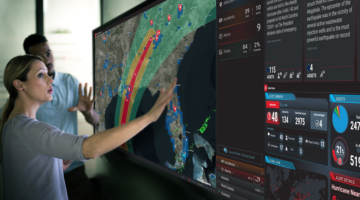
We discuss various preparedness techniques and common preparedness actions before severe weather events.
Request a demo or just call us at 888-366-4911