
Introduction
The modern global landscape presents unprecedented challenges for organizations managing business travel. From severe weather and geopolitical instability to localized disruptions and health crises, the risks facing traveling employees are more complex and dynamic than ever. A reactive approach to travel risk management (TRM) is no longer sufficient. To fulfill duty of care requirements and ensure business continuity, organizations must adopt a proactive, holistic strategy that safeguards their people wherever they are.
This whitepaper explores the five foundational pillars of a modern TRM program: plan, monitor, alert, respond and improve. By following these steps, organizations can build a robust system that not only reacts to crises, but also anticipates and minimizes their impact, fostering a safer and more secure environment for their entire workforce.
Many organizations approach TRM as a standalone function, a reactive measure to be activated only when an incident occurs. This siloed approach is fraught with vulnerabilities. True organizational resilience requires a more integrated and forward-thinking strategy. A successful TRM program must be a core component of a comprehensive critical event management (CEM) framework, designed to protect all people and assets from any type of critical event, not just those related to travel. This integrated approach enhances the ability to protect employees, maintain compliance with evolving duty of care standards, and mitigate the financial, legal, and reputational damage associated with critical events.
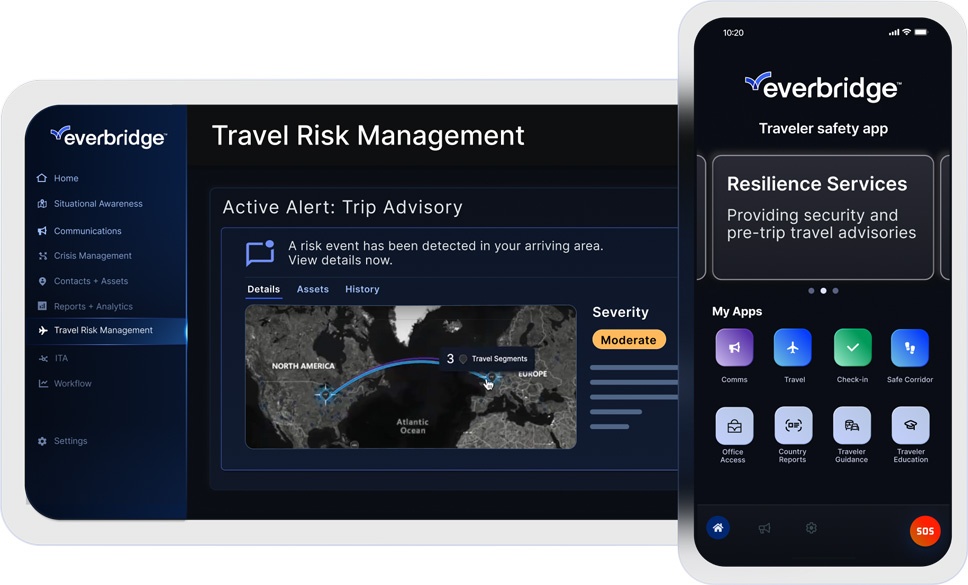
The five pillars of a successful travel risk management strategy
A robust TRM program is built on five key pillars that operate together to create a continuous cycle. This document provides a clear, 5-step guide to building and advancing your TRM program. It offers practical guidance on planning for risk, monitoring traveler safety, issuing timely alerts, managing effective responses, and fostering a cycle of continual improvement to safeguard your people and organization.
The world has become an unpredictable place creating uncertainty and insecurity for anyone doing business overseas or in unfamiliar environments.
This need for a cohesive, proactive TRM strategy is further underscored by the guidance provided in ISO 31030:2021 which ensures the safety and well-being of employees during corporate travel. Derived from the ISO 31000 risk management standard, it provides universal guidelines for anticipating, assessing, and addressing travel-related threats, filling a critical gap in global people risk management efforts.
1. Plan: Laying the foundation for safer travel
Successful TRM programs proactively identify the broad spectrum of risks, both major events and smaller disruptions, that can impact employee safety and business continuity. Planning involves:
- Evaluating historical and emerging threats (e.g. severe weather, local unrest, health risks)
- Considering regional, hyper-local, and activity-based risks unique to each trip
- Developing policies that address the full travel lifecycle, from pre-trip to return
Stakeholder engagement and policy alignment
Cross-functional collaboration is crucial to robust planning. Key stakeholders should be engaged early to create policies that are comprehensive, actionable, and agile. Stakeholder groups include:
- Human Resources: Employee well-being, communications, and policy enforcement
- Security: Threat assessments, incident response, and physical safety
- Legal: Compliance with duty of care and liability
- Senior Management: Sponsorship and business alignment
- IT: Supporting TRM technology infrastructure
- Suppliers and Travel Management Companies (TMCs): Operational support and seamless data flow
By laying this groundwork, your organization is better equipped to foresee obstacles and enable safe, productive travel experiences.
2. Monitor: Maintaining awareness throughout the journey
Mitigating risk demands real-time situational awareness, before, during, and after each trip.
Continuous monitoring of risk environments
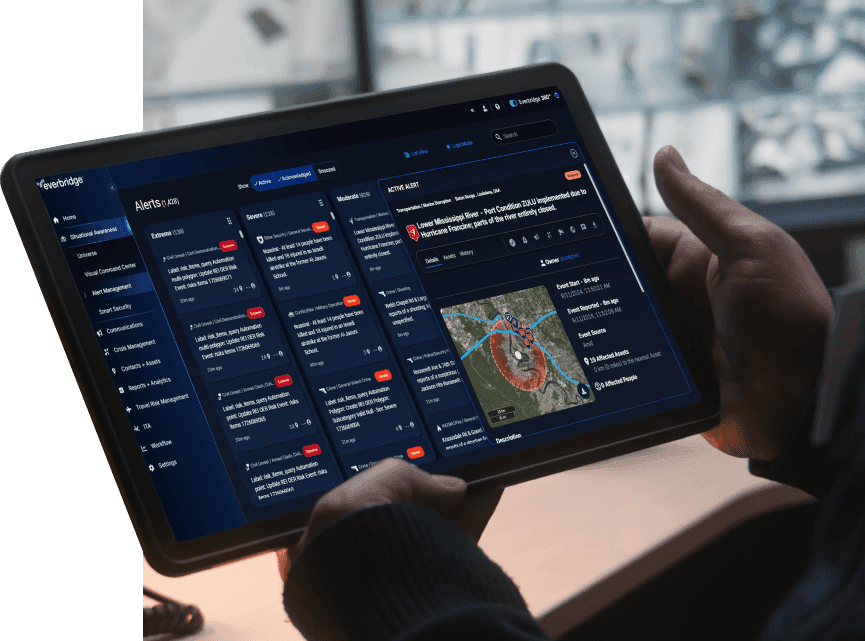
Organizations must proactively monitor for critical events and evolving threats at every phase of the travel lifecycle. Modern TRM solutions harness global risk intelligence, monitoring for:
- Regional and hyper-local incidents (e.g. protests, crime, severe weather)
- Health alerts and public safety advisories
- Disruptions impacting transportation, lodging, or business activity
This real-time monitoring gives security and travel teams a unified view of traveler locations, improving their ability to identify exposure and vulnerability across the organization.
3. Alert: Ensuring timely and relevant communication
Notifying travelers and stakeholders quickly, is essential for safety when new threats arise.
Smart and targeted alerting
A strong TRM program leverages automated, multi-channel alerts to deliver fast, reliable information. Alerting systems should:
- Notify only the travelers directly affected by a critical event to minimize alert fatigue and maintain relevance
- Provide clear, actionable guidance on next steps or safe areas
- Enable two-way communication, allowing employees to confirm safety or request assistance
A targeted approach ensures the right people get the right information at the right time, promoting confidence and readiness.

4. Respond: Coordinated and efficient incident management
An agile and coordinated response can mitigate harm and disruption when incidents occur.
Rapid response protocols
Effective response involves:
- Maintaining continuous visibility of traveler locations and exposure
- Initiating response protocols via a centralized platform
- Coordinating with medical, security, or transportation providers as needed
Automated communications, such as “mark yourself safe” prompts, enable organizations to verify employee status, prioritize support, and deliver rapid assistance to those who need it most.
During a worsening conflict in the Middle East, Everbridge successfully coordinated the overland evacuation of a British family. With airspace closed, security conditions unstable, and borders overwhelmed, the team acted quickly. Using real-time intelligence, secure transport, and support from regional partners, they ensured a safe and efficient extraction within 36 hours.
5. Improve: Learning and evolving for future resilience
The final, and ongoing, pillar is improvement. A successful TRM program constantly evolves, using data and feedback to enhance policies, technology, and processes.
Post-incident review and policy refinement
After each critical event, organizations should:
- Analyze their response speed, communication clarity, and procedural effectiveness
- Solicit feedback from impacted employees and stakeholders
- Identify technological or procedural gaps
By leveraging insights from real incidents and near-misses, organizations can adjust travel policies, platform rules, and training materials. This cycle of improvement ensures that lessons learned translate into greater preparedness for the future.

Conclusion: Building a culture of resilience
The complexities of the modern world demand that organizations move beyond a reactive checklist approach to travel safety. A truly effective travel risk management program is proactive, integrated, and continuous. It must be woven into the fabric of a broader critical event management strategy, transforming duty of care from a legal obligation into a cornerstone of the corporate culture.
By implementing the five pillars outlined in this whitepaper, organizations can build a dynamic and resilient framework to protect their people. This holistic approach not only mitigates financial and legal risks, but also builds a culture of safety and trust. When employees know their organization is committed to their well-being, they can travel and work with greater confidence, fueling business success even in an uncertain world.
Your next steps
Building a world-class TRM program is a journey of continuous improvement. Here are actionable steps you can take today:
Assess your current planning: Identify strengths and gaps in your workflows, technologies, and policies. Do you have a comprehensive, data-driven approach to planning for travel risk?
Enhance monitoring and alerting: Ensure your tools provide real-time visibility and automated, targeted alerts for all critical events.
Refine your response procedures: Assemble and empower cross-functional teams, and practice rapid, coordinated incident management.
Commit to improvement: Regularly review outcomes and integrate feedback to continuously strengthen your TRM program.Additional Resources
Additional resources
The top 10 questions to ask when choosing a travel risk management solution
Ensure employee safety and business continuity with the right TRM platform. This guide reveals 10 key questions to find a solution offering tracking, communication, AI alerts, and data security.
ISO 31030: Evolving expectations of travel risk management
Discover how ISO 31030 provides organizations with standardized guidance for travel risk management, enhancing employee safety, compliance, and resilience. It addresses duty of care, risk assessment, and policy alignment for global travel.
How Everbridge supports your organization and travelers
Discover how Everbridge can help you identify travel risks, monitor employees globally in real-time, send alerts, deliver 24/7 multilingual medical and security assistance, and maintain duty-of-care compliance.
Take a virtual tour
See how Everbridge can transform your travel risk management with a personalized demo tailored to your needs. Select your areas of interest, and we’ll deliver a custom video showcasing the TRM solutions that matter most to you.
Online resource hub
Access a wealth of knowledge, including whitepapers, analyst reports, online training, and in-person events. Our comprehensive resource hub equips you with the tools to keep your people safe and your organization running.
Explore the Everbridge product suite
Discover Everbridge High Velocity CEM, the industry’s most advanced critical event management platform. Combining automation, risk intelligence, and Purpose-built AI, it delivers resilience at scale. Explore our full product suite designed to support your organization in every step of its resilience journey.