Organizations must continually adapt how they protect traveling employees. Flight disruption, staffing constraints, border restrictions, health requirements, severe weather, geopolitical instability, and localized critical events can all affect business travel.
Direct answer: ISO 31030 is an international guidance standard for travel risk management. It helps organizations build, assess, and improve a travel risk management program that anticipates travel-related threats, evaluates traveler and destination risk, defines ownership, communicates with employees, supports incident response, and strengthens duty of care.
ISO 31030 applies to a company’s travel risk management program by turning travel safety from an informal process into a structured risk management discipline. It gives security, travel, HR, legal, and operational resilience teams a common framework for policies, approvals, monitoring, communications, assistance, and continuous improvement.
What is ISO 31030?
The International Organization for Standardization (ISO) is a worldwide federation of national standards bodies. ISO works with international organizations, governmental bodies, and non-governmental bodies to standardize guidance across many subjects.
ISO 31030:2021, Travel risk management – Guidance for organizations, was created as travel risk management changed and business travelers faced more complex threats. The standard was derived from the ISO 31000 risk management standard and adapted for organizational travel.
Before ISO 31030, organizations had no universal guidance for travel risk management. Many relied on internal judgment, fragmented procedures, and inconsistent travel safety practices, which created gaps in broader people risk management efforts.
ISO 31030 helps organizations manage and participate in business travel with more consistent governance. It provides guidance for creating or improving a travel risk management program that supports employee safety, operational continuity, and organizational resilience.
How ISO 31030 applies to a travel risk management program
ISO 31030 applies across the lifecycle of business travel. It helps organizations define how travel is approved, how risks are assessed, how travelers are supported, and how incidents are managed.
A company can use ISO 31030 to strengthen its travel risk management program in these areas:
- Governance and ownership: Define who owns travel risk decisions across security, travel, HR, legal, medical, and business leadership.
- Travel policy and authorization: Establish clear rules for travel approvals, destination restrictions, escalation, and exceptions.
- Traveler assessment: Evaluate traveler profiles, experience, medical needs, and other factors that may affect exposure.
- Destination risk assessment: Review location-specific risks, including security, health, transportation, infrastructure, and local disruption.
- Transportation and accommodation: Assess vendors, routes, accommodations, and ground transportation for traveler safety.
- Pre-trip preparation: Provide travelers with risk briefings, documentation guidance, training, and emergency contact information.
- Real-time monitoring: Monitor critical events that may affect travelers, including severe weather, civil unrest, health concerns, or transportation disruption.
- Traveler communication: Send timely alerts, check-ins, and instructions through reliable, multi-modal communications.
- Incident response: Coordinate assistance, escalation, evacuation, and business continuity actions when a critical event occurs.
- Program review: Measure performance, identify gaps, and improve policies, procedures, and technology over time.
ISO 31030 is not a one-time checklist. It is a practical framework for building repeatable travel risk management processes that help organizations anticipate, mitigate, respond, recover, and adapt.
Is ISO 31030 a certification standard?
ISO 31030 is a guidance standard, not a certifiable standard. Organizations use it to align travel risk management programs with internationally recognized guidance, strengthen duty of care, and improve traveler protection.
This distinction matters because ISO 31030 does not require a formal certification audit. Instead, organizations can assess their current travel risk management program against the guidance and prioritize improvements based on their risk profile, travel footprint, and operational needs.
Why ISO 31030 matters for duty of care
Duty of care is an organization’s responsibility to protect employee health, safety, and well-being during official business. That responsibility applies at the workplace and extends to business travel.
As employees travel across regions and jurisdictions, organizations must consider the additional risks associated with movement, destination conditions, accommodations, transportation, and local support. Failure to assess and manage these risks can increase legal, financial, operational, and reputational exposure.
ISO 31030 helps create a culture where travel-related risk is formally acknowledged, properly resourced, and managed through a coordinated program. It gives organizations a clearer way to demonstrate that traveler safety is part of enterprise risk management and operational resilience.
Benefits of ISO 31030 for organizations
Incorporating ISO 31030 guidance into a broader people risk management strategy can help organizations improve readiness and continuity. It also supports a more consistent approach to business traveler security.
Key benefits include:
- Protecting personnel, data, intellectual property, and assets.
- Reducing legal and financial exposure.
- Enabling business in higher-risk locations.
- Enhancing reputation, credibility, competitiveness, staff retention, and talent acquisition.
- Improving worker confidence in travel-related health, safety, and security arrangements.
- Contributing to business continuity capability and organizational resilience.
- Demonstrating effective control of travel-related risk, with the potential to lower insurance premiums.
- Assuring business partners, banks, and investors that travel risk is being managed.
- Helping meet customer expectations for supply chain security and stability.
- Increasing general productivity.
- Supporting sustainable development goals by strengthening the social dimension of sustainability.
These benefits depend on consistent execution. Organizations need policies, risk intelligence, communications, and response workflows that work together before, during, and after travel.
Common challenges in travel risk management
Redefining travel risk management policies can be difficult because travel risk touches many teams. Security, travel, HR, legal, medical, communications, and regional leaders often share responsibility, but they may not share the same systems or data.
Common challenges include:
- Fragmented ownership across departments.
- Inconsistent travel approval processes.
- Limited visibility into traveler location.
- Delayed awareness of critical events.
- Manual traveler outreach and check-ins.
- Unclear escalation paths during disruption.
- Limited reporting for program improvement.
- Difficulty applying policy across regions and traveler profiles.
ISO 31030 helps organizations address these challenges by creating a common framework. Technology then helps operationalize the framework with real-time risk intelligence, automated alerts, coordinated response, and measurable improvement.
Redefining travel risk management policies in accordance with ISO 31030
Fulfilling duty of care for traveling employees can involve the entire organization. However, the administration of travel risk policy is often delegated to a small group of functional leaders.
To make travel risk management more effective, organizations can distribute ownership across relevant teams. Each function should understand its responsibilities before travel begins, while travel is underway, and when a critical event affects employees.
For example, travel managers can customize travel parameters within their systems to align with corporate travel policies. These parameters may include destination risk ratings, country risk levels, transportation requirements, or approval thresholds.
If an itinerary adjustment falls outside specified parameters, the travel risk management system should alert the traveler, travel manager, and regional manager responsible for business traveler safety. This approach helps organizations know earlier, respond faster, and improve continuously.
Core capabilities for ISO 31030 alignment
A travel risk management program aligned to ISO 31030 should include capabilities that support prevention, preparedness, response, and recovery. These capabilities help organizations safeguard employees and assets while minimizing disruptions.
Important capabilities include:
- Travel risk assessment.
- Traveler tracking and location awareness.
- Real-time threat intelligence.
- Pre-trip briefings and traveler education.
- Emergency communications.
- Traveler check-ins and accountability.
- Incident response coordination.
- Medical and security assistance workflows.
- Reporting and program review.
- Integration with operational resilience and business continuity processes.
These capabilities help transform travel risk management from a reactive support function into a proactive resilience program.
How Everbridge helps companies manage travel risks and align with ISO 31030
With expanding duty of care responsibilities and rising risks to business travelers, organizations need scalable ways to reduce uncertainty and protect employees. Everbridge helps organizations improve risk visibility, situational awareness, communications, and response coordination.
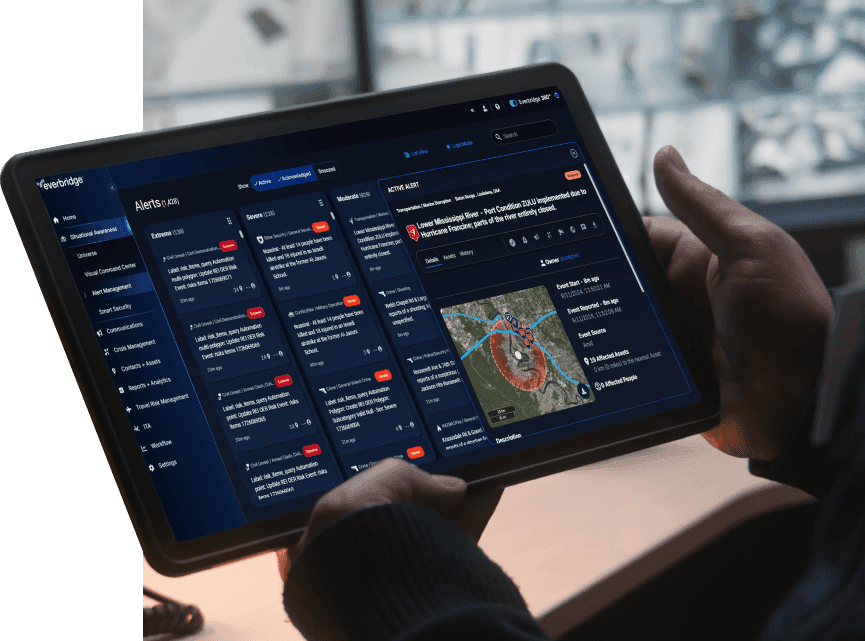
Everbridge 360 empowers organizations to navigate critical events confidently by connecting risk intelligence, communications, and response workflows. The High Velocity Critical Event Management platform helps organizations know earlier, respond faster, and improve continuously across people, assets, operations, and infrastructure.
Everbridge Travel Risk Management helps organizations support ISO 31030 alignment through:
- Real-time incident alerts and global security information.
- Traveler location awareness and itinerary visibility.
- Multi-modal communications for alerts, check-ins, and instructions.
- Coordinated response workflows for travel-related critical events.
- Risk intelligence that helps teams anticipate and mitigate disruption.
- Integration with broader critical event management and operational resilience programs.
By combining global risk intelligence with employee location data and communications, Everbridge helps organizations protect traveling employees. This approach supports stronger duty of care and helps keep business travelers safer wherever they go.
How Everbridge travel risk management works
Everbridge supports travel risk management by helping organizations connect risk signals to traveler action. This helps security, travel, and resilience teams move from awareness to coordinated response.
A typical workflow includes:
- Identify the traveler: Bring itinerary and location information into a central view.
- Monitor the risk environment: Use real-time threat intelligence to detect critical events that may affect travelers.
- Assess potential impact: Compare incidents with traveler location, destination, and policy parameters.
- Communicate quickly: Send targeted alerts, instructions, and check-ins through multiple channels.
- Coordinate response: Escalate assistance, involve regional leaders, and support operational continuity.
- Review performance: Analyze response activity and improve future travel risk management processes.
This coordinated approach helps organizations align travel risk management with ISO 31030 while strengthening resilience across the enterprise.
Resources for ISO 31030 alignment
Organizations can use ISO 31030 to assess current travel risk management maturity and prioritize practical improvements. Everbridge resources help teams understand gaps, align stakeholders, and operationalize travel risk management.
Download the ISO 31030 checklist
FAQs
ISO 31030 is an international guidance standard for travel risk management. It helps organizations build structured travel risk management programs covering governance, risk assessment, traveler safety, communications, incident response, and continuous improvement.
ISO 31030 applies by giving organizations a framework for travel policy, approvals, risk assessment, traveler preparation, destination monitoring, communications, incident response, and program review. It helps companies manage travel risk consistently across departments and regions.
No. ISO 31030 is a guidance standard, not a certifiable standard. Organizations align their travel risk management programs to ISO 31030 guidance to strengthen duty of care, operational resilience, and traveler safety.
ISO 31030 recommends that organizations implement structured travel risk management processes including governance, traveler risk assessment, communication capabilities, incident response planning, traveler support, and ongoing program review.
ISO 31030 helps enterprise organizations improve traveler safety, strengthen duty of care, reduce operational disruption, and coordinate incident response across security, HR, travel, and resilience teams.
Everbridge Travel Risk Management supports ISO 31030 alignment through real-time risk intelligence, traveler communication, incident response coordination, operational resilience integration, traveler monitoring, and enterprise-wide critical event management capabilities.
Important capabilities include travel risk assessment, traveler tracking, emergency communications, intelligence monitoring, incident management, traveler assistance, reporting, and operational resilience integration.
Travel assistance typically focuses on reactive support such as medical or security response. Travel risk management is broader and includes governance, prevention, risk intelligence, traveler communication, operational coordination, and resilience planning.”