For years, resilience inside large organizations has depended on extraordinary people doing extraordinary things under pressure.
When something went wrong, the same pattern played out. A cyber incident. A system outage. A severe weather event. Teams jumped in. Leaders coordinated across departments. People worked through the night, connecting the dots manually and guiding the organization through uncertainty.
Those moments matter. They reflect real leadership. But they also hide a deeper problem.
If an organization only performs well because a handful of experienced people can hold everything together in the moment, that is not resilience. It is dependence on heroics.
And that approach eventually breaks down.
The world has changed
Disruption today looks very different than it did even a few years ago.
It is faster, more interconnected, and rarely contained within a single function. A cyber incident can quickly become an operational outage. A weather event can affect workforce, facilities, and supply chain at the same time. A geopolitical shift can impact travel, security, and executive decision-making all at once.
These events do not happen in sequence. They overlap, they compound, and they move faster than most teams can keep up with.
At the same time, expectations have shifted. Boards and executive teams are no longer satisfied with simply getting through the last event. They want to understand whether the organization is improving – whether it is identifying risk sooner, coordinating faster, and making better decisions under pressure.
That is a higher standard. And it requires a different approach to resilience.
From heroics to systems
One of the clearest warning signs is when organizations begin to confuse effort with readiness.
They point to how quickly teams mobilized, how many calls were launched, or how hard people worked. Those things are important, but they are not the same as being well prepared.
If every serious incident still requires a scramble across disconnected tools, handoffs between teams, and late-night improvisation, then the organization is doing more work than it should have to.
What actually improves performance is a system.
A system that brings signals together earlier, helps the right actions happen faster, and gives teams a clear sense of what should happen automatically and where leadership is needed.
That is what allows organizations to respond consistently, not just occasionally.
Dynamically Adaptive Resilience
At Everbridge, this is the journey we have been on.
We started with Mass Notification.
We pioneered Critical Event Management.
We pushed it further with High Velocity CEM.
Now we are taking the next step: Dynamically Adaptive Resilience.
This is not about replacing people. It is about changing how work gets done.
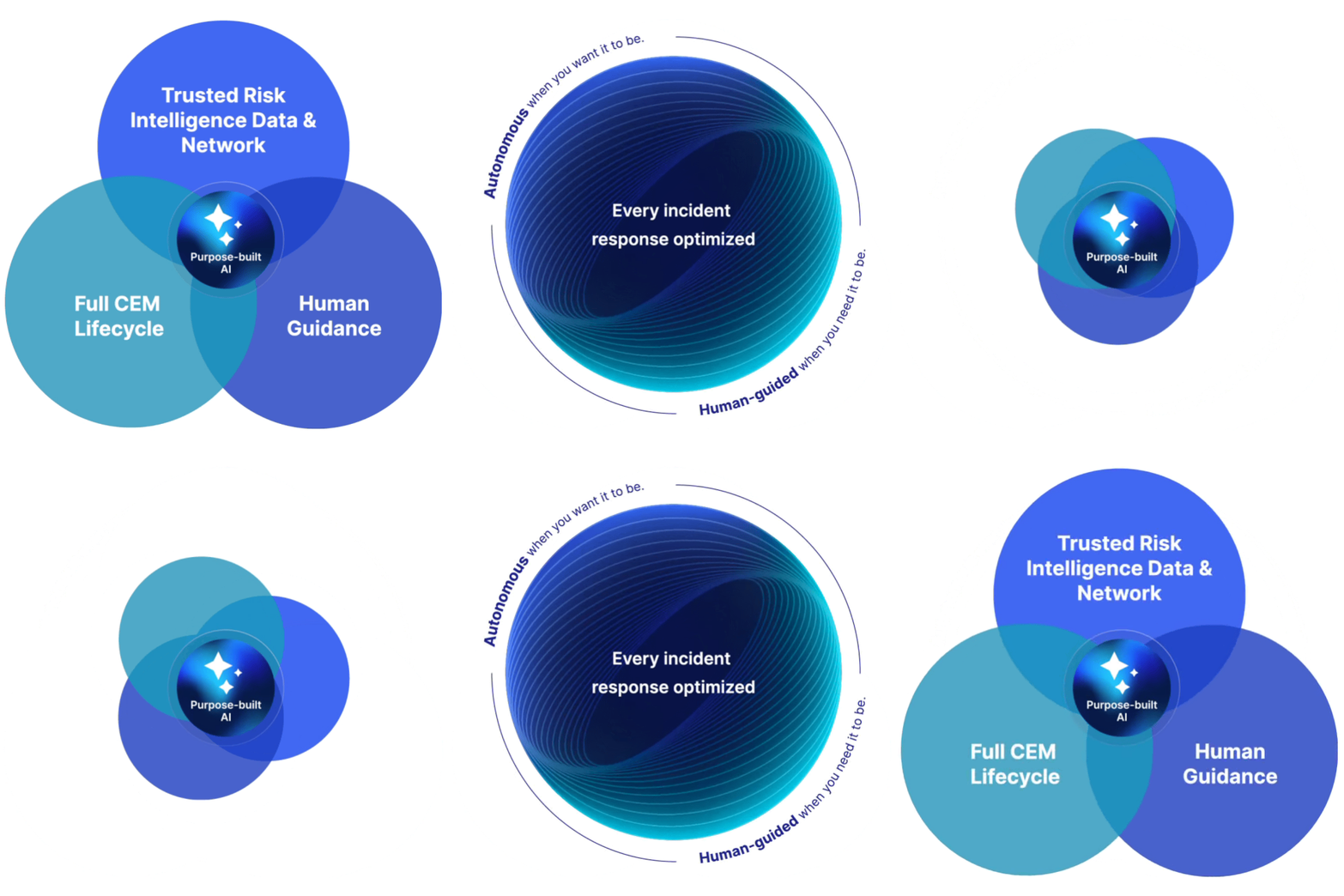
Dynamically Adaptive Resilience shifts organizations away from manual coordination toward systems powered by purpose-built AI. These systems handle routine work automatically and bring leaders in at the moments when judgment and accountability matter most.
In practical terms, it means helping organizations:
- Detect risk earlier
- Coordinate response faster
- Continuously improve how they manage critical events
Over time, that creates a very different operating model. Signals become actionable. Responses are coordinated across teams. And each incident strengthens the next one.
At the center of this approach is a simple balance:
Autonomous when you want it to be.
Human-guided when you need it to be.
Automation handles the predictable. Leaders focus on what actually requires judgment.
What this looks like in practice
It is easy to talk about resilience in theory. The real test is what happens when something actually goes wrong.
Imagine a severe storm forming in the Midwest. Forecast models show it strengthening and moving toward a major population center.
Within minutes, the system ingests those signals and identifies which facilities, employees, and operations are in the projected path. It recommends activating a response plan. Local leaders receive guidance tailored to their location. Employees receive clear instructions. Operations teams coordinate across safety, facilities, and supply chain.
Instead of dozens of phone calls and fragmented information, everyone is working from the same shared understanding of the situation.
Now take a different scenario.
A financial services company begins to detect signs of ransomware spreading through its network. The system correlates signals across IT and security, identifies affected systems, and coordinates response across teams. Leadership is brought in immediately with a clear picture of what is happening and what decisions need to be made.
Or consider a global company with employees traveling in a region where geopolitical tensions are escalating. Flights are shutting down. Conditions are changing quickly. The system identifies who is in the region, recommends activating evacuation protocols, and coordinates communication and security teams to move people to safety.
Different situations. Different teams. But the same outcome:
- Every signal becomes actionable intelligence
- Every response becomes coordinated action
- And every incident makes the next one strong
A new standard for resilience
In many organizations, the goal of an incident response is to resolve the issue and move on.
But the organizations that improve over time take a different approach. They treat every incident as a source of learning. They examine where visibility broke down, where coordination slowed, and where processes depended too heavily on individuals instead of systems.
That is where real value begins to show up.
In better decisions.
Faster coordination.
Less confusion.
More confidence across the organization.
Each event becomes an opportunity to improve the next.
This is why we have set a clear goal:
Every incident response optimized.
The objective is not simply to respond faster or to automate more steps. It is to improve the quality and consistency of every response. That means routine work handled automatically, the right people engaged at the right time, and systems that improve with each event.
Disruption is not going away, so the question is not whether organizations will face pressure, but how they respond to it.
The organizations that perform best will not be the ones that rely on improvisation or the same small group of experts. They will be the ones that build resilience into how they operate, measure it, and improve it over time.
That is the shift happening now.
From heroics to systems.
From reaction to operating discipline.
From effort to optimization.
And it is how organizations will protect people, keep operations running, and improve with every incident.