How prepared is your organization for the next crisis?
The nature of crisis has changed.
What were once isolated incidents, such as natural disasters, security threats, and operational disruptions, have become continuous, overlapping risks that demand faster, more coordinated responses. At the same time, expectations have shifted. Employees need immediate updates, regulators require accountability, and leadership demands continuity.
But most organizations are still trying to manage these demands with communication tools never designed for this complexity. That gap between rising expectations and outdated capabilities is where risk lives.
Why traditional crisis communication falls short
In the early moments of a crisis, clarity and speed matter more than anything else. Yet this is exactly where many organizations struggle.
These challenges aren’t just operational inefficiencies. They directly impact employee safety, business continuity, and organizational trust.
The pressure to communicate effectively is intensifying. Stakeholders across the organization and beyond it now expect real-time, transparent updates during emergencies.
Anything less creates uncertainty. And uncertainty amplifies risk.
The shift: from notification systems to resilience platforms
This is why emergency mass notification systems are undergoing a fundamental transformation.
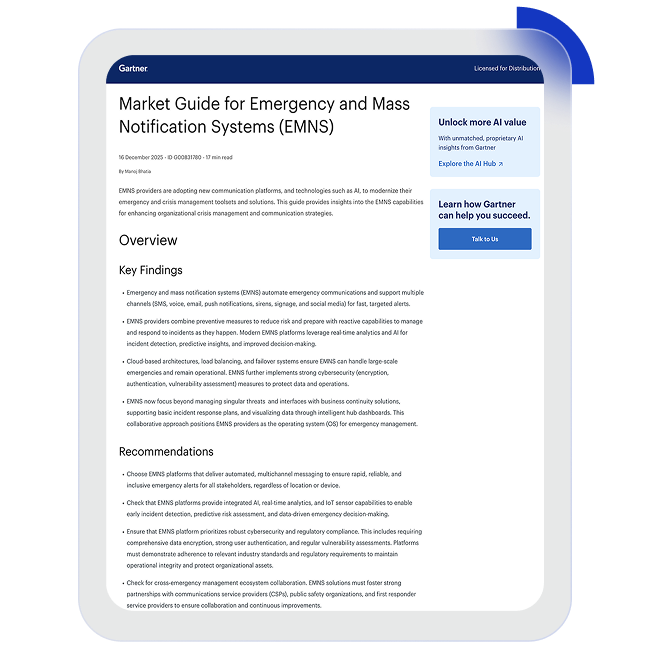
Gartner® defines emergency and mass notification systems (EMNS) as unified crisis management solutions that monitor, orchestrate and manage emergencies across all phases, ensuring compliance with regulatory standards. EMNS enables businesses, schools, governments, healthcare and utilities to quickly alert people, enhancing safety, minimizing disruption and supporting fast, coordinated response. Organizations collaborate with CSPs and rely on EMNS to protect lives and operations.
The next evolution: dynamically adaptive resilience
As risks become more complex and interconnected, even traditional “modern” systems can struggle to keep up.
This is where a new operating model is emerging: dynamically adaptive resilience.
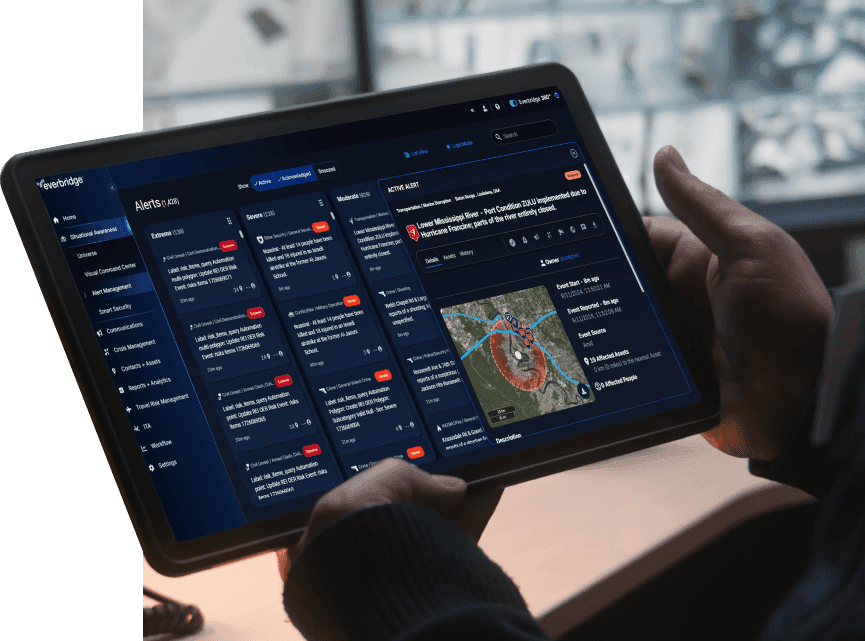
Rather than relying on static workflows or manual coordination, dynamically adaptive resilience introduces systems that continuously ingest signals, interpret risk, and guide response in real time. These systems combine AI-driven automation with human oversight, allowing routine actions to happen automatically while escalating critical decisions to leaders when judgment is required.
The goal is not simply to respond faster but to respond more consistently, more intelligently, and with less friction.
What defines a modern emergency mass notification system
Modern EMNS platforms are defined less by individual features and more by how capabilities work together.
Communication must be simultaneous and multichannel, ensuring that critical messages reach people wherever they are. Data must be real-time and actionable, not delayed or fragmented. Systems must integrate across HR, IT, and security environments, eliminating silos that slow response.
And increasingly, intelligence must be built in.
AI-driven insights allow organizations to move beyond reactive response toward predictive action, identifying risks earlier and guiding teams toward the most effective next steps.
Underpinning all of this is resilience by design. Systems must scale under pressure, remain operational during disruption, and maintain the highest levels of security and compliance.
From response to continuous resilience
The most important shift, however, is not technological, it’s operational.
Organizations are moving from a mindset of “respond and recover” to one of continuous resilience.
In this model, every incident becomes a source of learning. Systems capture what happened, identify where coordination broke down, and improve future response automatically. Over time, this creates a feedback loop where each disruption strengthens the organization’s ability to handle the next.
This is where dynamically adaptive resilience becomes especially powerful. It transforms resilience from a static capability into a continuous, evolving system of improvement.
Bringing it all together
Crisis communication is no longer just about sending messages.
It is about detecting risk earlier, coordinating response faster, and improving continuously.
Emergency mass notification systems are evolving to support this shift but the organizations that lead will be the ones that go further, embracing dynamically adaptive resilience as the foundation for how they operate.
The question is no longer whether disruption will happen, it’s whether your organization is built to adapt when it does.