
Selecting a critical event management platform is a strategic decision that can influence an organization’s ability to protect people, maintain operations, and respond effectively during disruptions. While feature comparisons and implementation considerations often dominate vendor evaluations, the most important questions are often broader: Will the platform support your organization’s long-term resilience goals? Can it scale alongside your operations? Will it help you communicate and coordinate effectively when the stakes are highest?
As organizations navigate an increasingly complex risk landscape—from severe weather and cyber incidents to operational disruptions and geopolitical events—these considerations have become more important than ever.
Looking beyond initial cost
Technology investments are rarely evaluated on price alone. For organizations responsible for protecting employees, maintaining business continuity, and managing critical events, the focus is often on overall value, reliability, and long-term outcomes.
When assessing critical event management solutions, several factors can significantly influence total cost of ownership:
Global reach and reliability
Organizations with distributed workforces and global operations require confidence that communications can be delivered quickly and reliably, regardless of location. Supporting communications at scale requires resilient infrastructure, redundancy, and the ability to reach people across multiple channels when traditional methods may be unavailable.
For many organizations, the value of a platform lies not only in its ability to send notifications, but in its ability to perform consistently during high-impact events.
For organizations operating across regions and time zones, reliability becomes a critical consideration. Everbridge supports organizations in more than 200 countries and territories through a globally distributed infrastructure designed for resilience, with 99.99% transactional uptime and multiple redundant communication pathways. This helps ensure critical communications can reach the right people, even during large-scale disruptions when traditional communication channels may be strained.
A unified approach to Critical Event Management
As resilience programs mature, many organizations look to reduce fragmentation across their technology landscape. Managing separate tools for mass notification, incident response, travel risk management, and operational resilience can create inefficiencies and limit visibility during critical situations.
A unified platform can help streamline workflows, improve coordination across teams, and provide a more comprehensive view of organizational risk and response activities.
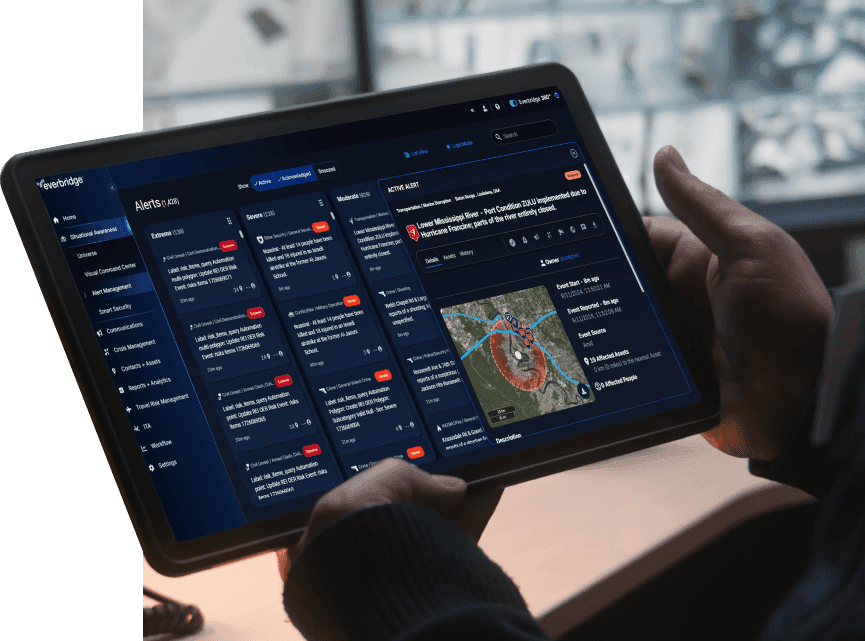
Increasingly, organizations are seeking to replace disconnected point solutions with a unified approach to resilience. Everbridge 360™ brings together risk intelligence, communications, automation, and coordinated response capabilities within a single platform, helping organizations manage the full lifecycle of a critical event from detection through recovery.
Security, compliance, and governance
Organizations operating in regulated industries face increasing pressure to meet security, compliance, and governance requirements. Critical event management solutions must support these obligations while providing the controls and auditability necessary for enterprise environments.
As a result, security certifications, compliance frameworks, and governance capabilities often play a significant role in platform evaluations.
Security and compliance requirements continue to expand across industries. Organizations evaluating resilience technologies often require platforms that can support stringent governance frameworks while maintaining operational flexibility. Everbridge provides enterprise-grade security and compliance capabilities, including certifications and frameworks such as FedRAMP, SOC, GDPR, and other globally recognized standards, helping organizations address both operational and regulatory requirements.
Expertise and ongoing support
Technology is only one component of a successful resilience program. Organizations also benefit from guidance, best practices, and ongoing support throughout implementation and beyond.
Access to experienced implementation specialists, customer success resources, and training programs can help organizations accelerate adoption and maximize the value of their investment over time.
Balancing capability with ease of use
When evaluating technology platforms, organizations often face a familiar challenge: balancing advanced capabilities with ease of administration.
As operational resilience programs evolve, requirements frequently extend beyond basic notification capabilities. Teams may need to coordinate incident response across multiple departments, integrate with existing enterprise systems, manage complex stakeholder communications, and maintain visibility into evolving threats and risks.
These expanding requirements naturally introduce additional sophistication. The key question becomes whether a platform helps organizations manage that complexity effectively.
Enabling efficient response
Modern critical event management platforms increasingly leverage guided workflows, templates, and automated processes to help teams respond quickly during disruptive events.
Pre-built playbooks and standardized response procedures can help reduce manual effort, improve consistency, and support faster decision-making under pressure.
Recent enhancements to the Everbridge 360™ experience have focused on reducing friction during critical moments. Guided workflows, streamlined communications, configurable event templates, and a unified operational view help teams move from awareness to action more quickly while minimizing manual effort. Organizations participating in the early adoption of Everbridge 360 reported faster onboarding and reduced training time due to the platform’s modernized user experience.
Integrating with existing systems
Organizations rarely operate in isolation. Critical event management often depends on information flowing between HR systems, IT service management platforms, security tools, collaboration platforms, and business applications.
Strong integration capabilities can help reduce administrative burden while improving situational awareness and response coordination across the organization.
Supporting adoption and readiness
Successful implementations extend beyond technology deployment. Training, onboarding, and ongoing education play a critical role in helping teams build confidence and preparedness.
Organizations that invest in readiness often see greater adoption, stronger operational outcomes, and improved performance during real-world events.
Organizations are also at different stages of their resilience journey. To support varying levels of maturity, Everbridge offers multiple Critical Event Management packages—from foundational emergency communications capabilities to enterprise-wide risk management and response orchestration—allowing organizations to adopt capabilities that align with their current requirements while supporting future growth.
Common requirements among mature resilience programs
While every organization has unique needs, those with mature resilience and critical communications programs often share several common priorities.
They require solutions that can:
- Support communications across global operations and distributed workforces
- Scale during large-scale incidents and periods of increased demand
- Integrate with existing enterprise technology ecosystems
- Support regulatory, compliance, and governance requirements
- Coordinate response efforts across multiple stakeholders and departments
- Consolidate fragmented workflows and improve operational visibility
As risk environments continue to evolve, many organizations are also seeking solutions that can adapt alongside their resilience programs and support future operational requirements.
Building resilience for the long term
Critical event management is ultimately about helping organizations communicate, coordinate, and respond effectively when disruptions occur.
While implementation considerations and budget discussions remain important parts of any technology evaluation, long-term success often depends on selecting a platform that aligns with broader business objectives, resilience goals, and operational requirements.
Whether the priority is protecting employees, maintaining business continuity, managing regulatory obligations, or coordinating complex incident response efforts, organizations benefit from evaluating solutions through the lens of long-term resilience and operational readiness.
The most effective critical event management platforms are not simply tools for sending notifications—they serve as foundational components of a modern resilience strategy, helping organizations navigate uncertainty while keeping people safe and operations running.