Utilities across North America are operating in a moment of profound transformation. Storms are intensifying, wildfire seasons are lengthening, and aging infrastructure is reaching its limits. Every year, the operational stakes grow higher. A single storm or fire can disrupt service for hundreds of thousands of customers. Yet for many utilities, the systems used to prepare for, respond to, and recover from these events remain disconnected.
This disconnect isn’t for lack of effort. Utilities have invested heavily in outage management systems, SCADA upgrades, AMI analytics, GIS platforms, and communication tools. Each one plays an important role. But during a major crisis, when situational awareness must be instantaneous, when field crews need clear instructions, when regulators and customers demand continuous updates, no single system has been able to pull the entire picture together.
This is the gap the new Everbridge, ServiceNow, and Ekatra Emergency Event Management (EEM) solution is designed to close. It unifies the physical, digital, and operational worlds into a coordinated experience.
To understand why this matters, it’s important to examine the forces reshaping the utility landscape.
The changing reality of utility emergency response
For decades, utility emergency operations were driven by predictable patterns: weather forecasts, seasonal preparations, and storm response plans that were well-understood and relatively stable. But the past ten years have changed everything. Utilities now contend with storms that arrive faster, hit harder, and linger longer. Wildfires, once seasonal events, now threaten communities nearly year-round. Infrastructure built half a century ago is failing more frequently, often during peak load conditions.
Then there’s regulatory pressure. Agencies like NERC and FERC have expanded expectations for documentation, evidence, and traceability. FEMA funding requires meticulous reporting. State regulators demand transparent timelines, performance metrics for restoration, and automated audit trails. All of this places unprecedented pressure on Emergency Operations Centers (EOCs), which must now manage not only the event itself, but also the quality and completeness of operational evidence.
In this environment, fragmented systems slow everything down. And in emergency response, speed is the single most valuable commodity.
The limitations of fragmented operations
Most utilities still manage emergency events through a patchwork of tools. Weather and wildfire intelligence may sit in one system, Operational Technology (OT) alerts in another, and critical asset information in ServiceNow or a separate CMDB. Playbooks often live as PDFs or SharePoint documents. Field crews rely on radio, phone, or multiple mobile apps that don’t sync cleanly with operations. Communications teams gather updates via email, chat, or manual calls into the EOC. Meanwhile, spreadsheets track rosters, contact lists, and mutual aid resources, even as events escalate in real time.
This fragmented approach creates three consistent pain points. First, decision-makers often lack a unified, real-time view of what’s happening. They may know the storm’s trajectory but not which assets are affected or which crews are available. Second, the handoff between detection and response is slow because playbooks aren’t automated, and tasks aren’t generated dynamically. Third, communication, both internal and external, becomes inconsistent and reactive. Customers, regulators, and partner agencies receive delayed or incomplete updates, even when the operational teams are working tirelessly behind the scenes.
Utilities don’t suffer from a lack of data; they suffer from a lack of integration.
A unified solution for emergency event management
The Everbridge + ServiceNow + Ekatra EEM solution brings all of these elements together. It creates an operational fabric that supports the full emergency lifecycle: preparing for threats before they hit, acting quickly when they arrive, responding efficiently in the field, and recovering with complete, auditable documentation.
Preparation becomes more proactive and automated. Weather systems, OT/SCADA alerts, GIS data, IoT sensor readings, and asset information flow through a unified data model. Rosters are pre-configured instead of assembled in the moment. Playbooks are not static documents but living workflows aligned to regulatory requirements.
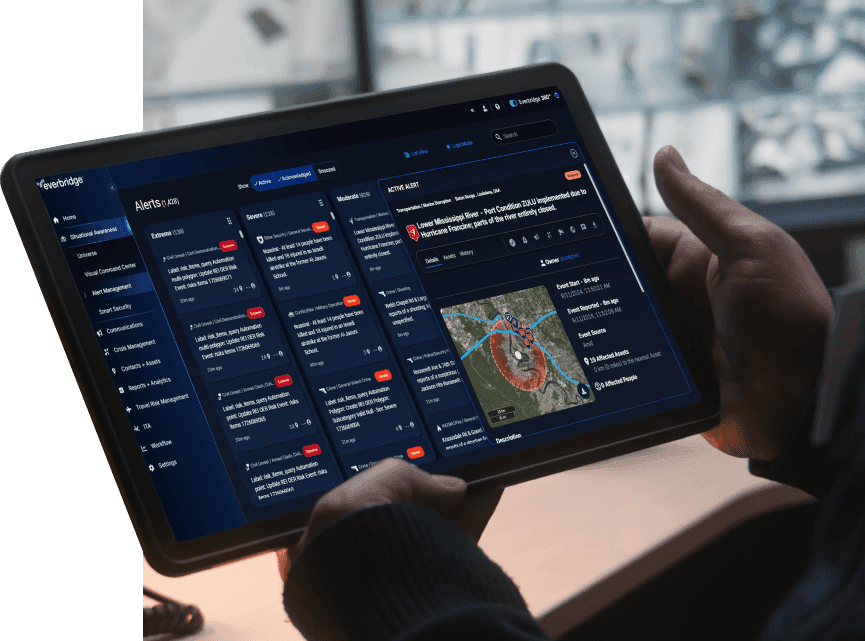
When a threat emerges, whether a wildfire or a major storm, the system initiates the response automatically. ServiceNow correlates asset impact and triggers operational workflows. Everbridge Visual Command Center provides real-time situational intelligence. Communications teams have a single source of truth from which to coordinate internal, customer-facing, and regulator-facing updates.
The response phase becomes more coordinated and more transparent. Field supervisors receive clear work packages and can submit status updates, photos, hazards, and asset conditions directly from mobile devices. These updates feed back into the shared dashboard for leadership, communications, and partner agencies. Mutual aid coordinators can see available resources, onboard external crews, and track progress without relying on standalone tools or manual updates.
Finally, recovery becomes significantly simpler. Every action, from the first alert to the last field report, is automatically logged. Evidence for NERC, FERC, FEMA, or internal after-action reviews is captured as a natural byproduct of the workflows, not as a herculean administrative effort after the fact.
Real-world impact: What utilities can expect
Utilities adopting unified emergency event management will realize dramatic improvements in both operational performance and customer experience. Restoration times shrink because delays between detection, tasking, and field execution disappear. Crew utilization improves because resources are assigned based on real-time awareness, not assumptions. Communications become clearer and more consistent because all teams are working from the same information.
Perhaps most significantly, regulators and oversight bodies gain confidence when the utility demonstrates compliance, transparency, and repeatable operational rigor. In a world where scrutiny is rising, this matters enormously.
A blueprint for the modern emergency operations center
What utilities need now is not another dashboard, another app, or another point solution. They need a unified solution that reflects the complexity of real-world operations. One that connects physical-world intelligence with digital workflows and field mobility. One that ensures every stakeholder, from the EOC to field crews to regulators, can see the same truth and act on it.
The Everbridge + ServiceNow + Ekatra solution represents this next-generation approach. It replaces fragmentation with orchestration, confusion with clarity, and reactive response with proactive resilience.
And for utilities facing a future defined by more frequent disruptions and higher expectations, it offers a path to faster restoration, stronger community trust, and a more resilient grid.
Build the resilience your utility needs
To learn how a unified Emergency Event Management solution can transform your storm response, outage operations, and regulatory readiness, explore the full solution.