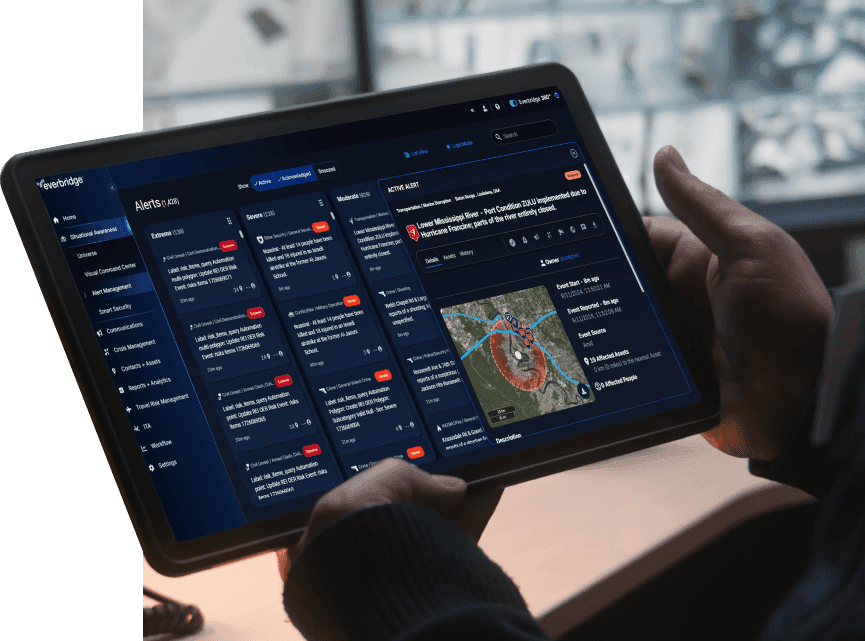

Executive protection (EP) has evolved beyond traditional close protection and secure transportation. Today’s enterprise leaders face a rapidly changing threat landscape that includes targeted violence, geopolitical instability, cyber-physical threats, civil unrest, insider risks, and travel-related disruptions. As threats become more dynamic and dispersed, organizations need more than a physical protection detail—they need a technology layer that provides real-time visibility, coordinated communications, and rapid incident response.
Effective executive protection programs typically combine three essential elements:
- Protective intelligence
- Physical executive protection services
- Technology-enabled command and control
Physical protection teams remain essential for safeguarding executives in the field. However, their effectiveness increasingly depends on access to timely intelligence, accurate situational awareness, and the ability to coordinate responses across security, business continuity, travel risk, and crisis management teams.
This is where modern resilience platforms play a critical role.
Everbridge provides both executive protection services and the technology infrastructure that enables organizations to monitor threats, coordinate response activities, and communicate with stakeholders before, during, and after incidents. Together, these capabilities help organizations build executive protection programs that support both personal safety and business continuity.
Why executive protection requires more than physical security
Traditional executive protection models focused primarily on physical threats in a limited number of environments. Today, executive risk is more complex.
Executives often:
- Travel internationally across varying threat environments
- Attend public events and high-profile meetings
- Face heightened visibility on social media and digital platforms
- Operate during periods of geopolitical uncertainty
- Make decisions that can increase organizational risk exposure
- Become targets during labor disputes, activism, or civil unrest
As a result, security teams must answer critical questions in real time:
- Where are our executives right now?
- Are any of them exposed to emerging threats?
- How quickly can we communicate with them?
- What resources can we deploy if an incident escalates?
- How do we coordinate security, operations, travel, and leadership teams simultaneously?
The answers require more than personnel. They require an integrated technology ecosystem that acts as the command-and-control layer of executive protection.
Threat intelligence integration
A common challenge for executive protection teams is managing information overload.
Threat indicators can emerge from:
- Breaking news events
- Severe weather incidents
- Civil unrest
- Terrorism threats
- Transportation disruptions
- Regional conflicts
- Localized criminal activity
- Infrastructure failures
Without centralized intelligence, EP teams may rely on fragmented data sources and manual monitoring processes.
An effective executive protection program integrates threat intelligence directly into operational workflows. Security leaders need a common operating picture that allows them to:
- Monitor global and local threats
- Understand executive exposure to emerging incidents
- Assess risk severity
- Prioritize response actions
- Coordinate resources across departments
Everbridge Visual Command Center helps organizations consolidate risk intelligence from multiple sources into a unified view. Security teams can visualize incidents alongside executive locations, travel plans, facilities, and operational assets, enabling faster risk assessments and more informed decision-making.
For executive protection teams, this means moving from reactive monitoring to proactive risk management.
Example: Protective intelligence during executive travel
Consider a CEO traveling to Singapore through multiple connecting airports.
During transit, a significant civil disturbance develops near a scheduled meeting location.
Rather than relying on manual monitoring or waiting for local reports, security teams can identify the incident through integrated threat intelligence feeds, assess proximity to the executive’s itinerary, and initiate protective measures before the executive arrives in the affected area.
The result is faster decision-making and reduced exposure to risk.
Real-time location tracking for executives
Knowing where executives are during an emerging threat is fundamental to effective protection. However, many organizations still rely on manual check-ins, travel itineraries, or outdated location data. In a fast-moving crisis, these methods can delay decision-making and response.
Modern executive protection programs require real-time visibility into executive movements and travel activity. Location intelligence enables security teams to:
- Identify executives near emerging threats
- Monitor travel routes
- Verify safety status
- Coordinate evacuations
- Deploy resources efficiently
- Support duty-of-care obligations
This capability becomes particularly valuable during international travel.
Whether responding to civil unrest, severe weather, transportation disruptions, or security incidents, location-based awareness helps organizations quickly determine who may be affected and what actions should be taken. For global enterprises, integrating executive protection with travel risk management creates a more comprehensive approach to safeguarding leaders wherever they operate.
Escalation and notification workflows
When an active threat emerges, speed matters.
The time between identifying a threat and initiating a response can significantly affect how well an incident is contained. Executive protection teams need predefined workflows that eliminate uncertainty during high-pressure situations.
Effective escalation processes should answer several questions immediately:
- Who needs to be notified?
- What information should be shared?
- Which response teams should be activated?
- How will status updates be tracked?
- When should executives receive direct communications?
Technology platforms help automate these workflows.
Using preconfigured incident response playbooks, security teams can rapidly:
- Notify executive protection personnel
- Alert executives and family members
- Activate crisis management teams
- Escalate to corporate security leadership
- Coordinate with business continuity stakeholders
- Maintain communication throughout the incident lifecycle
Two-way communication capabilities are particularly important.
Rather than simply broadcasting alerts, organizations can confirm whether executives have received instructions, request status updates, and gather situational information from personnel in the field.
What an executive protection-enabled Everbridge workflow looks like during an active threat
Consider a senior executive attending a conference in a major metropolitan area. During the event, local authorities report an active security incident within several blocks of the venue.
A mature executive protection workflow might look like this:
Step 1: Threat detection Risk intelligence identifies the incident and automatically maps its location.
Step 2: Exposure assessment Visual Command Center determines that the executive is within the potential impact area.
Step 3: Automated alerting Security teams receive immediate notifications while executive protection personnel are simultaneously activated.
Step 4: Executive communication The executive receives a targeted alert with protective instructions and a request to confirm status.
Step 5: Incident escalation Corporate security leaders, business continuity teams, and crisis management stakeholders are informed based on predefined escalation criteria.
Step 6: Response coordination Protective personnel coordinate movement to a secure location while maintaining real-time communications with the command team.
Step 7: Resolution and recovery Once the threat subsides, teams document actions taken, assess lessons learned, and update response plans.
This combination of intelligence, communication, and orchestration allows organizations to respond faster and more consistently than manual processes alone.
The role of executive protection services
Technology is only one part of an effective executive protection program.
When threats become physical, organizations need trained professionals capable of assessing risk, making decisions in the field, and protecting executives during dynamic situations.
Executive protection services provide:
- Advance planning and site assessments
- Protective intelligence analysis
- Travel security support
- Protective surveillance detection
- Residential security planning
- Event security coordination
- Close protection services
The strongest programs combine these services with integrated technology platforms.
Physical teams gain access to better intelligence and communications, while security leaders gain greater visibility into operations and response activities. This integrated model helps organizations scale protection programs without sacrificing situational awareness.
Post-incident documentation and continuous improvement
Executive protection programs are often evaluated based on their ability to prevent incidents. However, long-term effectiveness depends equally on learning from incidents that do occur.
After-action reviews help organizations answer important questions:
- How quickly was the threat identified?
- Were executives notified promptly?
- Did escalation workflows function correctly?
- Were communication gaps identified?
- What operational improvements should be made?
Technology platforms create a detailed record of incident activity, including:
- Alert timelines
- Communication logs
- Escalation actions
- Response milestones
- Executive status updates
- Resolution activities
This documentation supports compliance, reporting, training, and future program improvements. Over time, organizations can refine executive protection procedures based on real-world events rather than assumptions.
Building an executive protection program that supports business continuity
Executive protection is no longer solely a security function. Because executive leadership plays a critical role in organizational decision-making, protecting leaders directly supports operational resilience and business continuity. A disruption affecting a key executive can quickly become a disruption affecting the entire organization.
That is why leading enterprises increasingly view executive protection as a convergence of:
- Corporate security
- Travel risk management
- Crisis management
- Business continuity
- Protective intelligence
- Executive protection services
- Resilience technology
The organizations best prepared for today’s threat environment combine trained protection professionals with technology that delivers visibility, communications, and coordinated response capabilities.
Executive protection requires both people and platforms
As executive risk becomes more dynamic, organizations need a protection strategy that extends beyond traditional physical security.
Protective personnel remain essential for safeguarding executives in the field. But those teams are most effective when supported by real-time intelligence, location awareness, automated communications, and coordinated incident management.
Everbridge helps organizations strengthen executive protection through a combination of executive protection services and resilience technology, including risk intelligence, Visual Command Center, travel risk management capabilities, mass notification, and incident response orchestration.
Together, these capabilities support a more connected, proactive approach to protecting executives, maintaining business continuity, and enabling confident leadership as risk conditions continue to evolve.
FAQs
By combining executive protection personnel, threat intelligence, real-time location awareness, and coordinated communication workflows.
A program that integrates physical protection services with incident management, crisis communications, and escalation workflows.
By combining travel risk intelligence, itinerary monitoring, location awareness, proactive communications, and executive protection support when necessary.
Technology serves as the command-and-control layer that enables situational awareness, threat monitoring, communication, incident response, and post-event analysis.