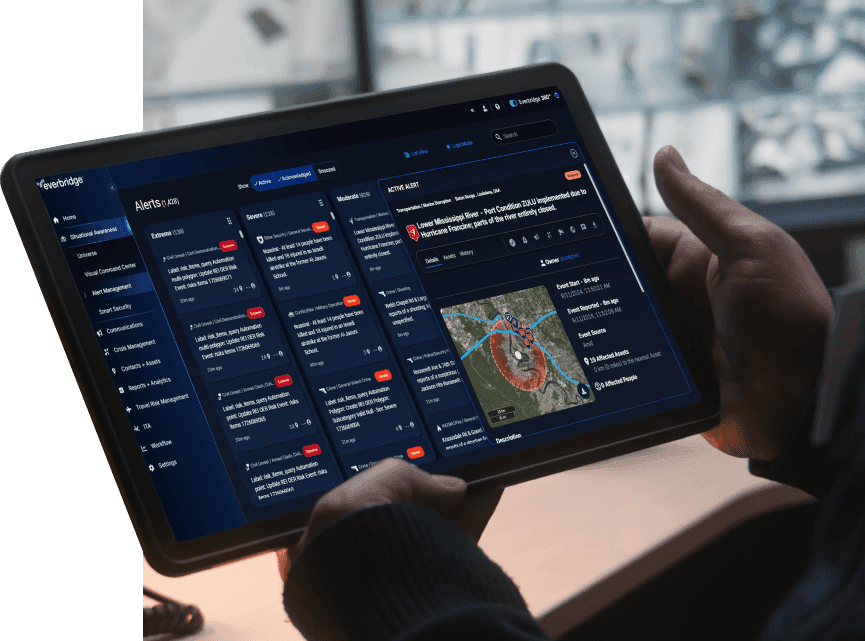

The future of security: AI, convergence, and risk intelligence
Physical and digital security is entering a period of rapid transformation. As threats become more sophisticated and interconnected, traditional protection models can no longer keep pace. According to the recent Gartner report on Emerging Tech: AI Vendor Race, the next frontier lies in adopting AI-driven capabilities, integrating cyber and physical security functions, and shifting from reactive threat detection to proactive risk intelligence.
This checklist outlines the key considerations and readiness steps technology and security leaders should evaluate to stay ahead of this evolution.
Phase 1: Assessment and strategy
Assess your current CEM, digital, and physical security capabilities to identify gaps and areas for improvement.
Define clear objectives for what you want to achieve.
Secure executive buy-in by presenting a clear business case for AI in CEM, focusing on risk and cost reduction and operational resilience.
Identify specific physical and digital security use cases for AI, such as automated monitoring of facilities, proactive threat intelligence for executive protection, or real-time occupancy tracking during an evacuation.
Phase 2: Data and technology readiness
Audit your existing data sources, including access control systems, video surveillance, and IoT sensors, to evaluate quality and accessibility.
Develop a data management strategy to ensure the information fed into AI systems is clean, structured, and ready for analysis.
Evaluate potential CEM vendors and platforms that specialize in AI, digital, and physical security.
Prioritize solutions that offer purpose-built AI designed for risk intelligence and can integrate with your current security infrastructure.
Phase 3: Governance and implementation
Establish an AI governance charter with clear rules and responsibilities for ethical and effective use.
Form a cross-functional team including IT, security, operations, and legal to oversee the AI integration project.
Start with a pilot program focused on a high-impact physical security use case, like automating alerts for unusual activity in a restricted area.
Develop new standard operating procedures (SOPs) that incorporate AI-powered insights and automated workflows.
Train your security and operations teams on how to use the new AI tools and interpret their outputs for faster decision-making.
Phase 4: Measurement and refinement
Define key performance indicators (KPIs) to measure the success of your AI implementation, such as a reduction in response times or improved accuracy of threat detection.
Gather feedback from end-users to understand the practical impact and identify areas for improvement.
Conduct post-incident reviews using AI-driven analytics to uncover weaknesses and refine your response playbooks.
Commit to a cycle of continuous improvement, regularly updating your AI models and strategies to adapt to the evolving threat landscape.
By using this checklist, you can comprehensively evaluate AI-focused critical event management vendors to ensure the solution your organization acquires meets your needs, now and in the future.
To experience our High Velocity CEM platform, Everbridge 360™, powered by Purpose-built AI and our unwavering commitment to empowering organizational resilience, book a demo today.