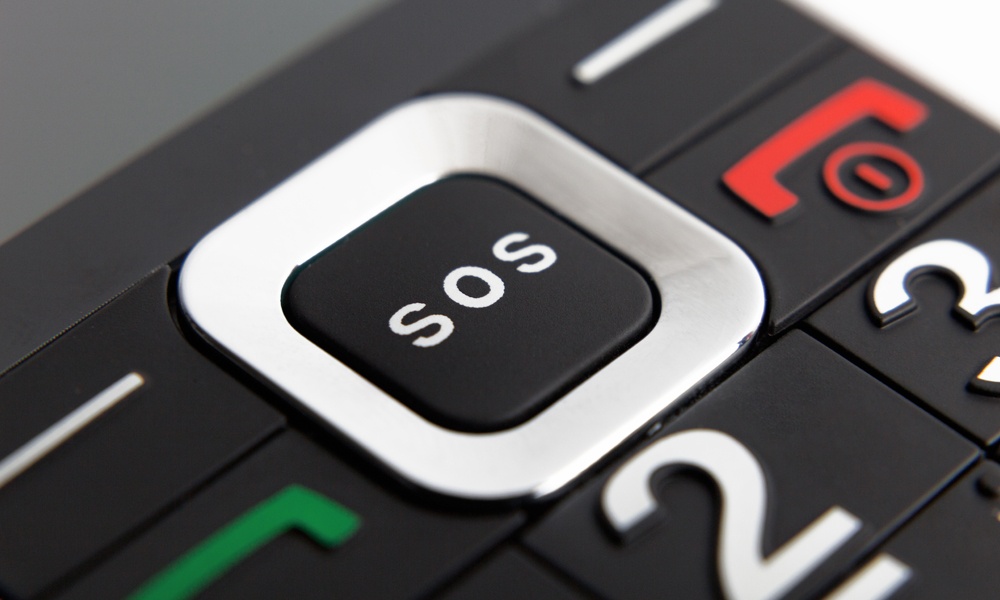
Kari’s Law is a U.S. federal 9-1-1 regulation that requires multi-line telephone systems (MLTS) to let callers dial 9-1-1 directly, without a prefix such as “9.” Businesses and organizations with an MLTS purchased, installed, or significantly upgraded after February 16, 2020, must also ensure that on-site security, front desk, or administrative personnel receive an automated notification with key call details, including the caller’s phone number and location.
To comply with Kari’s Law, organizations should confirm that every calling device on their network can:
- Reach 9-1-1 directly, without dialing a prefix or access code.
- Automatically notify designated on-site personnel when a 9-1-1 call occurs.
- Provide location information that helps responders and internal teams find the caller.
- Support emergency response across traditional phones, voice over internet protocol (VoIP) systems, and collaboration platforms.
Kari’s Law supports preparedness, response, and recovery by helping organizations safeguard employees and assets during critical events. With the right E911 solution, businesses can simplify compliance, minimize disruptions, and strengthen operational continuity.
Why Kari’s Law matters for 9-1-1 caller protection
Every year, more than 240 million 9-1-1 calls take place in the United States. When a caller cannot reach emergency services quickly, or when dispatchers cannot identify the caller’s location, response can be delayed during moments when every second matters.
Kari’s Law addresses a common communications gap in enterprise phone systems: the need to dial a prefix before reaching an outside line. In hotels, offices, schools, hospitals, campuses, and government buildings, that extra step can prevent people from connecting with emergency services when they need help.
As an employer or organization, supporting emergency access is part of duty of care and risk management. It also contributes to organizational resilience by helping people anticipate, mitigate, respond, recover, and adapt when critical events occur.
Common Kari’s Law compliance challenges
Many organizations still face uncertainty around E911 requirements because communications environments have become more distributed and complex. Hybrid work, VoIP, softphones, and collaboration tools can make it harder to understand where a call originated.
Common challenges include:
- Legacy MLTS configurations that still require a prefix for an outside line.
- Multiple phone systems across offices, campuses, hotels, or facilities.
- VoIP and collaboration platforms, such as Cisco Webex or Microsoft Teams, that need emergency calling validation.
- Incomplete location data for multi-floor buildings, large campuses, warehouses, and shared spaces.
- Limited awareness of how Kari’s Law and RAY BAUM’s Act work together.
- Internal uncertainty about who receives emergency call notifications and how they respond.
These challenges can affect readiness and stability during emergencies. A coordinated E911 approach helps organizations know earlier, respond faster, and improve continuously.
Everbridge E911 solutions for Kari’s Law compliance
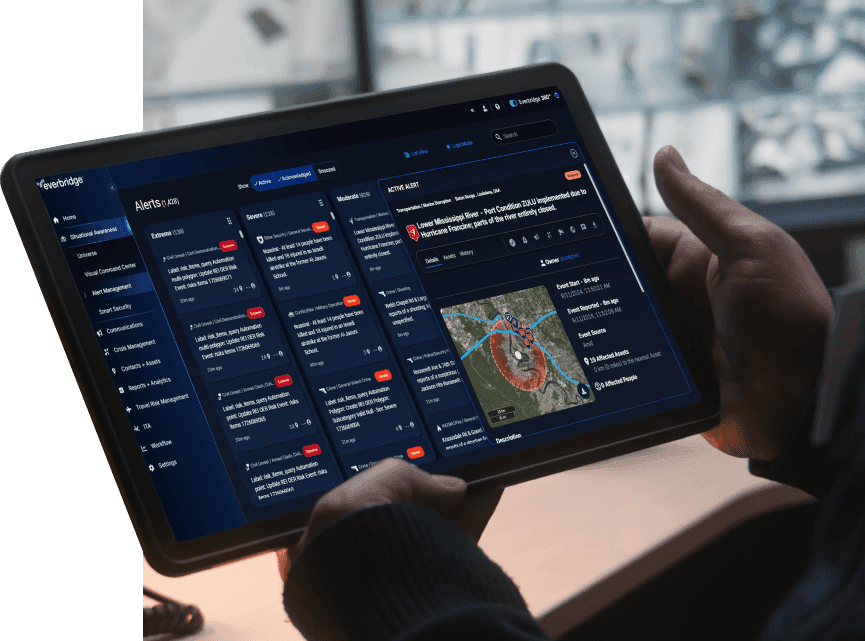
Everbridge helps organizations simplify E911 compliance and improve emergency response coordination. Everbridge E911 solutions support Kari’s Law and RAY BAUM’s Act requirements by helping organizations connect callers to 9-1-1, notify the right internal teams, and provide actionable location information.
Everbridge is a leader in critical event management (CEM) and empowers organizations to navigate critical events confidently. Through real-time information, automated workflows, and scalable communications capabilities, Everbridge helps organizations protect people, assets, operations, and infrastructure.
For businesses managing complex communications environments, Everbridge supports resilience, preparedness, and operational continuity. The result is a more coordinated response when employees, guests, visitors, patients, students, or residents place an emergency call.
How Kari’s Law compliance works
Kari’s Law compliance centers on two core requirements: direct 9-1-1 dialing and on-site notification. Organizations should also align their emergency calling strategy with RAY BAUM’s Act, which requires dispatchable location information for emergency responders.
A practical compliance path includes:
- Identify all calling devices and systems. Review traditional phones, VoIP systems, softphones, and collaboration tools that can place external calls.
- Confirm direct 9-1-1 dialing. Ensure users can dial 9-1-1 without entering a prefix, access code, or outside-line number.
- Configure on-site notifications. Designate security, front desk, or administrative personnel to receive automated alerts when a 9-1-1 call occurs.
- Validate call detail and location information. Confirm notifications include the caller’s number and location details that can guide internal response.
- Coordinate with RAY BAUM’s Act requirements. Ensure dispatchable location information is available for emergency dispatchers.
- Test and maintain the system. Reassess emergency calling after phone system upgrades, office moves, floor plan changes, or technology deployments.
This approach helps organizations maintain compliance while supporting business continuity and operational resilience.
Requirements and benefits of compliance
Direct dialing requirements
Direct dialing means a caller can pick up any capable calling device and dial 9-1-1 without entering a prefix. If someone can dial an external number from a device, that device must be able to reach 9-1-1 directly.
A simple rule applies: if a device can dial for pizza, it must be able to dial 9-1-1.
MLTS manufacturers and vendors are legally accountable for pre-configuring systems to support direct 9-1-1 dialing. Installers, managers, and operators are also accountable for ensuring that systems support direct access to emergency services.
Notification requirements
Kari’s Law also requires MLTS systems to provide an automated notification to on-site personnel when a 9-1-1 call occurs. The notification should reach the front desk, security office, or administrative personnel who can support responders when they arrive.
The notification must include important call details, such as:
- The phone number that dialed 9-1-1.
- The caller’s location.
- Information that helps designated personnel coordinate response.
Location detail is especially important in large or complex environments. A street address alone may not help responders locate a caller inside a multi-floor building, large campus, warehouse, hospital, hotel, or school.
Compliance benefits
Kari’s Law compliance helps organizations improve response and reduce avoidable delays. It also strengthens duty of care and demonstrates proactive risk management.
Key benefits include:
- Faster access to emergency services.
- Better internal awareness when a 9-1-1 call occurs.
- More precise location information for responders and on-site teams.
- Improved safety for employees, guests, visitors, students, patients, and residents.
- Stronger operational continuity during critical events.
- Reduced exposure to penalties and civil litigation risk.
Industry and use-case variants
Kari’s Law applies to organizations that use multi-line telephone systems, including systems typically found in office buildings, school campuses, hotels, hospitals, universities, government facilities, and businesses of all sizes.
The law applies universally, without exceptions, to organizations with an applicable MLTS. This includes municipal, state, and federal government agencies, universities, hospitals, and commercial enterprises.
Organizations that manufacture, import, sell, or lease MLTS technology should also understand Kari’s Law requirements. They must ensure the systems they provide support direct 9-1-1 dialing.
Use cases can vary by environment:
- Hotels: Guests must be able to dial 9-1-1 directly from room phones without knowing hotel-specific dialing rules.
- Office buildings: Employees and visitors need reliable emergency access across shared floors, conference rooms, and reception areas.
- Schools and campuses: Administrators need clear location information to help responders reach classrooms, residence halls, and other facilities.
- Hospitals: Staff, patients, and visitors need emergency calling that supports complex buildings and multi-floor locations.
- Government facilities: Agencies need consistent emergency access across offices, public spaces, and secured environments.
- Small businesses: If an organization uses an applicable MLTS, size does not remove the need to comply.
Proof, history, and enforcement
History of Kari’s Law
Kari’s Law originated from a tragedy in Texas. In 2013, Kari Hunt Dunn was the victim of a crime in a hotel. Kari’s daughter tried to call 9-1-1 four times but did not know the hotel phone system required dialing “9” first to reach an outside line.
Kari did not receive help in time. Her father, Hank Hunt, turned his grief into action and led a national effort to prevent others from facing the same barrier during an emergency.
Kari’s Law first became a Texas state law on May 15, 2015. In early 2018, it became a federal law after Congress passed it unanimously and the President signed it. The statute officially went into effect on January 6, 2020, with a compliance date of February 16, 2020, for all 50 states.
Penalties for non-compliance
Businesses found in non-compliance with Kari’s Law may face a fine of up to $10,000 plus $500 per day for the period of non-compliance. Organizations may also face additional Federal Communications Commission (FCC) penalties and potential civil litigation if emergency access failures contribute to delayed response.
Compliance supports more than legal readiness. It demonstrates a commitment to duty of care, employee safety, organizational resilience, and business continuity.
Kari’s Law and the FCC
When Congress enacts telecommunications legislation, the Federal Communications Commission develops the rules that implement and enforce the law. The FCC monitors complaints about alleged violations of Kari’s Law and related 9-1-1 requirements.
Under the FCC statute and the Commission’s rules, MLTS manufacturers and vendors must pre-configure systems to support direct 9-1-1 dialing. MLTS installers, managers, and operators must also ensure systems allow users to dial 911 without a prefix or access code, such as the number “9.”
For more information on the FCC’s interpretation of the law, enforcement, and organizational responsibilities, review the FCC Report and Order.
“In particular, these rules will make it easier for Americans in hotels, office buildings, and campuses to dial 911 and reach the help that they need in an emergency. And they will make it more likely than when such a 911 call is placed, an on-site notification is provided so that an employee can help speed response times when emergency personnel arrives.” — Ajit Pai, Chairman of the FCC, August 1, 2019
Resources and thought leadership
Kari’s Law and RAY BAUM’s Act
Kari’s Law works alongside the RAY BAUM’s Act, another important E911 regulation. RAY BAUM’s Act requires organizations to provide a “dispatchable location” to emergency dispatchers when someone dials 9-1-1 from their network.
A dispatchable location provides enough detail for emergency responders to find the caller. In practice, this can include building, floor, suite, room, or other information that helps responders locate the person quickly.
Kari’s Law focuses on direct dialing and internal notification. RAY BAUM’s Act focuses on sending actionable location information to the Public Safety Answering Point (PSAP) that receives the emergency call.
Take the next step toward E911 compliance
E911 compliance does not need to be difficult, but the stakes are high when an MLTS system does not support direct emergency access. Expert guidance can help organizations address regulatory requirements, modern communications systems, and location-aware response.
Everbridge helps simplify the compliance process and address the specific needs of each organization. With Everbridge E911, organizations can support Kari’s Law and RAY BAUM’s Act compliance while improving readiness for current and future E911 legislation.
Frequently asked questions
Kari’s Law is a U.S. federal 9-1-1 law that requires multi-line telephone systems to allow direct 9-1-1 dialing without a prefix. It also requires automated on-site notification when a 9-1-1 call occurs.
Organizations with an MLTS purchased, installed, or significantly upgraded after February 16, 2020, must comply. This includes businesses, hotels, schools, hospitals, universities, government agencies, and other organizations that use multi-line phone systems.
Businesses need to enable direct 9-1-1 dialing from all calling devices, configure automated on-site notifications, and ensure notifications include the caller’s phone number and location. They should also align E911 practices with RAY BAUM’s Act dispatchable location requirements.
Yes. Kari’s Law applies based on the use of an applicable MLTS, not the size of the organization. Small businesses with qualifying multi-line telephone systems need to comply.
Kari’s Law officially went into effect on January 6, 2020. The compliance date for all 50 states was February 16, 2020
A business found in non-compliance may face a fine of up to $10,000 plus $500 per day for the period of non-compliance. Organizations may also face additional penalties or civil litigation risk.
Kari’s Law requires direct 9-1-1 dialing and automated on-site notification. RAY BAUM’s Act requires organizations to provide dispatchable location information to emergency dispatchers for 9-1-1 calls.
Everbridge E911 solutions help organizations support direct 9-1-1 dialing, on-site notifications, and location-aware emergency response. Everbridge helps organizations minimize disruptions, safeguard employees and assets, and strengthen operational resilience.