
The FIFA World Cup 2026 is coming to the United States, Canada and Mexico, and it will be unlike any sporting event the U.S. has hosted. Across 11 U.S. host cities — from Los Angeles to Boston — the tournament will unfold over roughly six weeks during the summer of 2026, drawing an estimated 5.5 million in-person spectators and billions more watching globally. For U.S. businesses, the tournament is more than a cultural milestone. It is an operational challenge that requires advance planning. It’s an operational challenge that demands advance planning. Multiple cities will experience simultaneous surges in international visitors, road closures, transit overloads, extreme summer weather, heightened cyber threats, and the kind of prolonged disruption that a single Super Bowl weekend simply doesn’t produce. This guide breaks down the specific risks facing each U.S. host market and offers a practical playbook for protecting your people, facilities, and operations.
Why World Cup 2026 demands a different risk playbook
Most U.S. businesses have experience planning around major events — a conference, a marathon, a championship game. The World Cup is categorically different. Consider the scale: FIFA expanded the tournament to 48 teams for 2026, meaning more matches, more venues, and a longer calendar window than any prior edition. The United States, Mexico, and Canada will co-host, but the U.S. alone will stage 78 of the tournament’s 104 matches, including every game from the quarterfinals onward.
This creates a compounding effect. It’s not one city dealing with one weekend of disruption. It’s 11 U.S. metro areas experiencing rolling waves of activity — match days, fan zone events, team arrivals, media surges, protest activity, and security lockdowns — across June and July 2026. International visitors will arrive from dozens of countries, many unfamiliar with local transit systems, emergency protocols, or extreme U.S. summer weather. Fan zones, which FIFA plans to operate in each host city as large-scale outdoor gathering areas, will draw tens of thousands of people daily to locations outside the stadiums themselves.
For businesses operating in or near these cities, the risks span every category: physical security, employee safety, transportation, supply chain, cybersecurity, and reputational exposure. A standard event-day plan is unlikely to be sufficient. Organizations need a sustained, city-level resilience strategy — one that accounts for the unique risk profile of each host market.
Priority risks across the 11 US host cities
The 11 U.S. host cities are Los Angeles, Dallas, Houston, Miami, New York/New Jersey, Atlanta, Seattle, Philadelphia, Boston, Kansas City, and the San Francisco Bay Area. Each brings a distinct combination of venue type, climate, transit infrastructure, and threat landscape. Below is a breakdown of the most pressing risk categories that cut across all of them.
Transportation congestion, airport delays, and road closures
Every host city will experience significant transportation disruption. Road closures around stadiums and fan zones will ripple outward, affecting commute times, delivery routes, and emergency vehicle access. Airports in cities like Miami, Los Angeles, and New York/New Jersey — already among the busiest in the country — will face surges in international arrivals that stress customs processing and ground transportation.
Cities with less robust public transit, such as Dallas, Houston, and Kansas City, are particularly vulnerable. Employees who rely on driving to work near venue areas may face unpredictable delays. Businesses that depend on just-in-time deliveries should expect disruptions to last-mile logistics throughout the tournament window.
Extreme heat and severe weather
The tournament runs during peak summer, and several host cities face serious heat-related risk. According to the National Weather Service, June and July average high temperatures in Dallas, Houston, and Phoenix-adjacent areas regularly exceed 100°F. Miami’s combination of heat and humidity creates dangerous heat index values. Even cities like Philadelphia and New York can experience heat waves during this period.
Meanwhile, Houston, Miami, and Atlanta sit squarely in the path of Atlantic hurricane season, which begins June 1. Severe thunderstorms, flash flooding, and tornado risk are real concerns for outdoor fan zones and transit systems in the central U.S. cities. Seattle, while cooler, can experience wildfire smoke events that degrade air quality.
Public gatherings, protests, and civil unrest
The World Cup’s global profile can create conditions for political demonstrations and public expression. Past tournaments have seen protests related to FIFA governance, human rights issues in participating nations, labor practices, and local policing. U.S. host cities with a history of large public demonstrations — New York, Los Angeles, Seattle, San Francisco, and Philadelphia among them — should anticipate demonstrations near fan zones, transit hubs, and high-profile hotels.
Large, densely packed gatherings also present crowd-safety risks. Fan zones can hold tens of thousands of people in open-air settings, and High attendance, extended dwell times, and emotionally charged matches can increase the likelihood of crowd-management challenges.
Cybersecurity and digital threats
Major international events are prime targets for cyberattacks. The Cybersecurity and Infrastructure Security Agency (CISA) has consistently warned that large-scale sporting events attract phishing campaigns, ransomware attempts, and attacks on public Wi-Fi networks. Businesses in host cities should expect an increase in World Cup-themed social engineering attacks — fake ticket offers, fraudulent hospitality packages, and spoofed event communications.
Point-of-sale systems, corporate VPNs used by traveling employees, and IoT devices in venue-adjacent facilities are all potential attack surfaces. Organizations with employees attending matches or working near fan zones should reinforce endpoint security and credential hygiene well before the tournament begins.
Employee travel and executive movement
Companies sending employees to host cities — whether for work, client entertainment, or the matches themselves — take on duty-of-care obligations. Travel between host cities will be complicated by flight delays, hotel shortages, and ground transportation bottlenecks. Executive travel and VIP movement near venues will require advance route planning and real-time intelligence on road closures and security perimeters.
For organizations with global workforces, employees may also be traveling from abroad to attend matches, adding international travel risk management complexity around visas, health advisories, and emergency repatriation planning.
Supply chain and facility impacts
Businesses with warehouses, offices, retail locations, or production facilities near stadiums or fan zones should plan for access restrictions, delivery delays, and potential property risk. Supply chains that route through host-city ports, distribution centers, or freight corridors may experience slowdowns. In cities like Los Angeles and the San Francisco Bay Area, port-adjacent logistics operations could face compounding delays if security measures tighten around maritime infrastructure.
| Host city | Key venue | Top climate risk | Transit vulnerability | Notable threat considerations |
|---|---|---|---|---|
| Los Angeles | SoFi Stadium | Extreme heat, wildfire smoke | Heavy car dependency, LAX congestion | Large-scale protests, earthquake risk |
| Dallas | AT&T Stadium (Arlington) | Extreme heat (100°F+) | Limited public transit | Severe thunderstorms, tornado risk |
| Houston | NRG Stadium | Extreme heat, hurricanes | Car-dependent metro | Flooding, humidity-related illness |
| Miami | Hard Rock Stadium | Hurricanes, extreme heat index | Airport surge, limited rail | Tropical storms, coastal flooding |
| New York/New Jersey | MetLife Stadium | Heat waves, nor’easters (unlikely in summer) | Mass transit strain (NJ Transit, PATH) | Protest activity, Heightened security posture due to global visibility |
| Atlanta | Mercedes-Benz Stadium | Severe heat, thunderstorms | MARTA capacity limits | Crowd density in downtown core |
| Seattle | Lumen Field | Wildfire smoke | Light rail capacity | Protest culture, air quality |
| Philadelphia | Lincoln Financial Field | Summer heat waves | SEPTA capacity | Potential for demonstrations or crowd-related disruption near venue areas |
| Boston | Gillette Stadium (Foxborough) | Summer storms | Very limited transit to venue | Suburban venue access bottleneck |
| Kansas City | Arrowhead Stadium | Extreme heat, severe storms | Car-dependent | Tornado risk, limited transit options |
| SF Bay Area | Levi’s Stadium (Santa Clara) | Wildfire smoke, moderate heat | Caltrain/VTA capacity | Tech-sector cyber targeting |
How employers should prepare now
Map your exposure by city
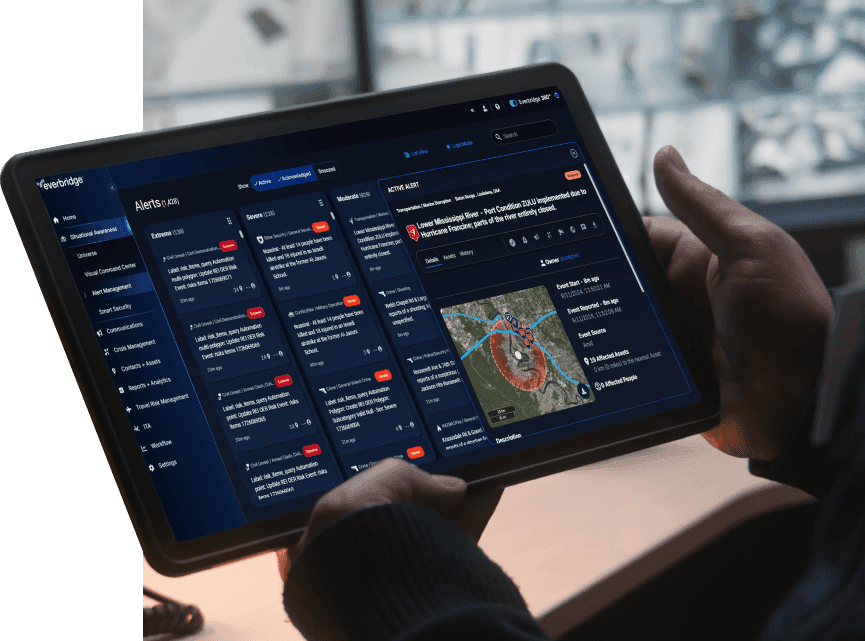
Start by identifying every touchpoint your organization has in each host city. This goes beyond office locations. Consider employee residences, client sites, data centers, warehouses, retail stores, travel routes, and vendor facilities. Overlay these against known venue locations, planned fan zone sites, and anticipated road closure zones. A critical event management platform such as Everbridge can automate this mapping by correlating asset locations with dynamic threat data, giving you a real-time picture of exposure as the tournament approaches.
Communicate with employees and travelers
Clear, proactive communication is essential. Employees in host cities need to know what to expect — transit changes, potential office closures, remote work options, and safety guidance. Employees traveling to host cities for business or personal reasons need pre-trip briefings and access to real-time alerts.
Everbridge mass notification capabilities help organizations reach affected employees quickly across SMS, email, push notification, and voice channels. Pre-built templates for common scenarios — severe weather, road closures, security incidents — save critical minutes when events unfold quickly.
Monitor threats in real time
The risk landscape during a six-week, multi-city tournament will shift daily. A static risk assessment completed months in advance won’t be sufficient. Organizations need continuous threat intelligence that aggregates open-source data, social media signals, weather forecasts, transportation alerts, and law enforcement advisories into a unified operating picture.
Everbridge’s threat intelligence capabilities are purpose-built for this kind of sustained, multi-location monitoring — helping teams prioritize relevant threats so security and operations teams can focus on what matters. They integrate real-time alerts with incident workflows and mass notification to accelerate response.
Coordinate with local authorities and event organizers
Each host city will stand up a multi-agency coordination structure involving local police, fire, emergency management, the FBI, Secret Service, and FIFA’s own security apparatus. Businesses with facilities near venues should establish contact with local emergency management offices now. Participate in tabletop exercises if invited. Understand evacuation routes, shelter-in-place protocols, and how official communications will be disseminated.
Prepare facilities near venues or fan zones
If your organization operates a facility within a mile of a stadium or planned fan zone, take specific steps:
- Assess physical security: perimeter access, surveillance, lighting, and entry controls
- Review insurance coverage for event-related property damage or business interruption
- Stock emergency supplies for shelter-in-place scenarios
- Identify alternate work locations and remote work triggers
- Brief on-site staff on crowd management and de-escalation
Build business continuity triggers
Don’t wait for an incident to decide whether to close an office or reroute a shipment. Define triggers in advance — specific conditions that activate pre-planned responses. For example:
- Heat advisory trigger: If the local heat index exceeds 105°F, activate remote work for employees in affected offices
- Transit disruption trigger: If major highway closures affect more than 30% of employee commute routes, shift to remote operations
- Security incident trigger: If law enforcement issues a shelter-in-place order within a defined radius of your facility, activate your emergency communication plan
- Cyber incident trigger: If a World Cup-themed phishing campaign is detected targeting your domain, escalate to your security operations center immediately
Business continuity planning tools help codify these triggers so response is fast, consistent, and documented.
World Cup 2026 readiness checklist
- Identify all organizational assets, employees, and travelers in each of the 11 US host cities
- Map facility locations against stadium, fan zone, and road closure zones
- Establish real-time threat monitoring for each host market
- Create or update mass notification templates for weather, security, transit, and cyber scenarios
- Brief employees in host cities on expected disruptions and safety protocols
- Activate travel risk management protocols for employees traveling to host cities
- Coordinate with local emergency management agencies near venue-adjacent facilities
- Review physical security posture for facilities within one mile of venues or fan zones
- Define business continuity triggers and pre-authorize response actions
- Test communication systems and conduct at least one tabletop exercise before June 2026
- Review cyber hygiene policies and alert employees to World Cup-themed phishing risks
- Confirm insurance coverage for event-related business interruption
FAQs
US employers have a legal and ethical obligation to take reasonable steps to protect employees from foreseeable harm. During the World Cup, this means proactively communicating about known risks in host cities, providing safety guidance to business travelers, and having systems in place to locate and communicate with employees during an incident. Organizations with global workforces should also consider duty-of-care requirements under local laws for employees traveling internationally to attend matches. Travel risk management solutions help organizations fulfill these obligations by tracking traveler locations and providing real-time risk assessments.
It depends on proximity to venues and fan zones, the nature of your operations, and the severity of expected disruption. Offices within a mile of a stadium or major fan zone will likely face significant access challenges on match days. Rather than making blanket decisions, define specific triggers — transit shutdowns, security perimeters, extreme heat advisories — that activate remote work or office closures. Communicate these triggers to employees well in advance so expectations are clear.
Treat World Cup host cities the way you would any elevated-risk travel destination. Issue pre-trip briefings that cover transportation disruptions, weather risks, crowd safety, and cybersecurity hygiene. Register travelers in your travel risk management system so you can locate and communicate with them in real time. For high-profile matches or cities with elevated threat levels, consider requiring pre-approval for travel and providing employees with emergency contact cards and local emergency numbers.
Fast, reliable communication across multiple channels is critical. A mass notification system that can deliver messages across multiple channels — SMS, email, push notifications, voice calls — within seconds is essential. Pre-build message templates for the most likely scenarios: severe weather warnings, security lockdowns, transit disruptions, and cyber alerts. Use two-way communication so employees can confirm their safety or request assistance. Test these systems before the tournament starts.
World Cup-themed cyberattacks will increase significantly in the months leading up to and during the tournament. Reinforce employee awareness training with specific examples of World Cup phishing lures — fake ticket sales, fraudulent hospitality offers, spoofed FIFA communications. Ensure endpoint protection is current for all devices, especially those used by traveling employees. Monitor for credential theft and domain spoofing. Coordinate with your security operations center to establish elevated monitoring during the tournament window, and integrate cyber threat intelligence into your broader critical event management workflow.
Now. Venue security plans, road closure schedules, and fan zone locations are already being finalized. Organizations that wait until early 2026 will find themselves competing for limited security consulting resources, working under compressed timelines to update communication plans, and reacting to disruptions they could have anticipated. The most resilient organizations will use the remainder of 2025 to map exposure, test systems, train employees, and build the triggers and playbooks that make response automatic when the tournament kicks off.