Full transcript
[00:05.3]
Hi there. I’m Caitlin Gillespie, the chief of meteorology here at Everbridge, and this is your rapid resilience weather update. If the skies across the Northeast look unusually gray filtered, that’s not cloud cover or the traditional summertime haze. It’s wildfire smoke that has traveled hundreds and even some cases thousands of miles from fires burning across Canada.
[00:27.0]
Smoke is currently affecting a broad area of the Great Lakes through New York, southern New England, Pennsylvania, New Jersey and the Mid Atlantic. Conditions vary considerably by location, but air quality has reached unhealthy to very unhealthy levels in portions of the region.
[00:43.1]
Early this morning, visibility across the New York City metro had fallen roughly 3 to 5 miles, while purple or very unhealthy air quality alerts were issued across Washington, D.C. much of Maryland and Northern Virginia. So how does smoke from Canada reach the Northeast?
[01:00.1]
Wildfires release tremendous amounts of heat, gases and particles into the atmosphere. Strong fires can loft that smoke thousands of feet above the ground. And once it reaches that level, the smoke becomes embedded within the larger atmospheric circulation, and this can then travel multiple states or even across continents.
[01:19.9]
So, in our event, ongoing winds have transported smoke southeastward from the fires in Ontario and other parts of Canada, across the Great Lakes and into the eastern United States. A weak front moving through the Northeast has, helped carry this concentrated plume of smoke southward, while high pressure and relatively limited ventilation have allowed for some of those particles to remain over the region.
[01:43.0]
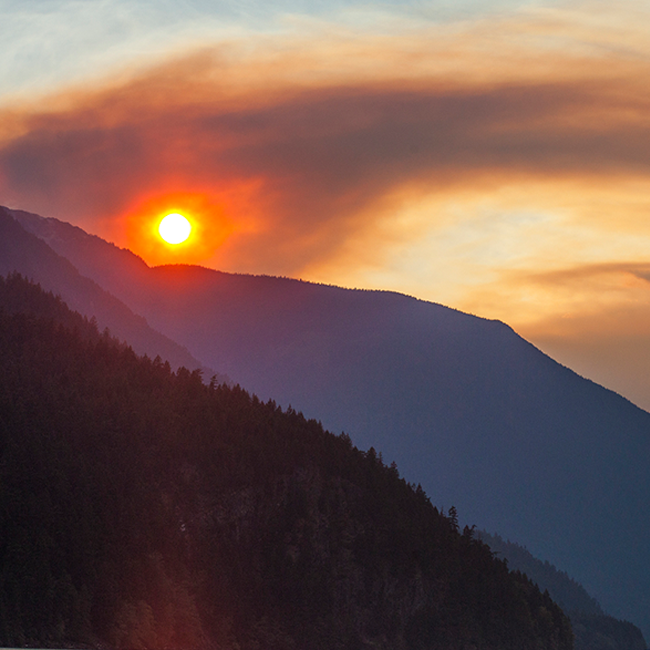
There’s also an important difference between smoke aloft and smoke near the ground. Smoke several thousands of feet above us can create that milky sky, reduced sunshine, and an orange and red appearance around the sun without necessarily causing severe air quality problems at the surface.
[02:00.3]
But once smoke is already traveling at, those lower levels, or when the daytime heating mixes elevated smoke downwards, the concentration of particles near the ground can rise quickly. This is when visibility deteriorates and the air Quality index, or aqi, can move into unhealthy categories.
[02:19.7]
The primary health concern are particles small enough to penetrate deep into the lungs and may aggravate asthma stimulus, copd, heart disease, and other respiratory or cardiovascular conditions. So, children, older adults, pregnant people, outdoor workers, and anyone with an existing heart or lung condition.
[02:38.5]
Those are particularly vulnerable folks that even though. No, okay, let’s rephrase from there. The primary health concern are particles small enough to penetrate deep into the lungs and may aggravate asthma, copd, heart disease, and other respiratory or cardiovascular conditions.
[02:59.6]
Children, older adults, pregnant people, outdoor workers, anyone with an existing heart or lung condition are especially vulnerable. But at, very unhealthy AQI levels, everyone should be reducing their exposure. So here’s what we can do. Check the current AQI through Air now or your state and local environmental agency before exercising, working or holding events outdoors.
[03:23.1]
Do not rely entirely on how the sky looks or smells, because smoke concentrations can change very quickly over short distances. When air quality is unhealthy, shorten or reschedule outdoor activity. Keep your windows and doors closed and even set your H Vac system to recirculate indoor air when possible.
[03:43.5]
Avoid adding more particles indoors through smoking, burning candles or other activities that create smoke. If you must spend extended time outdoors, a properly fitted N95 will help reduce your exposure to these fine smoke particles.
[04:00.1]
Follow your asthma or respiratory action plan and contact a healthcare provider if coughing, wheezing, chest discomfort or difficulty breathing worsens or does not improve. Now Looking ahead, Portions of New York and southern New England should see a gradual improvement as the main near surface smoke plume shifts further south, poor air quality may persist longer across parts of Pennsylvania and the mid Atlantic.
[04:25.4]
A more southerly wind approaching showers. This should eventually improve the mixing and help disper some of the smoke this weekend. But this is not necessarily a permanent all clear. Hundreds of wildfires remain active across Canada and this means additional smoke plumes may return when the wind pattern becomes favorable once again.
[04:46.7]
The bottom line the fires may be far away, but the health impacts are local. Continue checking the aqi. Adjust your outdoor plans when necessary and take extra steps to protect those vulnerable family members, employees and community members. Stay aware, stay safe and stay resilient.
[05:05.0]
Thank you for watching.