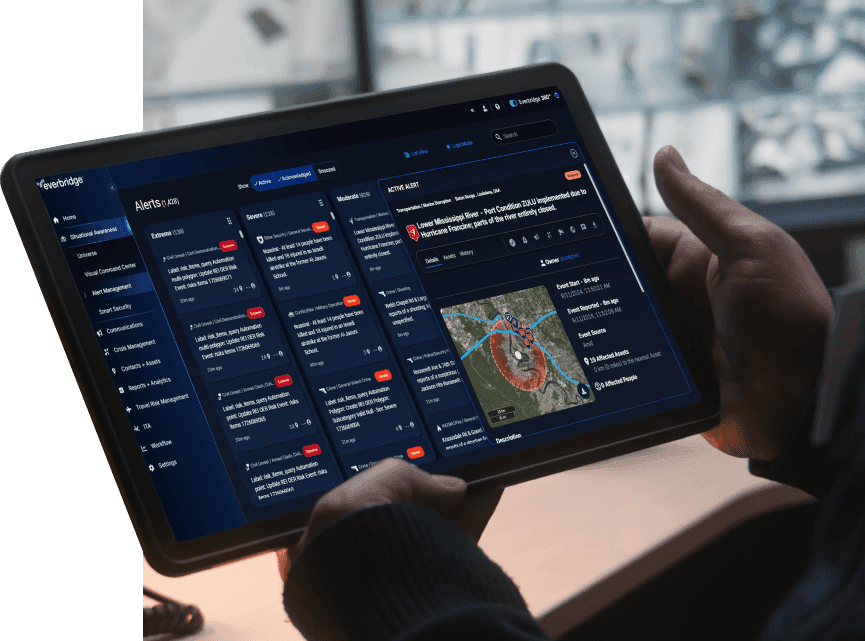

Organizations today are operating in an increasingly volatile and complex risk environment. Natural disasters, geopolitical instability, cyber threats, and supply chain disruptions are no longer isolated incidents—they are interconnected and escalating. Managing these risks requires more than traditional approaches. It requires speed, clarity, and precision at scale.
Artificial intelligence (AI) is no longer optional in this context. It is a critical capability that enables organizations to detect threats faster, make informed decisions under pressure, and protect people and operations when it matters most.
Understanding the expanding risk zone
The modern risk landscape has fundamentally changed. Organizations are now operating within an expanding risk zone defined by three key dynamics.
First, threats are converging. Macroeconomic volatility, natural disasters, civil unrest, and cyber attacks increasingly overlap and amplify one another. This creates cascading risks that escalate quickly and require coordinated response.
Second, information volume is overwhelming. Social media, open-source intelligence, and digital communications generate massive volumes of real-time data, often conflicting or incomplete. Identifying credible signals in this noise is beyond human scale.
Third, operational complexity has increased. Organizations must manage risk across distributed workforces, global supply chains, and diverse regulatory environments. Risk is no longer tied to a fixed location; it follows people, assets, and operations everywhere they exist.
These forces make one thing clear: traditional, manual approaches to critical event management are no longer sufficient. Organizations need the ability to process information at scale, act quickly, and respond with confidence. AI enables that shift.
Pillar one: Velocity
Velocity is not just speed – it’s speed with direction.
During a critical event, acting quickly is not enough. Organizations must act on the right information, at the right time, with the right response. AI enables this by transforming large volumes of data into clear, actionable intelligence.
Instead of overwhelming teams with raw information, AI prioritizes what matters: highlighting relevant risks, filtering noise, and guiding response decisions. Whether the goal is to protect employees, maintain operations, or mitigate disruption, velocity ensures that action is both fast and effective.
Without direction, speed creates confusion. With AI, speed becomes coordinated, informed action.
Pillar two: Speed
Speed in AI-powered critical event management operates across two critical dimensions: data ingestion and response automation.
In a crisis, information flows from multiple sources simultaneously: news feeds, social media, sensor data, internal systems. Human teams cannot process this volume in real time. AI can.
AI continuously ingests and analyzes diverse data streams, identifying relevant signals and discarding noise. This ensures organizations have immediate visibility into emerging threats.
At the same time, AI enables automated orchestration. Predefined workflows can trigger alerts, communications, and response actions instantly without waiting for manual intervention.
The impact is significant. Processes that traditionally take 20–30 minutes can be executed in minutes or less. In high-stakes situations, that time difference directly affects safety, continuity, and outcomes.
Pillar three: Accuracy
More information does not automatically lead to better decisions. In fact, it often creates uncertainty.
AI improves accuracy by validating information across multiple sources, identifying corroboration, and flagging inconsistencies. This reduces false positives and ensures decision-makers are working with reliable data.
A critical component of accuracy is confidence scoring. AI systems assess the reliability of incoming information and assign confidence levels accordingly.
- High-confidence data (e.g., verified seismic activity) can trigger immediate automated actions.
- Lower-confidence signals (e.g., unverified reports) can be escalated for human review.
This approach ensures organizations respond decisively to real threats while minimizing unnecessary disruption from false alarms.
Pillar four: Improvement
AI does not remain static. It continuously learns and improves.
Every critical event provides data that can be analyzed to refine future responses. AI evaluates patterns across incidents to identify what worked, what didn’t, and where improvements can be made.
This includes:
- Optimizing communication strategies and alert effectiveness
- Refining automation thresholds and workflows
- Improving coordination across teams and functions
Over time, AI systems become more precise, enabling greater levels of automation with confidence.
Importantly, this pillar also enables predictive capabilities. By analyzing historical trends, AI can identify patterns tied to geography, seasonality, or geopolitical conditions, allowing organizations to anticipate risks before they escalate.
The result is a shift from reactive response to proactive risk management.
Expanding applications beyond critical event management
While critical event management is a primary use case, AI capabilities extend across the organization.
In supply chain management, AI connects risk intelligence with operational data—routes, facilities, ports, and schedules—to identify disruptions and proactively mitigate impact.
In data analytics, AI enables real-time insight generation. Organizations can identify patterns in risk exposure across locations and use those insights to inform strategic planning.
In customer experience, AI helps analyze support interactions, identify recurring issues, and accelerate resolution through knowledge automation.
These applications demonstrate that AI is not just a risk management tool, it’s an enterprise-wide capability.
Debunking common AI for critical event management myths
Several misconceptions continue to slow AI adoption for critical event management use cases.
Myth: Automation eliminates human control
Reality: AI enhances human decision-making by handling data processing and routine tasks. Human oversight remains critical, especially for high-impact decisions.
Myth: AI cannot improve decision-making
Reality: AI accelerates access to relevant information, enabling faster, more informed decisions—especially in complex, time-sensitive scenarios.
Myth: AI in risk intelligence is overhyped
Reality: Risk intelligence is a natural fit for AI. Processing large data volumes and identifying patterns are precisely where AI delivers value.
Myth: Automation is unnecessary for low-risk organizations
Reality: Disruptions are increasing across all industries. The question is not if an event will occur, but when, and how prepared an organization is to respond.
Myth: AI is only for technology companies
Reality: Every organization faces risk. AI enables organizations across industries to operate with greater resilience and efficiency.
The path forward: High velocity critical event management
The combination of increasing threats, information overload, and operational complexity requires a new approach to critical event management.
AI enables organizations to:
- Process vast amounts of information in real time
- Identify credible threats quickly
- Automate response actions with confidence
- Continuously improve through learning
- Anticipate risks before they escalate
Importantly, AI does not replace human judgment—it enhances it. AI handles data processing and pattern recognition, while humans provide context, strategy, and decision-making.
Together, this creates a more resilient, responsive organization.
Taking action
Organizations at any stage can begin strengthening their capabilities.
- Early stage: Identify key gaps in visibility, speed, and coordination
- Implementation stage: Focus on adoption, governance, and measurable outcomes
- Advanced stage: Expand into predictive analytics and continuous optimization
The risk landscape will continue to evolve. Organizations that leverage AI effectively will not only manage disruption, they will operate with greater confidence, continuity, and competitive strength.
The question is no longer whether to adopt AI in critical event management. It is how quickly and effectively organizations can put it to work.