[0:05]
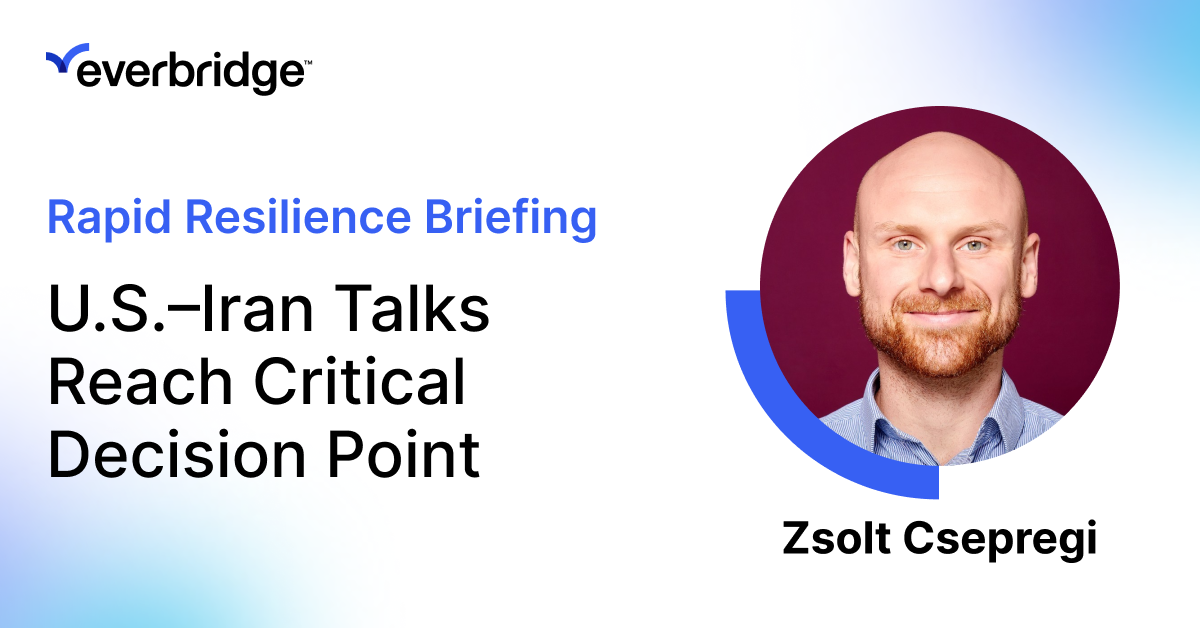
Hello, my name is Joel Chepregi and I'm the regional analyst for the Middle east and North Africa at agribidge's Global Insights team. Today I will outline the current state of the U. S Iran negotiations and what they mean for business operations in the Gulf, wider Middle east and global supply chains.

[0:22]
The central development is that Iran is reviewing a U.S. peace proposal and Washington expects an Iranian answer within roughly 24 to 48 hours, making this a critical decision point for regional security and global business continuity. The first pathway is rejection and the relapse into open conflict if Iran rejects the proposal.

[0:41]
US President Donald Trump has threatened renewed and intensified strikes against Iran. This would create the highest impact business risk with renewed disruption in Gulf shipping, energy infrastructure, regional air corridors, port operations, insurance markets and sanctions compliance.

[0:59]
The second pathway is acceptance and a contested de escalation. If Iran accepts the proposal, the most immediate military risks would ease, but it would not restore normal operations. Maritime security would remain fragile. European navies are reportedly surging towards the Strait of Hormuz to join US Forces and guarantee passage in case of a deal.

[1:20]
But naval presence alone cannot eliminate asymmetric threats. Iran could still disrupt traffic through mines, drones, missiles, fast boat harassment or attacks on nearby port infrastructure. Transport disruption would also persist. Around 1,600 commercial vessels remain delayed or stranded along, the Strait of Hormuz, and clearing that backlog would take significant time.

[1:44]
Even under a deal, vessel movement would likely resume unevenly with priority given to energy cargo, essential goods and ships already positioned for escorted transit. Energy operations would remain exposed. Gulf energy infrastructure has been partially shut down, degraded or operating under emergency conditions, and nearby facilities could remain vulnerable to renewed attacks or precautionary shutdowns.

[2:10]
Sanctions risk would remain volatile. Sanctions against Iran could be suspended, reimposed or reinterpreted on short notice, creating compliance uncertainty for firms with direct or indirect regional exposure. For businesses, the key takeaway is that this is not a binary choice between crisis and stability as, the two realistic scenarios are a relapse into conflict or a tense negotiation period marked by partial recovery and recurring disruption spikes.

[2:40]
That means companies should prepare for both pathways. Now for the conflict pathways, firms should be ready for rapid, decisions on rerouting inventory buffers, personal security and, movement, supplier continuity and sanctions exposure.

[2:56]
For the negotiation pathway, firms should plan for uneven vessel clearance, intermittent security alerts, sudden airspace or port restrictions, sanctions uncertainty, and elevated volatility in freight, fuel and insurance costs. The bottom line is a rejection would sharply raise the risk of redoed strikes and broader disruption a deal would reduce immediate escalation risk, but it would not restore operational stability.

[3:23]
In both cases, businesses should treat the Middle east operating environment as strategically important but highly volatile and still in rapid transition.
U.S. – Iran Talks Reach Critical Decision Point
U.S. – Iran negotiations have reached a critical stage, with continued risks to Gulf shipping, energy infrastructure, air travel, and global supply chains.

Related Resources
How Burns & McDonnell protects travelers during global crises
Discover how Burns & McDonnell uses Everbridge Travel Risk Management to protect employees during global travel. Learn how real-time threat intelligence, location awareness, and emergency communications strengthen duty of care and help keep traveling employees safe during critical events.

Close the major incident response gap with xMatters and ServiceNow
See how xMatters and ServiceNow help teams automate response, engage resolvers faster, and accelerate major incident resolution.
Security expert Chris Grollnek on why trusted emergency intelligence matters
Security consultant and critical incident expert Chris Grollnek shares why accurate, centralized emergency intelligence is essential during high risk events. Drawing on decades of experience assessing critical incidents, he explains how Everbridge helps organizations make faster, more informed decisions with trusted threat intelligence and unified communications.