[00:04.9]
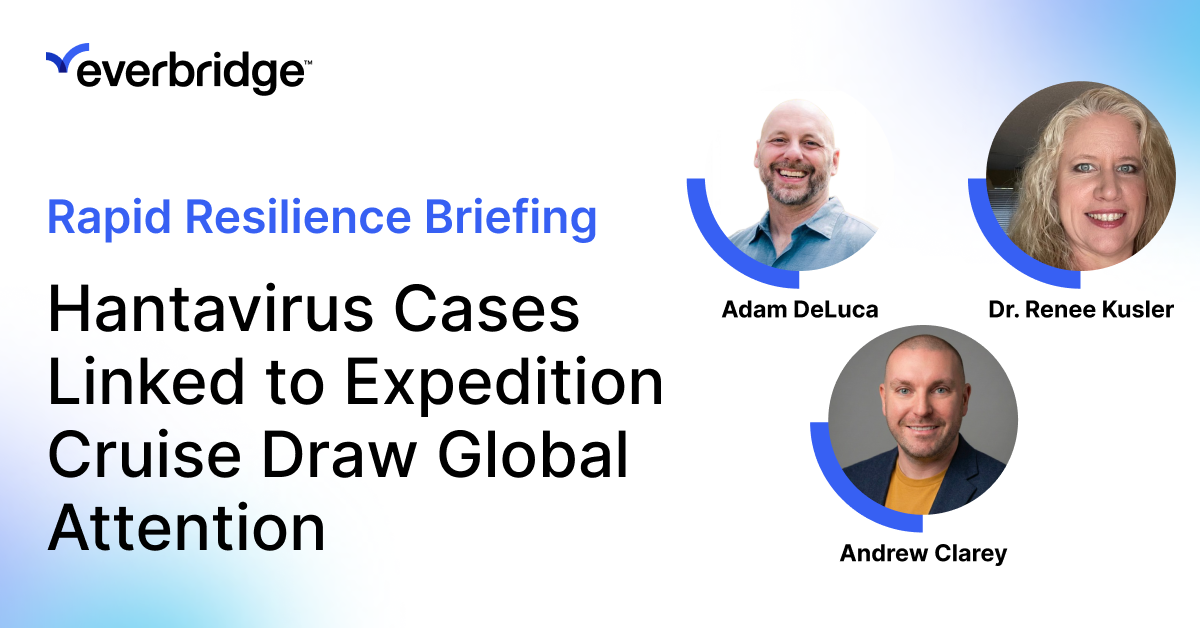
everybody. My name is Adam DeLuca. I'm the director of Risk Intelligence here at Everbridge. I wanted to welcome Dr. Renee Kuestler and Dr. Andrew Clary. Renee is a public health physician, and Andrew is the Deputy Chief Medical Officer here at Everbridge. He also has a background in maritime medicine.

[00:22.3]
And we're just going to talk about the hantavirus here for a little bit today. Obviously, very topical on everybody's mind. So we wanted to get two experts on to kind of explain the situation and how we can make businesses more resilient. Andrew, Renee. Good to see you guys today. Nice to be here. Thanks. Yeah.

[00:38.1]
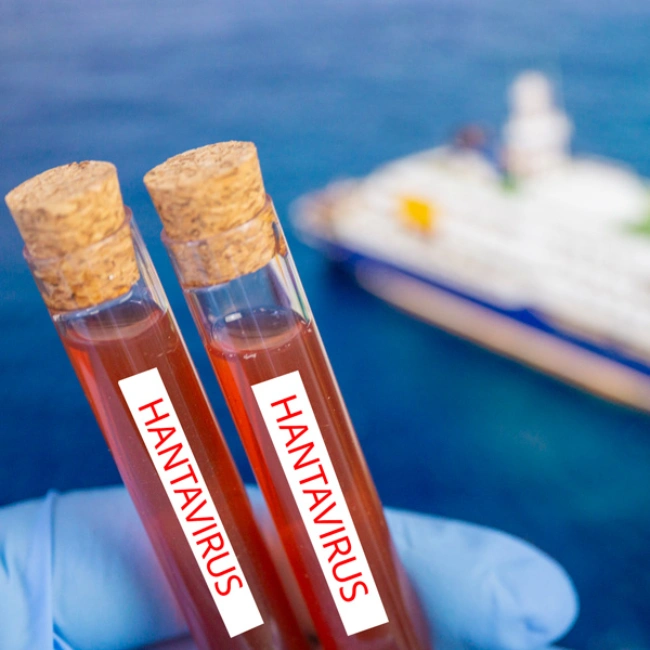
So, Renee, I'll start with you. You know, this all started with an, expedition cruise ship that left Argentina. Can you maybe give us some details about how this all came to pass and why it's on everybody's mind? Yes. Well, the MV Hondias, is an expedition cruise ship that left Argentina on April 1.

[00:56.4]
There were about 147 people on board from a variety of countries around the world. To. To date, so far, there have been eight reported cases of hantavirus linked to the ship, including six confirmed Andes strain hantavirus infections and three deaths.

[01:12.0]
Those three deaths are the main reason that we're really seeing this in the media right now. We're also starting to see additional confirmed cases after passengers have returned home, including one case in the United States, one case in France that was just reported, last night, and today, this is expected, given the incubation period of hantavirus, which can be up to six to eight weeks.

[01:33.3]
The ship arrived in the Canary Islands over the weekend. Passengers were disembarked and repatriated to their home countries on private, controlled flights, not commercial travel. And each country is now monitoring and managing passengers according to their own public health protocols.

[01:49.0]
This remains a coordinated international response focused on identifying cases early and also preventing any further spread. You know, obviously, I'd be remiss, that there was a worldwide pandemic just a few years ago. Obviously, Covid is still on everybody's mind, especially when a new virus kind of enters the news and enters our vernacular, and we might not know much about it.

[02:12.0]
Can you just tell us a little bit about Hantavirus and maybe how it's similar or dissimilar to Covid? Yeah, certainly. Well, hantavirus has actually been around for a long time. It's a group of viruses that are primarily carried by rodents, such as mice and rats.

[02:28.0]
People typically become infected through contact with either dust or materials that are contaminated with rodent urine or rodent droppings. You may be hearing a lot of comparisons to COVID 19, but these are very, very different viruses. COVID 19 spreads very easily from person to person through the air.

[02:46.8]
But hantavirus does not behave that way in this current situation. There has been no evidence of spread beyond the individuals linked to the cruise ship. So it's important to remember that hantaviruses, they're not new, they've been known about for decades and there have been studies about them and we do have cases sporadically throughout the world each year.

[03:06.9]
Now the risk of human to human transmission, has been a big topic of conversation, especially with the fear about the new COVID pandemic. For most hantaviruses there's no person to person spread. There's only one strain which happens to be the strain involved in this situation.

[03:24.7]
It's called the Andes strain that comes from South America. And it's the only one known to occasionally spread between, close, between people. Even then the transmission is very rare and it requires very close and prolonged contact such as within households or within caregiving settings or within a cruise ship.

[03:45.0]
It does not spread through casual contact travel, everyday interactions. So importantly, in this event, there's been no evidence so far of transmission outside of that group related to the ship. So contacts identified during repatriation, some people that were on the same flights as ill patients, even some that have developed symptoms have all tested negative so far, which is very reassuring.

[04:10.3]
That's good to know, especially somebody like myself who avoids contact with rats and rodents at all costs. The human to human, transmission is still kind of unlikely if you're without close contact. You know this, we're coming up around the time of year, you know, summertime, lots of travel.

[04:28.3]
We have these made major events, the World Cup, a lot of countries from South America participating and coming to the United States, Mexico and Canada. You know, for those that are due to travel, are there any precautions that individuals or organizations should take with this virus kind of coming back to the news?

[04:47.7]
Yeah, at this time there are no changes to travel plans recommended. The World Health Organization is continuing to assess the overall risk from this event is very low and there are no travel restrictions in place. This situation is linked to a very specific exposure and a very specific setting on one cruise ship.

[05:06.9]
It's not related to routine travel at this time. So for most travelers there's no increased risk. More generally, Hantavirus is best prevented by avoiding contact with rodents or contaminated environments. So particularly in rural or undeveloped areas, good travel practices, including hand hygiene and pre travel health advice for higher risk destinations remain very important.

[05:33.0]
Okay, so Andrew, I'd like to get your take on this. With infectious disease episodes like this occurring and obviously with COVID being very much on organizations and individuals minds, how can businesses develop resilience?

[05:48.8]
Not just a hantavirus or Covid, but when diseases, infectious diseases like this come up, how can they protect themselves and their peers, people? Yeah, it's a really important question and we saw with the COVID pandemic quite the scale of the impact that it had on organizations, irrespective of their location and the nature of their business.

[06:08.2]
In an interconnected world, we all become in fact impacted upon by these sort of episodes hopefully. And we've all heard very reassuring features from Dr. Kuesler about the limited impact of this so far. But it's understandable that businesses would want to get ahead of the curve I suppose in terms of their own business and their own operation.

[06:29.5]
Obviously if they've got any team members that are perhaps within the group that was on the expedition or associated with it, they're going to be immediately thinking about, well, how do they limit any potential further exposure within their organisation or operation? We all learned during the pandemic about the potential benefits of remote work and certainly there might be a need for organizations if they do have anyone that identified via the contact tracing that the public health bodies are performing that could be at risk, then capitalising on that remote work opportunity that thankfully technology now allows us to do with far greater ease and convenience could be a really important part of that.

[07:05.2]
As we've heard from Dr. Kussler, the incubation period, the time between contracting the infection and suffering from it can be quite lengthy with hantavirus, so it would need operations and businesses to be far more flexible than perhaps we've seen with some of the return to office programs that have come in post pandemic.

[07:23.1]
But that would certainly help protect further spread within an organisation and deal with sometimes what we see with the kind of cultural approach to presenteeism where infections can spread amongst a group of workers, which maybe if it's something just like the common cold virus, wouldn't be too worrying to a business.

[07:39.6]
But with evolving trends showing ongoing increases in viral infectious diseases of different natures and more severity and complexity, it can be important to just question is being in the workplace with feverish illness really the right thing for a business to be condoning or supporting.

[07:57.2]
So yeah, capitalizing on those opportunities, it's always worthwhile a business considering, the different global patterns that we see. So at the moment there's nothing that's suggesting that there will be a need to adjust or alter the operations within shipping routes, for example from Argentina or South America.

[08:17.1]
But obviously it is an evolving situation. And as we see public health reports, developing as testing, contact tracing evolves with this story, there is the possibility that the shipping routes, shipping lines may come under greater scrutiny or new processes or procedures.

[08:33.6]
And again, just being ahead of the curve and even just having the data knowing exactly what level of your shipping, your supply routes, your supply chains are involved in that region or that route could be a really important process so that if changes come about, you can be in that resilient position to make the change ahead of time rather than behind time.

[08:53.6]
And then otherwise just continue to encourage your team to operate good personal hygiene and safety practices that keep people safe. Of course vaccine mandates are very outdated and it's not something that's sort of encouraged or adopted frequently now, but making sure that your teams have ready and easy access to occupational health, that they've got pre travel screening opportunities like we offer here at Everbridge to make sure that team members that are on business travel have got all the information they need to protect themselves when they're traveling to different parts of the world, including considering any vaccines they may want to take.

[09:27.1]
Although it's important to just note that there isn't a hantavirus vaccine that's widely available at the moment. But in terms of protecting yourself from other infectious illnesses, vaccines can be an increasingly important part of that kind of protection bubble. So each of those personal and business related elements can help just broaden out that resilience that a business has.

[09:46.7]
When we see episodes like this, develop which with the data, data trends out there around increasing travel, increasing travel to different parts of the world and the increase in crossover of zoonotic, so viral infections from animals across into human species.

[10:02.4]
It's important that we have that increased awareness and preparation so that we can react promptly to these issues when they come around. I think you mentioned something that's really important. It's flexibility, being able to adapt to these situations. You know, when risks and vulnerabilities expose themselves to organizations and individuals, the ability to pivot and adapt, adapt is extremely important to build resiliency and I think it's important.

[10:26.7]
I'm glad you highlighted that. You know, Dr. Cleary, Dr. Kuzler, thank you so much for your time today. It's great to know that our assist teams, our medical, teams here at Everbridge are on the situation. They're going to be communicating with customers and producing, medical Risk intelligence on the topic, to make sure that we're, and you all are staying ahead of the situation and again, allowing yourself to build that resiliency in the face of this kind of ongoing situation.

[10:54.8]
Thank you guys, so much again. I hope you have a wonderful day, and thank you, everybody, for joining us. Thank you. Bye. Bye. Bye.
Hantavirus Cases Linked to Expedition Cruise Draw Global Attention
Cruise-linked hantavirus cases are drawing global attention, highlighting the importance of infectious disease preparedness, operational flexibility, and travel resilience.
Related Resources

Wildfire smoke creates health and operational risks in the Northeast
Wildfire smoke is reducing air quality across the Northeast and Mid-Atlantic, creating health risks and operational challenges for businesses and communities.
How Burns & McDonnell protects travelers during global crises
Discover how Burns & McDonnell uses Everbridge Travel Risk Management to protect employees during global travel. Learn how real-time threat intelligence, location awareness, and emergency communications strengthen duty of care and help keep traveling employees safe during critical events.

Close the major incident response gap with xMatters and ServiceNow
See how xMatters and ServiceNow help teams automate response, engage resolvers faster, and accelerate major incident resolution.