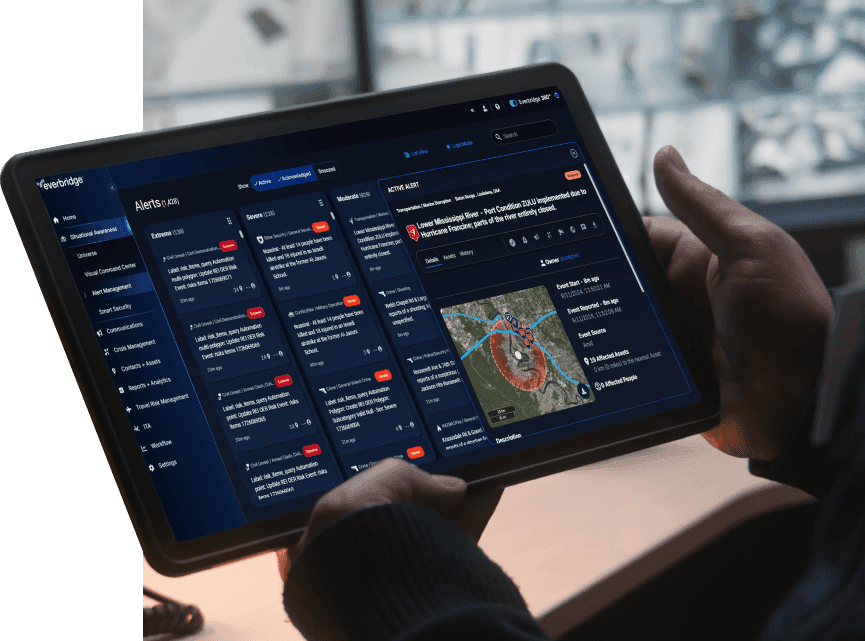

Choosing Critical Event Management software is a strategic resilience decision that affects how quickly your organization can identify threats, communicate with stakeholders, coordinate response, reduce downtime, and learn from every disruption.
The risk environment is only getting more complex. Organizations face severe weather, digital failures, travel risks, executive targeting, civil unrest, utility outages, cyberattacks, and geopolitical events.
Our guide, Top 10 Questions to ask when choosing Critical Event Management software, notes that McKinsey has estimated global organizations could face $1.3 trillion in losses by 2030 from these types of critical events.
That is why a Critical Event Management software RFP should go beyond a basic feature checklist. Buyers need to understand whether a platform can support the full lifecycle of critical event management: planning, monitoring, alerting, responding, analyzing, and continuously improving.
This guide outlines the most important CEM platform RFP considerations, how to think about vendor scorecard criteria, and how to assess your organization’s current maturity level before selecting a solution.
What should be included in a Critical Event Management software RFP?
A strong Critical Event Management software RFP should evaluate the vendor’s ability to support real-time risk detection, reliable communications, automated response workflows, mobile use, two-way communication, contact data accuracy, platform security and compliance, scalability, implementation, support, and long-term innovation.
It should also help stakeholders compare vendors based on operational outcomes, not just product features. The real question is not simply, “Can this tool send alerts?” The better question is, “Can this platform help us anticipate developing risks, and coordinate an effective response across our organization?”
Why CEM RFPs need to go beyond emergency notification
Many organizations begin the buying process by looking for mass notification or emergency communication capabilities. Those capabilities matter, but they are only one element withinn a mature Critical Event Management program.
During a real crisis, teams need to know what is happening, who and what is affected, which actions should happen next, whether messages were received, how the response is progressing, and what should improve afterward. If the process depends on disconnected tools, manual handoffs, or outdated contact data, response slows down when speed matters most.

How do you evaluate a CEM platform?
Evaluate a CEM platform by asking how well it performs across reliability, usability, communication, automation, intelligence, scalability, data security, implementation, and long-term vendor partnership.
Below are the top areas to include in a Critical Event Management software RFP or vendor evaluation process.
1. Full lifecycle automation and reliability
Critical events rarely follow a neat script, and seldom occur in isolation, meaning teams need dynamically adaptive platforms for complex situations. A strong CEM platform should help teams monitor risks, identify affected people and assets, launch communications, coordinate response workflows, and review performance after the event.
Reliability is equally important. During a crisis, the system must perform under pressure, including during spikes in traffic or major disruptions. Ask vendors for uptime data, redundancy details, failover mechanisms, and examples of platform performance during real-world incidents.
RFP questions to ask:
- Can the platform support the full Critical Event Management lifecycle (Plan – Monitor – Alert – Respond – Improve) in one system?
- What uptime statistics can you provide?
- What redundancy and failover measures are in place?
- How has the platform performed during real-world emergencies or high-volume communication events?
- Can you provide case studies showing system reliability during a crisis?
2. Ease of use during high-stress situations
A platform that works well during training exercises may still fail users during a real emergency if it is too complicated. Crisis response teams need intuitive workflows, fast alerting, and clear next steps.
RFP questions to ask:
- How many steps does it take to send an alert?
- Can users launch predefined messages or response workflows quickly?
- Can non-technical users operate the system during high-pressure situations?
- What tasks can be completed with one-click or guided workflows?
- How much training is required for occasional users?
- Can administrators structure user roles to drive efficient behavior and limit mistakes?
3. Mobile capabilities and two-way communication
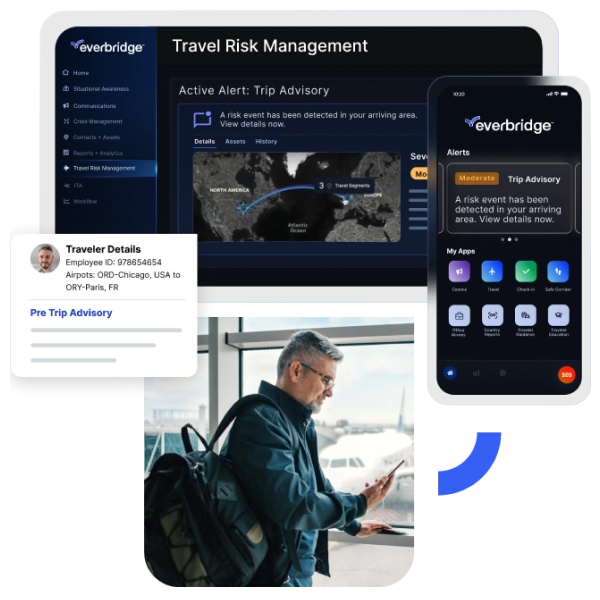
Critical events do not wait for administrators to be at a desk. Your CEM platform should allow authorized users to manage alerts, track incidents, access resources, and communicate from mobile devices.
Two-way communication is also essential. It gives teams real-time feedback from employees, responders, residents, travelers, or other affected groups. This can include safety confirmations, location sharing, images, survey responses, polling, or chat.
RFP questions to ask:
- Can administrators manage alerts and communications from a mobile device?
- Does the platform support SMS, push notifications, voice, and email?
- Can recipients confirm safety or provide status updates?
- Can recipients share location data or images?
- Can teams use polling, surveys, or chat to gather real-time information?
- Does the mobile application provide streamlined connectivity to emergency services?
4. Training, implementation, and support
Even intuitive software requires strong onboarding and support to ensure a successful deployment and foundation for future scalability. Your RFP should clarify how quickly the platform can be deployed, what training is included, and what support model the vendor provides after launch.
RFP questions to ask:
- What is the typical implementation timeline?
- Will we have a dedicated implementation specialist?
- What training is included?
- Is 24/7 support available?
- Are online modules, live training, or on-site training available?
- How do you support new users after deployment?
- Is support included in the subscription or priced separately?
5. Contact data management and security
A CEM platform is only as effective as the data behind it. If contact information is incomplete, outdated, or difficult to manage, messages may not reach the right people at the right time.
Security also belongs in the RFP from the start. Critical Event Management platforms often handle sensitive employee, location, asset, and operational data. Buyers should ask about encryption, audits, data protection practices, and third-party certifications.
RFP questions to ask:
- Does the platform support automated contact data updates?
- Can it integrate with HR, identity, travel, facilities, or other enterprise systems?
- How are manual contact updates managed?
- What encryption standards are used?
- Can you provide audit results or third-party certifications?
- How do you protect sensitive employee, location, and response data?
6. AI-enabled automation and decision-making
AI should not be treated as a vague feature label. In a CEM RFP, ask how AI supports specific operational outcomes: faster alerting, better signal detection, reduced manual work, improved prioritization, and more informed decisions.
RFP questions to ask:
- How does the platform use AI to automate critical event response?
- Can AI help prioritize verified information from multiple sources?
- Does the platform provide real-time insights or predictive analytics?
- How does AI reduce response times?
- What human oversight exists for AI-supported recommendations?
- How are AI-generated insights validated?
7. Scalability across routine incidents and major emergencies
A CEM platform should handle both everyday operational incidents and enterprise-wide crises. Routine alerts may require standardized automation, while major emergencies may require dynamic workflows, cross-functional coordination, and executive visibility.
RFP questions to ask:
- Can the platform handle both routine incidents and large-scale crises?
- How does the system scale during high-volume events?
- Can workflows adapt based on incident severity, location, or impact?
- What analytics are available to evaluate response effectiveness?
- How does the platform differentiate routine communication from critical event response?
- What AI or workflow automation capabilities support response at scale?
8. Risk intelligence sourcing and validation
Accurate risk intelligence is foundational to Critical Event Management. The platform should ingest and analyze data from trusted sources such as weather services, government alerts, social media, travel feeds, third-party intelligence providers, and other relevant sources.
However, more data is not always better. The real value comes from surfacing timely, relevant, validated intelligence that teams can act on.
RFP questions to ask:
- What risk intelligence sources are included?
- How does the platform curate risk intelligence via an analyst network?
- What types of long form risk intelligence are included?
- How does the platform validate intelligence for accuracy?
- Can we customize or prioritize sources based on our organization’s risk profile?
- Does the platform provide automated alerts for relevant threats?
- How does the system reduce false positives or outdated information?
- Can risk intelligence be connected to people, locations, assets, or operations?
9. Vendor track record and industry fit
A vendor’s past performance is a useful indicator of how well it can support your organization. Ask for references and case studies from organizations with similar size, complexity, geography, industry, or regulatory requirements.
RFP questions to ask:
- Can you provide references from organizations like ours?
- Can you share case studies from our industry?
- How have you supported organizations with complex or niche requirements?
- What types of critical events has your platform supported?
- How do customers measure success after implementation?
10. Innovation roadmap and long-term partnership
Critical Event Management needs will continue to evolve. The vendor you select should have a clear roadmap for AI, automation, risk intelligence, analytics, integrations, usability, and continuous improvement.
RFP questions to ask:
- What is your product roadmap for the next 12–24 months?
- How are you investing in AI, machine learning, automation, and analytics?
- How does customer feedback influence product development?
- How often are new features released?
- How do you help customers mature their CEM programs over time?
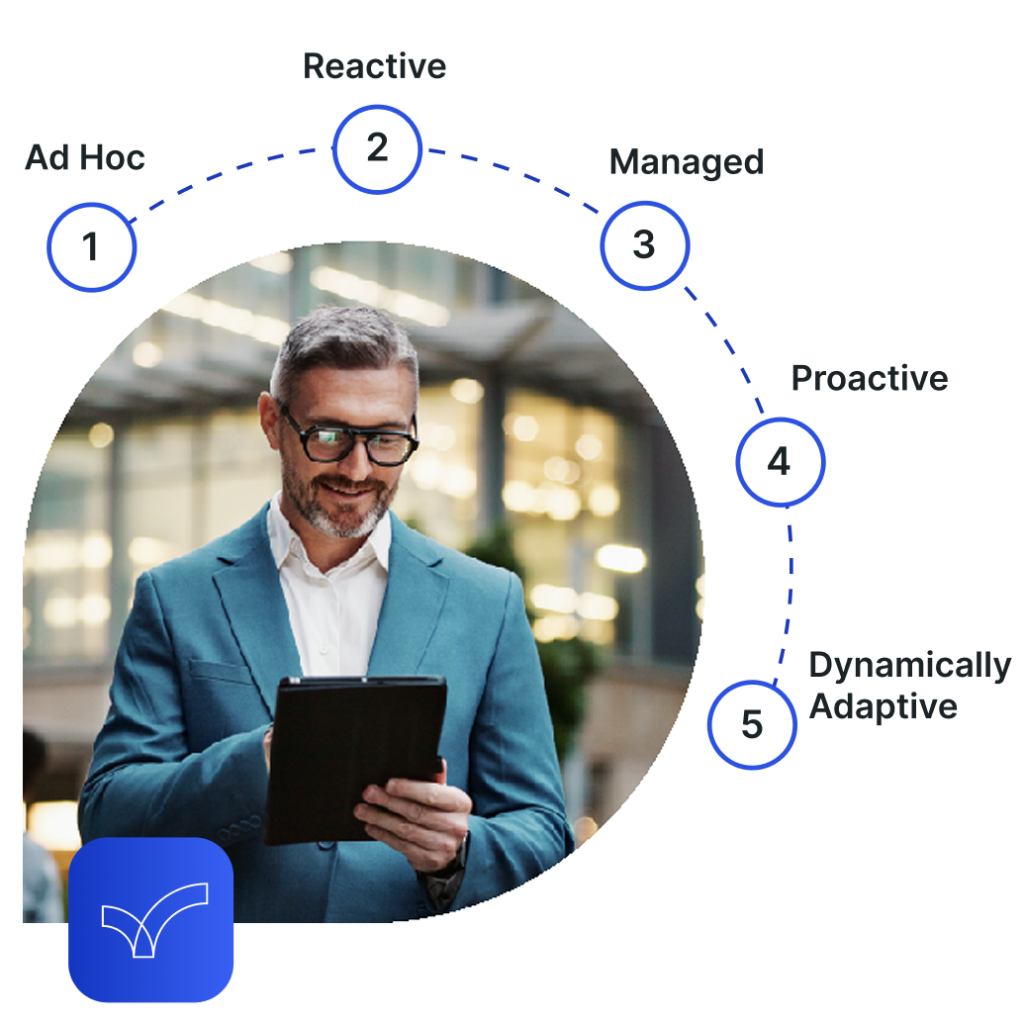
How mature is your Critical Event Management program?
Use this maturity assessment to understand where your organization is today and what capabilities to prioritize in a CEM software RFP.
| Maturity level | Program state | What it usually looks like | What to prioritize in a CEM RFP |
|---|---|---|---|
| Level 1 — Reactive | Critical event response is manual, fragmented, or event-driven | Teams rely on email, phone trees, spreadsheets, or disconnected notification tools; response steps vary by team; post-incident learning is limited | Reliable mass notification, centralized contact data, simple alert templates, mobile alerting, basic reporting |
| Level 2 — Coordinated | Core teams have defined processes, but tools and data remain partially siloed | Security, BC, IT, HR, facilities, and operations teams coordinate during incidents, but workflows often require manual handoffs | Two-way communication, role-based workflows, contact data integrations, mobile administration, incident tracking, escalation paths |
| Level 3 — Orchestrated | Risk intelligence, communications, response workflows, and reporting are connected | Teams can monitor threats, identify impacted people/assets, trigger response workflows, and track outcomes across functions | Full lifecycle automation, decision-ready risk intelligence, AI-assisted prioritization, executive dashboards, cross-functional response orchestration |
| Level 4 — Dynamically adaptive | CEM intelligence supports real-time response and continuous improvement | The organization can detect threats earlier, automate response tasks, adapt workflows dynamically, analyze performance, and improve resilience over time | Purpose-built AI, validated multi-source risk intelligence, automated response orchestration, predictive analytics, continuous improvement reporting, scalable global operations |
How resilient is your organization?
Evaluate your organization’s resilience and business continuity readiness. Take our free online maturity assessment to benchmark your risk preparedness against industry leaders. Receive a personalized report that includes:
Your organization’s resilience maturity score, benchmarked against data from more than 600 public and private sector organizations.
Tailored recommendations to improve your readiness and build a faster, more adaptive response capability.
What should a CEM vendor scorecard measure?
A CEM vendor scorecard should measure how well each vendor supports the operational outcomes your organization needs most. It should not simply count features.
Recommended scoring categories include:
| Scorecard category | What to evaluate |
|---|---|
| Reliability and uptime | Uptime history, redundancy, failover, crisis performance, delivery reliability |
| Full lifecycle automation | Planning, monitoring, alerting, response, reporting, and continuous improvement |
| Ease of use | Alert speed, interface clarity, non-technical user experience, guided workflows |
| Mobile and two-way communication | Mobile administration, recipient responses, location sharing, surveys, polling, chat |
| Contact data management | Automated updates, integrations, segmentation, data quality controls |
| Security and compliance | Encryption, audits, certifications, access controls, data protection |
| AI and automation | AI-supported prioritization, response automation, predictive insights, human oversight |
| Risk intelligence | Source coverage, validation, customization, relevance, alerting |
| Scalability | Routine incidents, major emergencies, global reach, peak-volume performance |
| Implementation and support | Onboarding, training, support availability, customer success model |
| Vendor track record | Industry references, case studies, proven crisis performance |
| Innovation roadmap | Product investment, AI roadmap, analytics, customer feedback process |
Organizations should weight these categories based on their risk profile. For example, a global enterprise with mobile employees may give more weight to risk intelligence, mobile communication, and scalability. A highly regulated organization may give more weight to auditability, security, reporting, and vendor track record.
Why does CEM software need more than mass notification?
Mass notification helps organizations send messages quickly. Critical Event Management software should go further by helping teams detect threats, understand impact, automate response, coordinate stakeholders, track outcomes, and improve over time.
That difference matters. When a severe weather event, cyberattack, civil unrest incident, facility disruption, or supply chain issue occurs, organizations need more than a message blast. They need a connected response process that helps them decide who is affected, what actions to take, how to communicate, and how to measure whether the response is working.
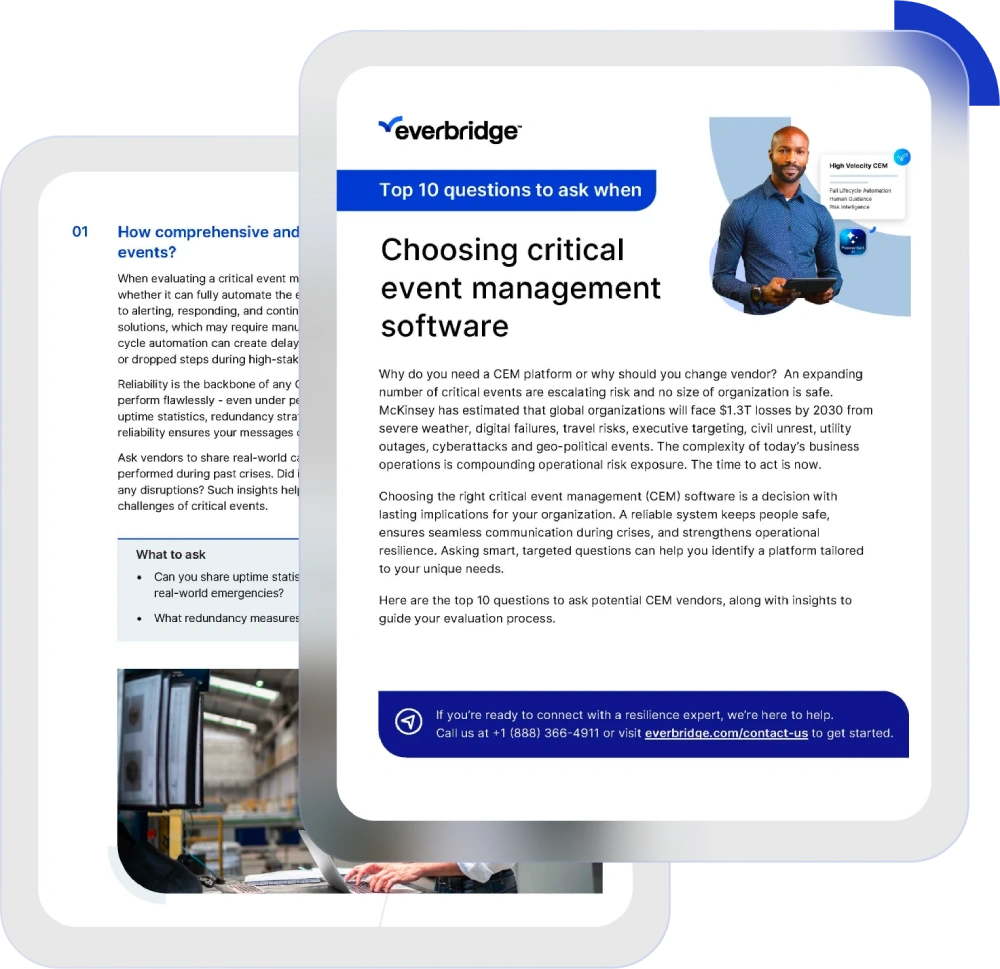
Top 10 Questions to Ask When Choosing Critical Event Management Software
Use this guide to pressure-test vendors, align internal stakeholders, and prepare stronger RFP conversations before selecting a Critical Event Management platform.
Critical Event Management software comparison checklist
Our buyer’s checklist makes it easy to evaluate and compare solutions, helping to ensure your chosen solution delivers the speed, intelligence, and automation required to keep your people safe and your organization running.
FAQs
A Critical Event Management software RFP is a structured vendor evaluation document used to compare CEM platforms. It typically includes questions about reliability, alerting, risk intelligence, automation, mobile capabilities, two-way communication, integrations, security, scalability, implementation, support, and vendor experience.
Ask vendors how their platform performs during real-world emergencies, how quickly users can send alerts, how the system supports two-way communication, how it validates risk intelligence, how AI is used, how contact data is managed, and how the vendor supports implementation and long-term success.
Mass notification focuses on sending messages to people during an incident. Critical Event Management software is broader. It supports threat monitoring, impact assessment, automated workflows, two-way communication, incident response, analytics, and continuous improvement.
A CEM vendor scorecard should include categories such as reliability, lifecycle automation, usability, mobile communication, contact data management, security, AI, risk intelligence, scalability, implementation, support, vendor track record, and product roadmap.
Evaluate AI by focusing on practical outcomes. Ask whether it helps prioritize verified risk intelligence, automate response tasks, reduce response times, provide predictive insights, and support decision-making without removing necessary human oversight.
Organizations at any maturity level can benefit from CEM software, but priorities differ. Reactive teams may need reliable alerting and centralized contact data first. More mature teams may prioritize AI, automated response orchestration, validated risk intelligence, executive dashboards, and continuous improvement analytics.