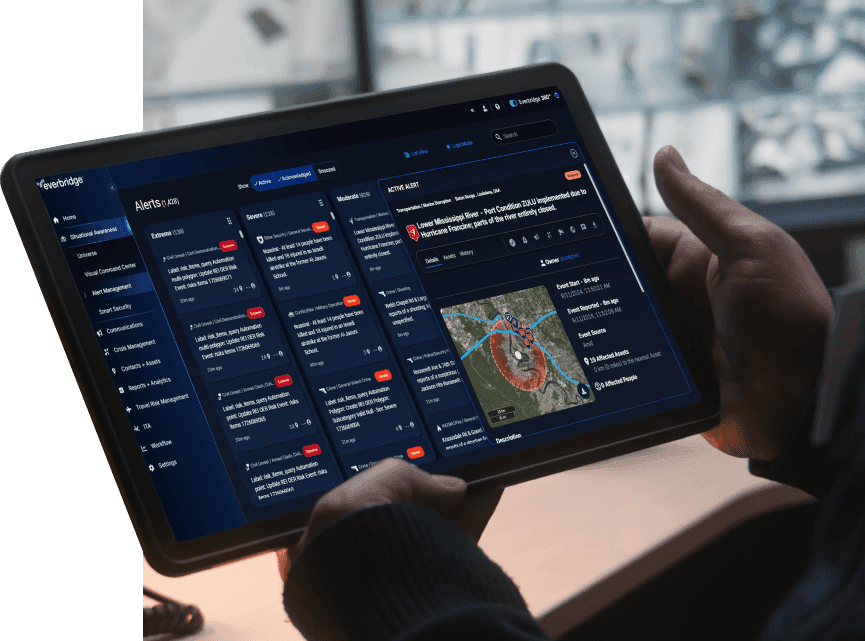

Choosing travel risk management software is no longer just a travel operations decision. It is a duty of care, employee safety, business continuity, and enterprise resilience decision.
As organizations send employees, contractors, executives, and field teams across regions, the risk environment keeps getting more complex. Severe weather, geopolitical instability, civil unrest, health events, transportation disruptions, and cyber-physical incidents can affect travelers with little warning. When something happens, organizations need to know who may be impacted, where they are, how to reach them, and what support they need.
That’s why a travel risk management software RFP should go beyond a basic feature checklist. The right platform should help your organization identify risks earlier, communicate faster, support impacted travelers, and improve continuously after each event.
Our “Top 10 Questions to Ask When Choosing a Travel Risk Management Solution” guide emphasizes that effective TRM is critical to employee safety, disruption reduction, and business continuity. It also notes that only 24% of surveyed organizations have a strong Travel Risk Management program in place as defined by ISO 31030, and only 21% feel they have adequate measures in place to meet the standard’s key travel safety requirements.
This blog is not a full travel risk management RFP template. Instead, it outlines the most important areas to evaluate when building a TRM vendor scorecard, preparing RFP questions, or comparing corporate travel risk management platforms.
Top 10 Questions to Ask When Choosing a Travel Risk Management Solution
Use this guide to pressure-test TRM vendors, align internal stakeholders, and prepare stronger RFP conversations around traveler safety, duty of care, risk intelligence, communications, integrations, data security, and support.
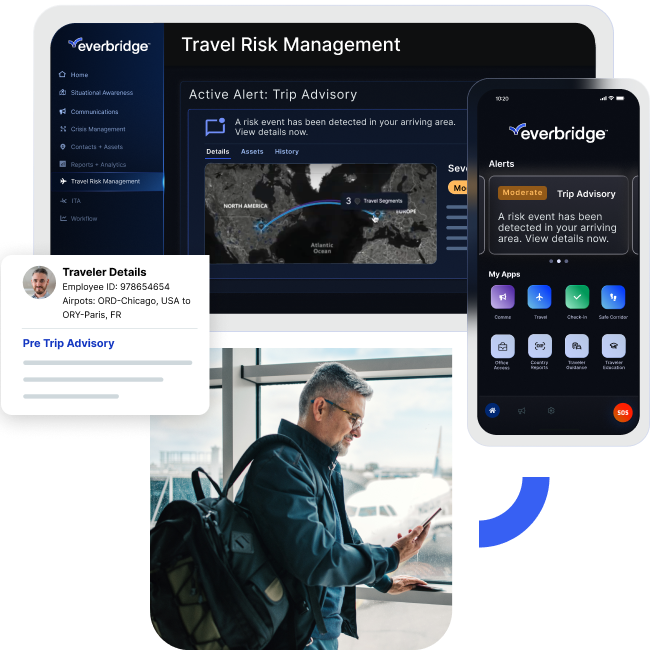
What should be included in a travel risk management software RFP?
A strong travel risk management software RFP should evaluate how well each vendor supports:
- Real-time global traveler tracking
- Reliable performance during high-pressure events
- Multi-channel emergency communications
- Two-way traveler check-ins
- Duty of care coverage across personnel types
- AI-powered risk intelligence
- Data privacy, security, and compliance
- Integrations with travel, HR, and enterprise systems
- Implementation, training, and support
- Product roadmap and future innovation
The goal is not just to find a platform with the most features. The goal is to select a travel risk management solution that fits your organization’s operating model, risk exposure, traveler population, and maturity level.
Why TRM RFPs need to go beyond feature checklists
Many RFPs over-focus on whether a platform has a specific feature: traveler tracking, SMS alerts, dashboards, or booking data integrations. Those features matter, but they do not tell the full story.
A better TRM RFP asks how those capabilities work together during a real disruption.
For example:
- Can the platform identify travelers already in an affected area?
- Can it identify travelers scheduled to arrive soon?
- Can it send location-specific guidance?
- Can employees confirm they are safe?
- Can the organization escalate support if someone does not respond?
- Can travel, security, HR, and business continuity teams work from a shared view of risk?
- Can AI-powered intelligence help teams anticipate risk before it becomes an emergency?
The right RFP should help stakeholders compare vendors based on operational readiness, not just software functionality.
Top travel risk management software RFP considerations
1. Real-time global tracking
A travel risk management platform should give your organization timely visibility into where travelers are and who may be exposed to a critical event. Without accurate traveler location data, even the best response plan can stall.
RFP questions to ask:
- Can the system identify employees impacted by an emergency, whether they are currently traveling or scheduled to depart soon?
- How accurate and timely is the platform’s traveler location data?
- Can the platform monitor global hotspots and provide predictive insights?
- Does the system support visibility into international and domestic travel?
- Can teams filter travelers by region, itinerary, risk exposure, business unit, or traveler type?
2. Reliability during high-pressure scenarios
Travel risk platforms are most important when conditions are unstable. That means reliability, redundancy, and uptime should be central to the vendor evaluation.
A platform that works during normal business hours but struggles during major disruptions is not enough. Your RFP should assess how the vendor performs during high-volume, high-stress events such as natural disasters, political unrest, airport closures, health emergencies, or regional conflict.
RFP questions to ask:
- How does the platform perform during widespread travel disruptions or major critical events?
- What redundancy measures are in place to ensure consistent service?
- Can the vendor provide examples of how the system handled past emergencies?
- What resilience, redundancy, and information security certifications does the vendor hold?
- What service-level commitments are provided for availability and support?
3. Multi-channel communication
During a travel disruption, communication has to be fast, targeted, and reliable. A strong TRM platform should support multiple channels so organizations can reach travelers through the method most likely to work in the moment.
RFP questions to ask:
- Does the platform support SMS, email, push notifications, and voice calls?
- Does it support two-way communication so travelers can confirm safety or request help?
- Can alerts be targeted based on location, itinerary, risk profile, or traveler group?
- How reliable is the SMS delivery network globally?
- Does the platform provide delivery reports and response tracking?
4. Flexibility and policy alignment
No two organizations manage travel risk the same way. A global enterprise with high-risk travel routes, executives, field teams, expatriates, and contractors will need a different configuration than an organization with lower travel volume or narrower geographic exposure.
A strong platform should adapt to your travel policies, escalation workflows, risk thresholds, and internal roles.
RFP questions to ask:
- Can the platform be configured to enforce specific corporate travel policies?
- Does it support role-based access for travel, security, HR, legal, and regional teams?
- Can workflows be adapted by geography, traveler type, risk level, or business unit?
- Can the platform scale as travel volume, regions, or risk complexity change?
- Can administrators make changes without extensive vendor or third-party support?
5. Duty of care coverage
Travel risk management is not just about frequent international travelers. Organizations also have a duty of care responsibility for domestic travelers, remote workers, expatriates, contractors, executives, guests, and employees in high-risk regions.
RFP questions to ask:
- Can the platform track and manage risk for personnel beyond international travelers?
- Does it support domestic travelers, remote workers, expatriates, contractors, guests, and customers?
- Can the system help manage risk for employees in high-risk locations even when they are not actively traveling?
- Can traveler groups be segmented by risk profile, region, employment status, or business function?
- How does the platform support duty of care documentation and reporting?
6. AI-powered risk intelligence
Modern travel risk management should help organizations move from reactive response to proactive risk mitigation. AI-powered risk intelligence can help teams process large volumes of data, detect emerging threats, filter noise, and trigger faster response workflows.
RFP questions to ask:
- What data sources feed the platform’s AI or risk intelligence engine?
- Does the platform analyze government alerts, global news, weather systems, social media, transportation data, or other real-time sources?
- How does the system prioritize and filter intelligence to reduce false positives?
- Can it generate anticipatory alerts with enough lead time to reroute, evacuate, or advise travelers?
- Can automation trigger notifications, escalations, or response workflows when a risk is detected?
- Does the platform assess travel-specific risk, not just general security risk?
7. Data security and compliance
Travel risk management software handles sensitive data, including employee location, itinerary, contact, and sometimes personal profile information. Security and privacy requirements should be a central part of the RFP process.
RFP questions to ask:
- Is the platform compliant with GDPR and other relevant regional data protection laws?
- How is sensitive data encrypted in transit and at rest?
- What access controls protect traveler and employee information?
- What measures are in place to prevent data breaches?
- What security certifications does the vendor hold?
- How does the platform support auditability and compliance reporting?
8. Integrations with travel, HR, and enterprise systems
TRM software becomes more valuable when it connects with the systems your organization already uses. Integration reduces manual work, improves data accuracy, and helps teams make faster decisions.
RFP questions to ask:
- Can the platform connect directly with Global Distribution Systems and third-party travel platforms?
- Does it integrate with HR systems to keep employee data current?
- Can it ingest booking data from airlines, hotels, and car rental companies?
- Can it connect with travel policy, travel insurance, security, or critical event management systems?
- How are integration failures monitored and resolved?
- Are integrations included in the subscription or priced separately?
9. Implementation, training, and support
A travel risk management platform is only effective if teams can implement it, adopt it, and use it under pressure. RFPs should evaluate the vendor’s onboarding model, support availability, administrator training, and traveler education resources.
RFP questions to ask:
- What onboarding and training options are included?
- How long does implementation typically take?
- Is 24/7 customer support available for urgent issues?
- What training is available for administrators, security teams, travel managers, and travelers?
- Are self-service resources available?
- What services require additional fees?
10. Roadmap and future innovation
Travel risk changes constantly. A platform that meets today’s needs may not be enough two or three years from now. Evaluate how each vendor invests in innovation, AI, automation, analytics, and customer-driven product improvements.
RFP questions to ask:
- What is the vendor’s roadmap for future enhancements?
- How does the platform incorporate AI and machine learning to improve efficiency?
- Are product updates included in the subscription?
- How often are updates released?
- How does customer feedback influence product development?
- How does the vendor help customers adapt to emerging travel risk challenges?
How mature is your travel risk management program?
Use this maturity table to assess where your organization is today and what capabilities to prioritize in a TRM software RFP.
| Maturity level | Program state | What it usually looks like | What to prioritize in a TRM RFP |
|---|---|---|---|
| Level 1 — Reactive | Travel risk response is manual, fragmented, or event-driven | Traveler data may live across booking tools, spreadsheets, emails, and regional teams. Communications are inconsistent, and impacted travelers are difficult to identify quickly. | Real-time traveler tracking, centralized traveler data, basic alerting, emergency contact workflows, clear implementation support |
| Level 2 — Coordinated | Core travel, security, HR, and risk teams have defined processes, but visibility is limited | Teams coordinate during disruptions, but data, communications, and escalation workflows are not fully connected. | Multi-channel communication, two-way check-ins, role-based access, HR and travel system integrations, policy configuration |
| Level 3 — Orchestrated | Traveler visibility, risk intelligence, communications, and response workflows are connected | Teams can identify impacted travelers, send targeted alerts, confirm safety, and escalate response tasks across functions. | AI-powered risk intelligence, automated workflows, dashboards, reporting, compliance support, global SMS reliability |
| Level 4 — Dynamically adaptive | Travel risk intelligence supports proactive decision-making and continuous improvement | The organization can anticipate risks, adapt travel guidance, automate response actions, and improve based on incident trends and traveler outcomes. | Predictive analytics, anticipatory alerts, automated response orchestration, critical event management integration, continuous improvement analytics |
How to turn TRM evaluation criteria into a vendor scorecard
A travel risk vendor scorecard should help stakeholders compare vendors consistently. Instead of scoring every feature equally, group RFP responses into practical categories and weight them based on your organization’s risk profile.
Useful scorecard categories include:
| Scorecard category | What to evaluate |
|---|---|
| Traveler visibility and tracking | Accuracy, timeliness, itinerary coverage, current and upcoming travel visibility |
| Risk intelligence and AI | Data sources, false positive reduction, predictive insights, alert relevance |
| Communications | SMS, email, push, voice, two-way check-ins, global delivery reliability |
| Duty of care coverage | Support for employees, contractors, expatriates, remote workers, domestic travelers, and guests |
| Security and compliance | GDPR, regional privacy laws, encryption, access controls, certifications |
| Integrations | GDS, travel management companies, HR systems, booking data, insurance, policy, CEM |
| Reliability and resilience | Uptime, redundancy, performance during major events, support availability |
| Implementation and adoption | Onboarding, training, administrator resources, traveler education |
| Roadmap and scalability | AI innovation, product updates, global scalability, customer feedback process |
Organizations with high travel volume, executive travel, international operations, regulated environments, or frequent high-risk destinations should weight risk intelligence, communications, reliability, and duty of care coverage more heavily.
FAQs
A travel risk management software RFP should include requirements for traveler tracking, risk intelligence, emergency communications, two-way check-ins, duty of care coverage, data security, compliance, integrations, implementation support, and vendor roadmap. It should also ask how the platform performs during real disruptions, not just whether specific features exist.
Evaluate a TRM platform based on how well it helps your organization identify impacted travelers, detect emerging risks, communicate quickly, confirm traveler safety, protect sensitive data, integrate with travel and HR systems, and support your duty of care obligations.
Ask vendors about real-time global tracking, system reliability, multi-channel communication, policy configuration, duty of care coverage, AI-powered risk intelligence, data privacy, travel system integrations, implementation timelines, support availability, and future product innovation.
A travel risk vendor scorecard should measure traveler visibility, risk intelligence, communications, duty of care coverage, security and compliance, integrations, reliability, implementation support, scalability, and roadmap strength. Weight each category based on your travel volume, geographic exposure, regulatory obligations, and risk maturity.
AI can help travel risk teams analyze large volumes of real-time data, identify emerging threats, reduce noise, prioritize relevant alerts, and trigger faster response workflows. This helps organizations move from reactive crisis response toward proactive risk mitigation.
Important integrations include Global Distribution Systems, travel management platforms, HR systems, airline, hotel, and car rental booking data, travel policy systems, travel insurance data, and critical event management platforms.

Top 10 Questions to Ask When Choosing a Travel Risk Management Solution
Use this guide to pressure-test TRM vendors, align internal stakeholders, and prepare stronger RFP conversations around traveler safety, duty of care, risk intelligence, communications, integrations, data security, and support.