
Martyn’s Law introduces new preparedness requirements for public premises and events
The Terrorism (Protection of Premises) Act 2025, commonly known as Martyn’s Law, received Royal Assent on 3 April 2025. It is intended to improve protective security and organizational preparedness across the UK by requiring those responsible for certain premises and events to consider how they would respond to a terrorist attack.
The substantive requirements are not yet in force. The implementation period gives organizations time to understand whether they are in scope, review the statutory guidance, and prepare proportionate procedures before commencement.
Who may be in scope?
Qualifying premises are generally buildings, or buildings together with associated land, used for activities specified in the Act and where at least 200 people may reasonably be expected to be present at the same time.
Standard duty premises generally accommodate 200 to 799 people. Enhanced duty premises generally accommodate 800 or more people.
Qualifying events generally involve 800 or more people and controlled entry. Whether a premises or event is in scope depends on the statutory criteria and its individual circumstances.
Premises that may fall within scope include those used for entertainment and leisure, retail, hospitality, healthcare, education, places of worship and transport. Organizations should refer to the latest Home Office and Security Industry Authority guidance when assessing their position.
Everbridge Response Management
During a critical event, crisis management, business continuity, security and operational teams must coordinate people, processes and communications while maintaining an accurate view of the situation. Disconnected tools and static plans can lead to missed actions, inconsistent communications, and delayed decisions.
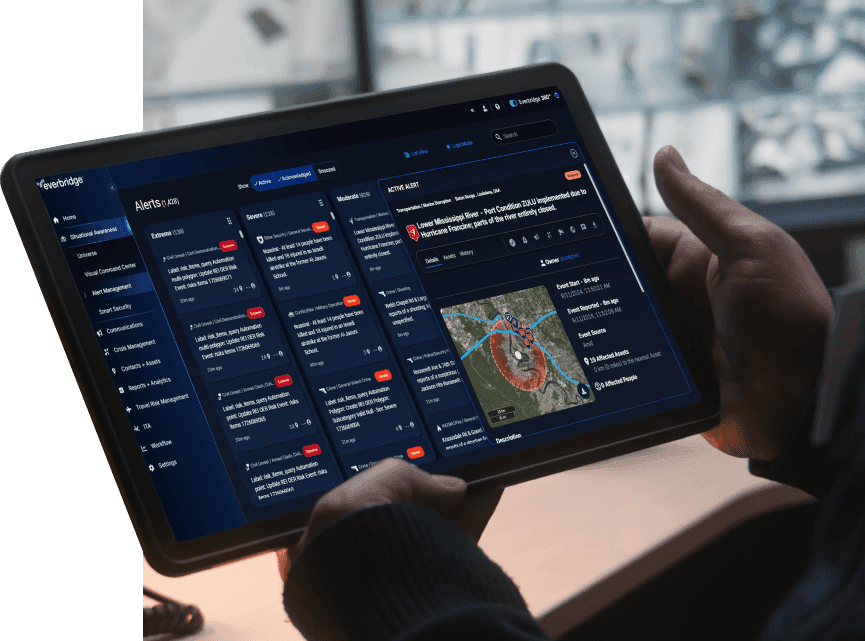
Everbridge Response Management transforms response procedures into guided workflows that help teams manage incidents consistently and efficiently. As part of the Everbridge 360 platform, it connects planning, communications, response execution and reporting in a unified experience.
A shared view of tasks, communications, decisions and incident activity helps stakeholders coordinate action, maintain accountability, and support a faster, more controlled recovery.
Response Management capabilities
Unified response and communication
Coordinate response activities, teams, resources and communications from a shared incident workspace. Dashboards, collaboration tools and a central incident log help teams work from the same information.
Dynamic task management
Turn standard operating procedures into actionable tasks that can be assigned to a team, role or individual. Add new actions during an incident as circumstances change.
Mobile response plans
Give authorized users access to plans, tasks, communications, and incident information wherever they are working.
Forms, dashboards and reporting
Collect updates through forms and surveys, track impact, create situation reports and maintain an auditable record for after-action review.

Support faster, more coordinated action
Response Management helps organizations move from static plans to coordinated execution by:
- Automatically launching predefined workflows and communications
- Assigning actions and giving task owners clear accountability
- Collecting real-time information from response teams and the field
- Providing status updates and dashboards for different stakeholder groups
- Capturing incident details in a shared record to support situation and after-action reporting


Response Management connects business continuity, disaster recovery and emergency communication processes, helping teams coordinate a consistent response to disruptions of any scale.
Important note
This resource provides general information only and does not constitute legal, regulatory or specialist security advice. Organizations should refer to the latest Home Office and Security Industry Authority guidance and seek professional advice appropriate to their circumstances.
Technology alone does not establish compliance with Martyn’s Law. Effective preparedness also depends on appropriate governance, trained people, proportionate procedures, regular exercises, and informed professional judgement.