
Organizations today face an unprecedented array of threats. From cyber-attacks and outages, natural disasters, supply chain disruptions, pandemics, geopolitical Operational resilience and business continuity planning are related, but they are not the same. Business continuity planning focuses on maintaining or restoring critical operations during and after a disruption; operational resilience is the broader capability to anticipate, mitigate, respond, recover, and adapt so the organization can continue delivering important services through uncertainty.
In short, business continuity is a plan for continuity and recovery. Operational resilience is a measurable, organization-wide capability that strengthens people, assets, operations, and infrastructure before, during, and after critical events.
Organizations need both. Business continuity supports operational continuity when incidents occur, while operational resilience helps organizations navigate critical events confidently, minimize disruptions, safeguard employees and assets, and improve continuously.
Context: Why the distinction matters
Organizations today face an unprecedented array of threats, including cyberattacks, outages, severe weather, natural disasters, supply chain disruptions, pandemics, geopolitical events, and sudden regulatory changes. This risk environment demands more mature preparedness, response, and recovery strategies.
The growing prevalence of these threats has elevated business continuity, business resilience, operational resilience, and organizational resilience to top priorities. These terms are often used interchangeably, which can create confusion and lead to gaps in risk management.
That misconception is declining. The BCI Continuity & Resilience Report 2025 found that only 40.2% now claim there is no difference between business continuity and resilience in their organizations.
Understanding the distinction helps organizations build a comprehensive strategy. The goal is to survive immediate disruption, maintain stability, and strengthen readiness for long-term uncertainty.
What business continuity planning means
Business continuity is an organization’s capability to maintain critical operations at acceptable levels during and after disruptions. Business continuity planning uses documented procedures, roles, recovery priorities, and communications to guide response and recovery.
Business continuity planning emphasizes minimum acceptable service levels. The objective is not always to optimize performance during disruption; it is to keep critical functions operating at defined thresholds until normal operations can resume.
The foundation of business continuity planning includes:
- Backup systems: Alternative resources that support continuity when primary systems fail, such as redundant data centers, alternative communication channels, or standby equipment.
- Recovery procedures: Step-by-step instructions for restoring operations, including what actions to take, who owns them, and in what sequence they should occur.
- Emergency response protocols: Immediate actions that prioritize safety, establish command structures, and coordinate response across the organization.
A strong business continuity plan helps teams respond quickly, reduce downtime, and recover critical services with less confusion.
What operational resilience means
Operational resilience is the organization’s ability to continue delivering critical services through disruption. It includes the capacity to anticipate threats, mitigate exposure, respond in a coordinated way, recover effectively, and adapt after the event.
Operational resilience is broader than a business continuity plan. It connects risk management, risk intelligence, operational continuity, incident response, communications, technology, suppliers, facilities, workforce readiness, and governance.
Business resilience and organizational resilience are closely related terms. Business resilience often describes the enterprise-wide ability to overcome, adapt, and evolve, while operational resilience focuses on the stability and adaptability of critical operations and services.
Unlike a plan that activates during an event, operational resilience integrates into daily operations. Resilient organizations build flexible systems, adaptive processes, diversified resources, and a culture of continuous improvement before critical events occur.
Operational resilience also extends beyond recovery. Resilient organizations do not simply return to the previous operating state; they use disruption as an opportunity to improve processes, strengthen systems, and enhance performance.
Key differences: Operational resilience vs. business continuity planning
Business continuity planning focuses on maintaining operations during and after disruption. Operational resilience focuses on strengthening the organization’s ability to adapt, evolve, and continue delivering critical services across a wider range of conditions.
| Business Continuity | Business Resilience |
| Response to incidents | Preparation for uncertainty |
| Focus on recovery and restoration | Focus on adaptation and evolution |
| Event-driven activation | Continuous operational integration |
| Maintaining minimum service levels | Optimizing performance through disruption |
Both approaches support continuity. The difference is scope: business continuity planning is a core discipline within a broader operational resilience strategy.
Common challenges when organizations treat them as the same
Confusing business continuity planning with operational resilience can limit preparedness. Organizations may have detailed recovery plans but still lack the adaptive capacity to manage complex, cascading, or long-duration critical events.
Common challenges include:
- Plan-only thinking: Teams rely on static documents that may not reflect changing threats, dependencies, or operating conditions.
- Limited visibility: Leaders lack real-time risk intelligence across people, assets, operations, and infrastructure.
- Siloed response: Business units, security teams, IT, facilities, and communications teams work from different information sources.
- Unclear service priorities: Plans focus on systems or departments rather than the services most important to customers and stakeholders.
- Inconsistent communications: Stakeholders receive delayed, incomplete, or conflicting updates during response and recovery.
- Limited learning cycles: Post-incident reviews do not consistently lead to measurable improvements in readiness and resilience.
Operational resilience helps close these gaps by connecting preparedness, response, recovery, and continuous improvement.
Metrics and measurement for continuity and resilience
Business continuity planning and operational resilience use many shared metrics. The difference is how organizations interpret those metrics and apply them to improve capability over time.
- Recovery time objective (RTO): The maximum acceptable downtime for a critical system or process. Business continuity uses RTO to define recovery targets; operational resilience uses it as one input for assessing adaptive capacity.
- Recovery point objective (RPO): The maximum acceptable data loss during disruption. Business continuity uses RPO to set backup requirements; operational resilience evaluates whether data loss thresholds align with risk tolerance.
- Mean time to recovery (MTTR): The average time required to restore operations after incidents. Business continuity tracks recovery efficiency; resilience programs evaluate whether MTTR trends show improving capability.
- Incident response time: The speed at which teams activate response procedures. Business continuity treats faster activation as evidence of preparedness; resilience programs assess whether response improves as capabilities mature.
- System downtime: The total time critical systems remain unavailable. Business continuity aims to minimize downtime; operational resilience also reduces impact through flexible work processes and service alternatives.
- Cost of recovery: The cost of restoring operations after disruption. Business continuity uses this metric to justify backup and recovery investments; resilience planning assesses whether adaptive approaches reduce overall disruption cost.
These metrics become more valuable when they inform action. Mature programs use measurement to know earlier, respond faster, and improve continuously.
How to achieve both business continuity and operational resilience
Modern organizations need both reactive recovery capabilities and proactive adaptive capacity. The most effective strategies integrate business continuity planning into a broader operational resilience and organizational resilience program.
A practical approach includes:
- Identify critical services: Define the services, processes, people, assets, operations, and infrastructure that must remain available.
- Map dependencies: Document internal systems, suppliers, facilities, workforce roles, and data flows that support critical services.
- Set impact tolerances: Establish acceptable thresholds for downtime, data loss, service degradation, and operational disruption.
- Build continuity plans: Create procedures for response, recovery, communication, and escalation.
- Use real-time risk intelligence: Monitor threats that may affect employees, assets, infrastructure, suppliers, and operations.
- Exercise and test regularly: Validate plans through scenarios, drills, and cross-functional exercises.
- Coordinate response: Align teams through shared situational awareness, automated communications, and clear decision paths.
- Measure and improve: Use lessons learned, metrics, and maturity assessments to strengthen readiness over time.
Business continuity planning keeps the organization moving during disruption. Operational resilience ensures the organization can continue improving as the risk landscape changes.
Explore Everbridge resilience solutions for continuous improvement
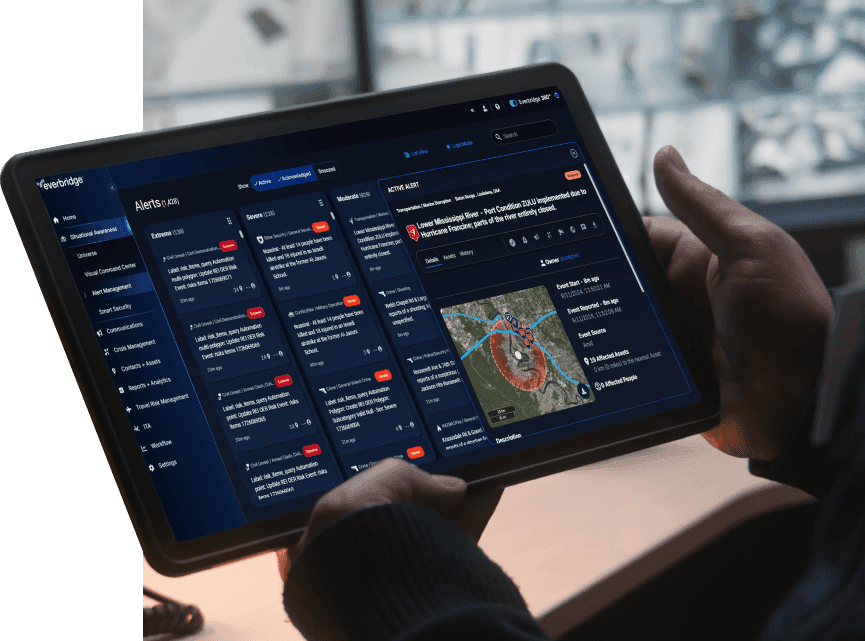
The Everbridge High Velocity Critical Event Management platform unites preparedness, response, recovery, and continuous improvement. It helps organizations move beyond reactive planning and toward proactive operational resilience.
Everbridge 360TM empowers organizations with risk intelligence, automated response, and coordinated communication capabilities. Powered by Purpose-built AI, Everbridge helps teams know earlier, respond faster, and improve continuously.
With critical event management (CEM), organizations can:
- Anticipate threats with real-time risk intelligence.
- Mitigate disruption through proactive planning and coordination.
- Respond quickly with automated workflows and targeted communications.
- Recover critical operations with measurable continuity processes.
- Adapt after critical events through lessons learned and continuous improvement.
This integrated approach supports both business continuity and operational resilience. It helps organizations minimize disruptions, safeguard employees and assets, and maintain operational continuity across complex events.
Resources and thought leadership
Organizations can assess how resilient they are and how prepared they are for business disruptions. The Everbridge Best in Resilience journey helps organizations compare maturity, identify gaps, and strengthen readiness.
For teams evaluating business continuity and resilience capabilities, Everbridge BCIC provides a closer look at how technology can support continuity, operational resilience, and coordinated critical event response.
Frequently asked questions
Operational resilience is the broader capability to anticipate, mitigate, respond, recover, and adapt while continuing to deliver critical services. Business continuity planning is the documented process for maintaining or restoring critical operations during and after a disruption.
Yes. Business continuity planning is a core component of operational resilience. It provides the procedures, recovery objectives, roles, and communications that support operational continuity during critical events.
Business resilience describes the enterprise-wide ability to overcome, adapt, and evolve through disruption. Operational resilience focuses more specifically on the ability to sustain critical operations, services, infrastructure, and dependencies through disruption.
Organizations need business continuity to maintain minimum acceptable service levels during disruption. They need operational resilience to strengthen readiness, improve adaptability, reduce impact, and continue delivering important services as conditions change.
Common metrics include recovery time objective, recovery point objective, mean time to recovery, incident response time, system downtime, and cost of recovery. Operational resilience programs also use these metrics to evaluate maturity, adaptability, and continuous improvement.