
Organizations today face an increasing number of threats that disrupt operations, impact customers, and create significant financial and reputational risk. Cyberattacks, severe weather, supply chain disruptions, technology outages, workplace violence, and geopolitical events all require organizations to respond quickly and effectively.
With the increasing number of threats, why are we keeping our business continuity and disaster recovery teams and plans separated from our crisis management response teams?
You have a business continuity management team responsible for conducting an impact assessment to identify important business services, dependencies, and recovery strategies for when something happens. At the same time, your crisis management teams oversee the response when an event occurs and operations are impacted.
So why are we creating a gap between preparedness, response, and recovery?
When we consider true organizational resilience, it requires more than awareness and communications. It requires connecting preparedness, response, recovery, and continuous improvement into a single operational framework.
This is where Everbridge 360 and BC in the Cloud bridge the gap and bring response and recovery together to improve your organizational resilience posture.
Why context matters when an event happens
When something goes wrong, most organizations can answer one question right away: What happened?
Knowing is only half of the battle. Can you answer the more important question: What does this mean to my business?
Without business context, crisis teams are forced to make decisions without a complete view of what is at risk.
That is where BC in the Cloud provides the business context needed to make informed decisions during a crisis.
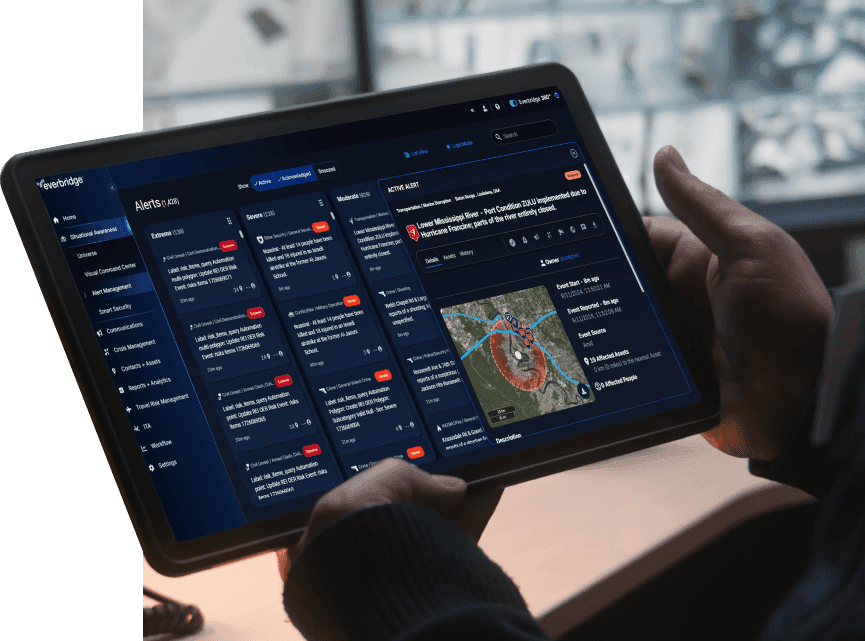
Through business impact assessments, organizations identify important business services, downstream dependencies, recovery strategies, and the operational relationships that matter most. Then, when an event occurs in Everbridge 360, teams can see why the threat matters and what could be impacted across people, processes, technology, locations, and third-party providers.
That is the difference between simply responding and responding with confidence.
This is where Everbridge keeps people safe and organizations running.
Are you ready for what’s next?
Get the 2026 Emergency & Crisis Communications Report
Discover new research from Everbridge and the Business Continuity Institute (BCI) to help you close the gap between preparedness, response, and recovery.
You’ll learn how to:
- Strengthen leadership and decision-making during critical events
- Improve coordination and communication across teams
- Prepare for emerging risks, including cyber threats, technology failures, and extreme weather
Better together: Response and recovery in one strategy
Many organizations have invested in Everbridge for Mass Notification, Risk Intelligence, or Response Management. That investment already gives them a strong foundation for detecting threats, communicating quickly, and coordinating response.
BC in the Cloud extends that value by adding the impact assessment, dependency mapping, and recovery planning needed to move from crisis response to true resilience.
Instead of managing response and recovery through disconnected teams, plans, and applications, organizations can operate from a single source of truth with connected workflows and shared data.
When a threat is identified, crisis teams can activate their response workflows for events like cyberattacks, severe weather, power outages, earthquakes, active assailant situations, and other disruptive events. At the same time, continuity teams can launch communications and recovery tasks for people, processes, technology, locations, and third-party vendors.
This creates a more complete operating model, where response teams and business continuity teams are working from the same information and toward the same goal: restoring operations faster.
Why connected platforms matter
The challenge with disconnected tools is not just inefficiency. It’s the gap they create between teams that should be working together.
When planning lives in one system and response lives in another, organizations lose time, context, and coordination. They also create more work for already stretched teams trying to manage separate processes during an incident.
Everbridge 360 and BC in the Cloud close that gap with a single pane of glass for resilience. Organizations can plan, prepare, communicate, respond, recover, and improve within one connected ecosystem.
And this matters not only during a crisis, but after it.
Every incident provides an opportunity to improve resilience moving forward. Track lessons learned, issues, action items, and improvement opportunities in BC in the Cloud so organizations can refine plans, strengthen recovery strategies, and improve their overall resilience over time.
That’s how resilience becomes a cycle, not a one-time exercise.
Know earlier, respond faster, improve continuously.
Questions to ask when evaluating a critical event management solution
As organizations look at the future of resilience, they should ask some important questions:
- Can we connect business continuity planning with crisis response?
- Can we see what impacts and dependencies to inform our response?
- Can we activate response and recovery tasks in one workflow?
- Can our teams work from the same information across planning, communication, and recovery?
- Can we capture lessons learned and use them to improve future performance?
- Can we track the overall impact time from response to recovery as part of the overall incident management?
- Can my business continuity and crisis management teams access the same information about a critical event?
If the answer is no, then there is likely still a gap between preparedness and response.
Better together for what comes next
Organizational resilience is not built in a single moment. It’s built through preparation, tested through response, and strengthened through improvement.
That’s why BC in the Cloud and Everbridge 360 are better together.
For new organizations evaluating a resilience strategy, this approach provides a connected way to prepare, respond, recover, and improve. For existing Everbridge customers, it creates a natural next step by extending the value of the platform you already use and bringing deeper business context into your response strategy.
Resilience isn’t measured by how quickly an organization sends an alert. It’s measured by how effectively it restores critical operations, protects customers, and learns from every disruption.
That requires preparedness, response, recovery, and continuous improvement to work together – not as separate disciplines, but as one connected resilience strategy.
Next steps
Join webinar on How Everbridge 360 and BC in the Cloud connect preparedness, response, and recovery in a single operational workflow.
See how a connected approach to preparedness, response, and recovery can help strengthen your resilience strategy.
Want to know more about how to connect your Business Continuity and Crisis Management teams together? Why not start with a resilience committee!
Learn more about the importance of resilience committees.