Organizations need a documented process for deciding when to close facilities, restrict travel, or send employees home before severe weather creates unsafe conditions. An inclement weather policy answers three questions every leader faces during a storm, wildfire, or winter event: When do we act? Who decides? How do we tell employees what to do?
This guide walks through how to build that policy step by step — from setting activation thresholds and assigning decision-makers, to sending real-time alerts, to tracking whether every employee is confirmed safe. It also covers what to do after the event, including how to review response times, update contact data, and close gaps before the next storm.
A usable inclement weather policy defines: the specific weather risks that apply to each location, the exact conditions that trigger a closure or evacuation, who is authorized to make that call, how instructions reach employees on-site, remote, in the field, and traveling, what safety actions employees take (shelter-in-place, evacuate, stay home), how employee safety status gets confirmed and tracked, and how pay, time off, and flexible work apply during the disruption.
The sections below provide the step-by-step process, example decision thresholds, message templates, and a safety-tracking workflow organizations can adapt directly into their own policy.
Use these tips when developing an inclement weather policy:
- Define the severe weather risks that apply to your locations.
- Set clear decision criteria for closures, delays, remote work, travel restrictions, and evacuations.
- Document employee safety procedures for each likely weather scenario.
- Clarify employee rights, pay practices, flexible work options, and time-off procedures.
- Create pre-approved communication templates for before, during, and after an event.
- Use multiple communication channels so urgent messages reach every employee.
- Assign roles for monitoring, approvals, message publishing, and post-event recovery.
- Train employees and test the policy before severe weather occurs.
- Review outcomes after each event and improve the plan continuously.
An inclement weather policy should be practical, accessible, and easy to activate under pressure. Everbridge helps organizations know earlier, respond faster, and improve continuously so they can navigate critical events confidently.
Context and problem framing
Weather events continue to pose significant challenges to employees and businesses alike. By 2024, the United States had experienced 27 separate billion-dollar weather and climate disasters, with total losses reaching $182.7 billion, according to the NOAA National Centers for Environmental Information.
This marks a continued upward trend, with an average of 23 such events annually over the past five years. These disasters included severe storms, tropical cyclones, wildfires, winter storms, and droughts, illustrating the growing frequency and intensity of severe weather.
With these patterns showing no signs of slowing, organizations need a comprehensive inclement weather policy that supports preparedness, response, and recovery. A clear policy helps protect employees and maintain operational continuity when conditions change quickly.
What inclement weather includes
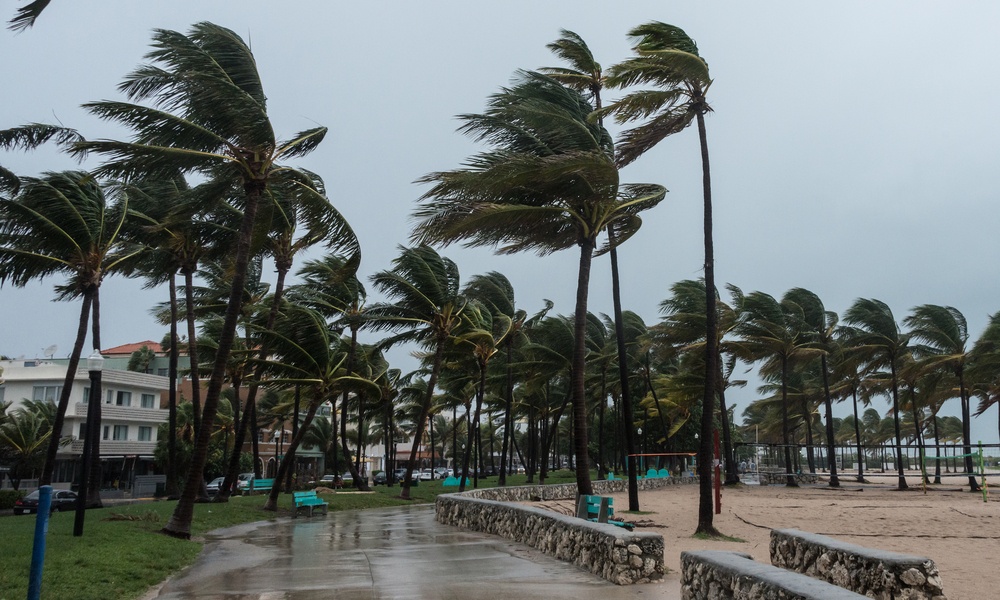
Inclement weather includes adverse weather conditions that can threaten people, assets, operations, and infrastructure. Common examples include hurricanes, wildfires, flooding, heavy rain, tornadoes, snowstorms, hailstorms, heat waves, and ice storms.
Each weather event creates different safety and operational risks. A policy should account for regional threats, facility types, employee travel patterns, and the needs of on-site, hybrid, remote, and mobile workers.
Why an inclement weather policy matters
Given the increasing frequency and severity of inclement weather events, organizations need a policy that is comprehensive and actionable. While OSHA does not have a specific standard that covers working in cold environments, employers have a responsibility to provide workers with employment and a place of employment that are free from recognized hazards, including winter weather-related hazards.
An inclement weather policy helps organizations address employee safety, support OSHA expectations, and strengthen organizational resilience. It also reduces confusion by giving leaders and employees a shared response framework.
Common challenges
Inclement weather becomes harder to manage when organizations rely on ad hoc decisions or single-channel communication. Employees need clear instructions before conditions become unsafe, and leaders need reliable ways to reach people wherever they are.
Common policy gaps include:
- Unclear activation criteria: Employees may not know when the office will close, when travel is restricted, or when remote work applies.
- Limited communication channels: Email alone may not reach employees quickly enough during urgent severe weather conditions.
- Undefined roles: Teams may not know who monitors weather, approves decisions, sends alerts, or coordinates recovery.
- Inconsistent employee guidance: Employees may receive different instructions across departments, regions, or facilities.
- Incomplete employee rights information: Policies may not clearly explain pay, time off, flexible work, or expectations during closures.
- Outdated contact data: Employee records may be incomplete, which can delay notifications during critical events.
- No post-event review: Organizations may miss opportunities to improve preparedness, communication, and operational resilience.
A strong policy reduces these gaps by defining expectations in advance. It also gives employees confidence that the organization can anticipate, mitigate, respond, recover, and adapt.
Everbridge solution overview
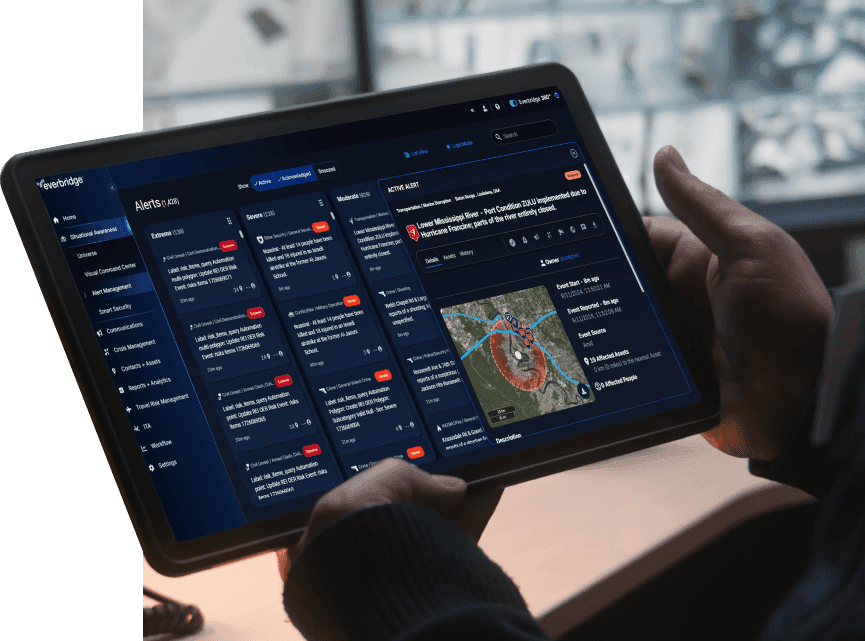
Everbridge 360, the High Velocity Critical Event Management platform, helps organizations manage severe weather and other critical events from risk intelligence through response and recovery. Powered by Purpose-built AI, Everbridge 360 empowers organizations to safeguard employees and assets, minimize disruptions, and support operational continuity.
An inclement weather policy works best when it connects written procedures with real-time communication capabilities. Everbridge helps organizations deliver alerts, coordinate response actions, and keep employees informed before, during, and after severe weather.
How Everbridge Mass Notification tools strengthen an inclement weather policy
Everbridge Mass Notification helps organizations send real-time alerts and instructions to employees, residents, or other stakeholders. These communications can include impending weather conditions, safety instructions, evacuation orders, shelter locations, office closures, and operational updates.
Mass notification capabilities support an inclement weather policy by helping organizations:
- Send urgent alerts across multiple channels.
- Reach employees based on location, role, or risk exposure.
- Provide consistent instructions during fast-moving weather events.
- Confirm message delivery and employee safety status.
- Coordinate communications across preparedness, response, and recovery.
How Travel Protector helps protect traveling employees
Travel Protector helps organizations keep employees safe when they are traveling. Teams can send immediate alerts to travelers in affected areas, recommend precautions, adjust travel plans, or provide alternative route information.
Travel Protector can also help organizations communicate weather-related disruptions such as flight cancellations, road closures, or transportation delays. This helps employees make informed decisions and supports duty of care.
How it works
An effective inclement weather policy should guide actions before, during, and after a severe weather event. This structure helps leaders move from preparedness to response and recovery without relying on improvised decisions.
Before inclement weather events
Preparation is the best way to minimize impact. Organizations should identify the most likely weather risks, define decision thresholds, and develop pre-approved messages for events such as tornadoes, flooding, hurricanes, winter storms, or wildfires.
Key actions before severe weather include:
- Assess location-specific risks: Identify weather threats that could affect each facility, worksite, region, and traveling employee group.
- Define activation criteria: Clarify when the policy triggers office closures, delayed openings, remote work, shelter-in-place actions, evacuations, or travel restrictions.
- Create communication templates: Draft clear messages for likely scenarios so teams can send instructions quickly.
- Confirm employee contact data: Keep mobile numbers, email addresses, work locations, and emergency contacts current.
- Assign responsibilities: Determine who monitors weather, approves decisions, publishes alerts, and coordinates follow-up.
- Train employees: Conduct emergency preparedness training so employees know how to react and where to find instructions.
- Rehearse the process: Test the communication tree and notification channels before they are needed.
Pre-configured messages should use direct language. For example, if a tornado warning affects a facility, the message should tell employees to move to the designated shelter location immediately.
Example decision thresholds by weather hazard
Use documented, hazard-specific thresholds so decisions during an event are consistent and defensible, not improvised. Adjust these examples to match local building codes, regional risk, and workforce type.
- Hurricanes/tropical storms: Begin pre-event actions at a Tropical Storm or Hurricane Watch; close facilities and activate evacuation procedures once sustained winds are forecast to exceed 39–74 mph in the affected area, per National Hurricane Center guidance.
- Hurricanes/tropical storms: Begin pre-event actions at a Tropical Storm or Hurricane Watch; close facilities and activate evacuation procedures once sustained winds are forecast to exceed 39–74 mph in the affected area, per National Hurricane Center guidance.
- Winter storms: Consider delayed opening or closure when forecast snow accumulation exceeds 4–6 inches in a 12-hour period, or when the National Weather Service issues a Winter Storm Warning for the facility’s region.
- Extreme heat: Restrict outdoor and field work when the heat index reaches 103°F (National Weather Service “Danger” category), and suspend non-essential outdoor work at 125°F or higher, consistent with OSHA heat-illness prevention guidance.
- Tornadoes: Move employees to shelter-in-place locations immediately upon a Tornado Warning (not just a Watch) for the facility’s county.
- Flooding: Close roads and restrict travel when local emergency management issues a Flash Flood Warning or when facility access roads are reported impassable.
- Wildfires: Prepare for evacuation at a Level 2 (“Set”) evacuation notice from local fire authorities, and evacuate immediately at a Level 3 (“Go”) notice.
Document these thresholds in the written policy and link them directly to the communication templates so the decision-maker can trigger the correct message the moment a threshold is met.
During inclement weather events
When a severe weather event begins, employees need current information from a trusted source. Organizations should use all available internal communication channels to ensure urgent instructions reach the right people.
For urgent messages, use channels that provide immediate visibility. Desktop alerts, mobile alerts, text messages, phone calls, digital signage, and panic button notifications can reach employees faster than email alone.
Messages during an event should include:
- The type of weather risk.
- The affected locations or employee groups.
- The required safety action.
- Where to find additional information.
- When employees can expect the next update.
- Who to contact for help.
Sample email message
Subject line: Important update: Inclement weather advisory
Dear team,
Due to forecasted severe weather conditions, the organization is implementing the inclement weather policy. Please review the attached policy for safety procedures, work expectations, and employee rights.
Stay indoors until further notice. Additional updates will be provided as conditions change.
Regards,
[Your name, department, and contact information]
Sample text message
Inclement weather advisory: Due to severe weather conditions, all employees should stay indoors and avoid travel until further notice. Updates will be provided as the situation evolves.
After inclement weather events
After the event has passed, organizations should review the communication strategy and operational response. This review helps identify what worked, what caused confusion, and what should change before the next critical event.
Post-event actions should include:
- Survey employees about message clarity, timing, and preferred channels.
- Confirm the status of facilities, worksites, assets, and infrastructure.
- Document response timelines and decision points.
- Update communication templates and emergency contacts.
- Adjust policy language based on lessons learned.
- Review staffing, pay, and flexible work impacts.
- Share recovery instructions and return-to-work guidance.
Most importantly, keep the emergency communication plan current. Employees join and leave the organization, remote offices open or close, and communication coordinators may change roles.
How to track employee safety during severe weather
Tracking employee safety is a core part of an inclement weather policy, not an afterthought. Organizations should build a documented check-in process so leaders know who is safe, who needs help, and who has not yet responded.
Follow these steps to track employee safety during a severe weather event:
- Send a status-check message as soon as the policy activates. Ask employees to confirm safety with a simple one-tap or one-word reply (for example, “Safe” or “Need Help”).
- Set a response deadline. Give employees a clear window (for example, 30–60 minutes) to respond before escalating to a manager or emergency contact.
- Segment tracking by location and role. Group employees by office, jobsite, field territory, or travel status so response teams can prioritize the highest-risk groups first.
- Escalate non-responders automatically. Route unconfirmed employees to a supervisor or safety team for a phone call, text follow-up, or in-person welfare check.
- Maintain a live status dashboard. Track “Safe,” “Needs Help,” and “No Response” categories in real time so incident commanders can direct resources where they are needed.
- Document the final headcount. Record confirmed-safe totals, outstanding welfare checks, and any employees requiring follow-up support for the after-action report.
- Keep a manual backup process. Maintain a printed or offline contact list and call tree in case digital systems or cell networks are disrupted during the event.
This process gives organizations a documented, repeatable way to answer the question every leader asks during a disaster: is everyone accounted for?
Benefits and core features of an inclement weather policy
A comprehensive inclement weather policy protects employees while helping the organization maintain stability. It should combine safety procedures, communication guidelines, employee rights, and business continuity planning.
Safety procedures
A policy should clearly outline safety protocols for the severe weather events most likely to affect the organization. These procedures help employees act quickly and reduce uncertainty during critical events.
Include:
- Designated evacuation routes.
- Shelter-in-place locations.
- Assembly points.
- Facility shutdown procedures.
- Premises security steps.
- Travel restrictions.
- Return-to-work instructions.
- Procedures for employees who work alone, remotely, or in the field.
Communication guidelines and templates
Organizations should establish clear communication channels before severe weather occurs. The policy should explain how employees will receive updates and how often the organization will communicate.
Include communication channels such as:
- Text messages.
- Phone calls.
- Email.
- Desktop alerts.
- Mobile app notifications.
- Digital signage.
- Intranet updates.
- Manager briefings.
Templates should cover alerts before, during, and after an event. They should be short, specific, and written in plain language.
Employee rights and work expectations
An inclement weather policy should define employee rights and work expectations during closures, delays, transportation disruptions, and unsafe conditions. This information helps employees understand what to do and reduces uncertainty for managers.
Include guidance on:
- Pay practices during closures or missed work.
- Flexible working arrangements.
- Remote work expectations.
- Adjusted work hours.
- Time-off procedures.
- Reporting requirements.
- Transportation disruptions.
- Travel cancellations or delays.
Organizations should review policy language with legal, human resources, safety, and operations teams. This helps ensure the policy aligns with internal requirements and applicable regulations.
Business continuity and recovery
Severe weather can affect more than employee commutes. It can disrupt supply chains, facilities, transportation, technology systems, and customer operations.
A strong policy should connect employee safety with business continuity planning. Include steps for maintaining essential operations, restoring services, and communicating with employees, customers, vendors, and other stakeholders.
How to incorporate public agency alerts into an inclement weather policy
An effective inclement weather policy should not rely only on internal observation — it should incorporate official public alerts so organizations act on the same information as local emergency management agencies.
To integrate public alerts into the policy:
- Monitor National Weather Service (NWS) alerts for the counties or regions where facilities, jobsites, and traveling employees are located.
How to incorporate public agency alerts into an inclement weather policy - Subscribe to local emergency management agency notifications, including county or state Offices of Emergency Management, for evacuation orders and shelter guidance.
- Track Integrated Public Alert and Warning System (IPAWS) messages, which distribute Wireless Emergency Alerts (WEAs) and Emergency Alert System (EAS) messages during severe weather.
- Cross-reference FEMA and NOAA guidance when setting activation thresholds, so internal decision criteria stay aligned with official warning levels (Watch vs. Warning vs. Emergency).
- Route qualifying public alerts directly into the internal notification workflow, so a NWS Tornado Warning or a county evacuation order automatically triggers the organization’s pre-approved employee message.
- Document the source of each activation decision (e.g., “NWS Tornado Warning issued 2:14 PM”) in the after-action report to show the policy was triggered by verified, official information.
Aligning the internal policy with public agency alerts reduces lag time between an official warning and employee notification, and it demonstrates due diligence if the response is ever reviewed after an incident.
Industry and use-case variants
Inclement weather policies should reflect the organization’s operating model, workforce distribution, and risk profile. A single office location may need a different approach than a distributed enterprise with field teams, travelers, and critical infrastructure.
Office-based and hybrid workforces
Office-based and hybrid teams need clear guidance for closures, delayed openings, remote work, and return-to-office decisions. The policy should explain when employees should avoid travel and how they will receive updates.
Helpful policy elements include:
- Office closure criteria.
- Remote work procedures.
- Building access restrictions.
- Parking and transportation updates.
- Return-to-office timing.
- Manager communication expectations.
Field teams and frontline workers
Field teams may face more direct exposure to severe weather. These employees need location-aware alerts, stop-work guidance, travel instructions, and escalation procedures.
Helpful policy elements include:
- Jobsite weather monitoring.
- Vehicle safety requirements.
- Check-in procedures.
- Supervisor escalation paths.
- Shelter locations.
- Criteria for suspending work.
Traveling employees
Traveling employees may be affected by severe weather outside their home region. Organizations should account for travel disruption, road closures, flight cancellations, lodging issues, and local emergency guidance.
Helpful policy elements include:
- Traveler location awareness.
- Destination risk updates.
- Alternative route guidance.
- Travel postponement criteria.
- Emergency contact procedures.
- Expense and rebooking guidance.
Severe weather scenarios
The policy should include scenario-specific instructions for the weather risks most likely to affect the organization. These may include hurricanes, wildfires, flooding, tornadoes, snowstorms, hailstorms, heat waves, and ice storms.
Each scenario should define the likely hazards, employee instructions, communication timeline, and recovery steps. This makes the policy easier to activate when speed and clarity matter.
Proof and stories
Public weather and safety data show why severe weather preparedness is now a core component of organizational resilience. NOAA reported 27 separate billion-dollar weather and climate disasters in the United States by 2024, with total losses reaching $182.7 billion.
OSHA guidance also reinforces the importance of protecting employees from recognized weather-related hazards. Organizations that document policies, train employees, and communicate quickly are better positioned to reduce risk and maintain continuity.
Everbridge supports this resilience path by helping organizations connect risk intelligence, communication, and coordinated response. These capabilities help teams anticipate disruption, mitigate impact, respond effectively, recover faster, and adapt over time.
Resources and thought leadership
Organizations can strengthen their severe weather preparedness by using practical planning tools and expert resources. These resources help teams assess gaps, improve communications, and support a measurable resilience program.
Helpful resources include:
- Take the Best in Resilience maturity self-assessment
- Access the Gartner Market Guide for Emergency and Mass Notification Systems
- Download the crisis management plan template
- Watch the severe weather resilience webinar
These resources can support the Best in Resilience journey by helping organizations assess maturity, close preparedness gaps, and improve critical event management.
Call to action
As inclement weather events continue to challenge organizations, it is essential to prepare before disruption occurs. A comprehensive policy, supported by real-time communication and critical event management capabilities, helps organizations safeguard employees and assets while maintaining operational continuity.
Everbridge empowers organizations to navigate critical events confidently. With Everbridge solutions for mass notification, incident communications, travel protection, and operational resilience, organizations can know earlier, respond faster, and improve continuously.
Frequently asked questions
An inclement weather policy should include activation criteria, safety procedures, communication channels, employee rights, work expectations, pay and time-off guidance, travel restrictions, role assignments, and post-event recovery steps. It should also include templates for communicating before, during, and after severe weather.
An inclement weather policy helps organizations protect employees, reduce confusion, and maintain business continuity during severe weather. It also supports risk management by documenting how the organization prepares for, responds to, and recovers from critical events.
Organizations should use multiple communication channels, including text messages, phone calls, email, desktop alerts, mobile notifications, and digital signage. Urgent messages should be short, direct, location-specific, and sent through channels employees are most likely to see quickly.
OSHA does not have a specific standard that covers working in cold environments. However, employers have a responsibility to provide a workplace free from recognized hazards, including winter weather-related hazards.
Organizations should review the policy at least annually and after every significant severe weather event. Reviews should include employee feedback, contact data updates, communication performance, role changes, and lessons learned.