A better alternative to manual calling trees during critical events
Organizations should not rely on manual calling trees as their primary communication method during a critical event. Manual calling trees can help with small groups, but they are too slow, inconsistent, and difficult to measure when organizations need to reach employees quickly, confirm safety, and report status to leaders.
A better alternative is an automated mass notification and incident communications system. With Everbridge Mass Notification, organizations can send consistent messages across multiple channels, collect responses, focus follow-up on people who have not replied, and keep stakeholders informed as conditions change.
Critical events and business disruption
A crisis is a time of intense difficulty or danger. In organizational resilience planning, the broader term is critical event because disruption can come from many sources, including severe weather, a facility issue, terrorism, natural disasters, cyber disruption, or a business-specific incident.
Critical event management does not always begin after an incident occurs. An organization may see a disruption coming, such as three feet of snow expected the next morning, and gather its crisis management team in advance to decide what employees should do.
During a critical event, organizations usually need to:
- Inform employees about what has happened, what actions to take, and when to expect updates.
- Account for employees by confirming who is safe, who needs assistance, and who has not responded.
- Respond to questions with approved, consistent information from the right teams.
- Report progress to executives, operational leaders, and response teams.
Manual calling trees can support a conversation between two people. The challenge begins when the person making the call does not have complete information, cannot reach the next person, or needs to call back repeatedly as the situation evolves.
Common challenges with manual calling trees
Manual calling trees are slow at scale
A manual calling tree requires one person to call another person, who then calls the next person or group. This process may work for a small team, but it becomes time consuming when an organization needs to contact hundreds or thousands of employees.
If the first person cannot reach the next person, the chain slows down immediately. During a critical event, that delay can prevent employees from receiving timely instructions.
Messages can become inconsistent
Manual calling trees depend on people repeating information accurately under pressure. Even with good intentions, the message may become garbled as it moves from person to person.
This creates unnecessary confusion. Employees may receive different instructions, ask the same questions repeatedly, or act on outdated information.
Employee accountability is difficult
Informing employees is only one part of critical event communication. Organizations also need to know whether employees received the message, whether they are safe, and whether anyone needs help.
Manual calling trees make this difficult to measure. Teams may need spreadsheets, repeated calls, and manual status updates before they can report progress to leadership.
One or two communication paths are not enough
A manual calling tree often relies on a small number of communication paths, such as voice calls or SMS. During a serious incident, cellular networks may become congested or unavailable, and social media channels may not provide a reliable way to confirm receipt.
Organizations need multiple ways to reach people. They also need a process that can continue over time as conditions change.
Everbridge solution overview
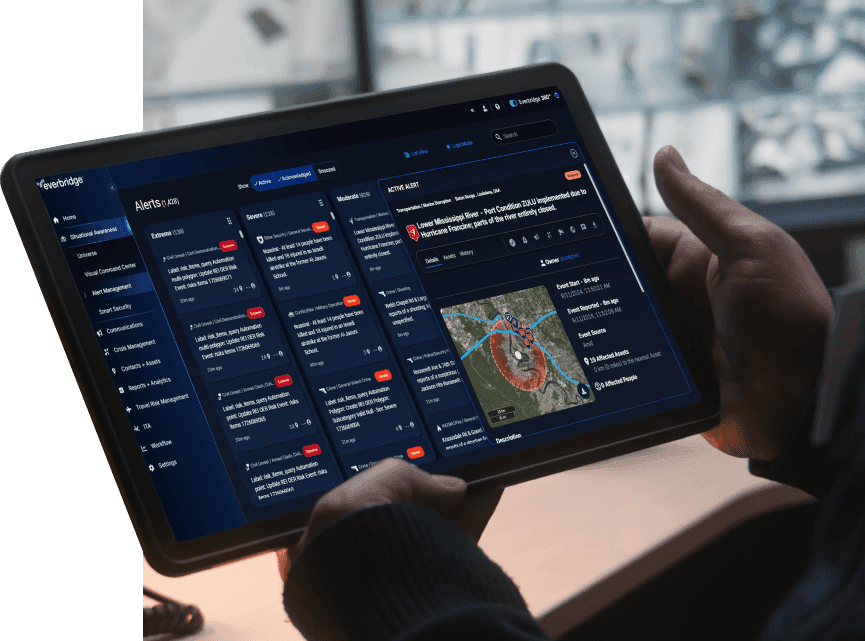
Everbridge helps organizations move from manual calling trees to automated, coordinated critical event communications. Everbridge 360 provides a unified way to identify critical events, assess potential impact, communicate with affected people, and support a measurable response.
The High Velocity Critical Event Management platform helps organizations manage critical events at speed and scale. Powered by Purpose-built AI, Everbridge supports faster decision-making, proactive communication, and coordinated response across teams.
With an automated notification system, organizations can:
- Reach many people in a short period of time.
- Send the same approved message to every recipient.
- Use multiple communication channels instead of relying on one path.
- Ask employees to respond with their status or acknowledge instructions.
- Focus follow-up on people who have not responded.
- Provide measurable updates to leaders and response teams.
How automated notification works during a critical event
Example scenario: severe weather and office closure
Consider a simple scenario involving severe weather. The organization needs to tell employees not to come into the office the next morning.
With a manual process, teams must confirm phone numbers, make repeated calls, document who answered, and pass the message down the tree. If the organization has more than 1,000 employees, the process takes even longer, and the message may change along the way.
With an automated notification system, the organization can send the message to the right employees quickly and update them as the situation develops. The system can also request a response, such as confirming safety, acknowledging the instruction, or indicating whether help is needed.
A practical communication sequence
An automated approach helps organizations move from broad notification to targeted follow-up:
- Identify the affected audience based on location, role, facility, team, or other criteria.
- Send an approved message across multiple channels, such as voice, SMS, email, mobile app, or other configured paths.
- Request a response when accountability is required.
- Review who received, acknowledged, or did not respond to the message.
- Escalate follow-up to the people who have not responded.
- Continue sending updates as the critical event changes.
- Report communication status to response teams and executives.
This sequence helps organizations stay in command while reducing manual work. It also helps response teams focus attention on people who may need assistance.
Benefits and features of automated notification systems
Manual calling trees versus automated notification systems
| Capability | Manual calling tree | Automated notification system |
|---|---|---|
| Speed | Calls must move person to person, which slows communication at scale. | Messages can reach large groups in a short time. |
| Message consistency | Information may change as people repeat it. | Approved messages are sent consistently to each recipient. |
| Communication channels | Often limited to voice calls or SMS. | Supports multiple configured channels for better reach. |
| Employee accountability | Responses are tracked manually and can be difficult to report. | Responses can be collected, measured, and escalated. |
| Follow-up | Teams must manually identify and call non-responders. | Follow-up can focus on people who did not respond. |
| Executive reporting | Status updates may take significant manual effort. | Communication status can be reported more efficiently. |
Why automation improves resilience
Automated notification does not replace good planning or human judgment. It gives teams a scalable way to execute their communication plan when speed, accuracy, and accountability matter.
Key benefits include:
- Proactive communication before, during, and after a critical event.
- Coordinated updates across employees, leaders, and response teams.
- Real-time visibility into response status.
- Reduced dependency on a single communication path.
- More reliable documentation for post-incident review.
- Stronger support for the organization’s Best in Resilience journey.
Industry and use-case variants
Manual calling trees create similar challenges across industries, but the use cases often differ by operating model. Automated notification systems help organizations tailor communication to the people, facilities, and workflows affected by the event.
Common use cases include:
- Corporate offices coordinating employee instructions during severe weather.
- Healthcare organizations communicating with staff during operational disruption.
- Manufacturing sites notifying teams about facility issues or safety procedures.
- Higher education institutions reaching students, faculty, and staff during campus incidents.
- Government agencies coordinating public safety and internal response.
- Retail and hospitality organizations communicating across distributed locations.
- Financial services organizations supporting continuity during technology or facility disruptions.
- Transportation and logistics teams updating employees during large-scale events or natural disasters.
Scenario proof: when manual calling trees stop working
The point at which a manual calling tree stops working is usually the point at which the organization needs speed, scale, and measured accountability. If teams need to reach more than a handful of people, collect responses, and report status, manual calling trees become difficult to manage.
In a first cycle of communication, an organization may try to reach everyone and receive responses from a large portion of employees. The next step is to focus on people who did not respond, because they may need additional support.
Manual calling trees make that targeted follow-up harder. Automated notification systems help teams see who responded, who did not, and where to focus next.
Resources and thought leadership
Organizations can strengthen critical event communication by combining internal plans, automated notification capabilities, and guidance from recognized resilience and emergency management resources.
Helpful resources include:
- Everbridge mass notification
- Everbridge resilience maturity self-assessment
- Gartner Market Guide for Emergency and Mass Notification Systems
- Ready.gov business preparedness guidance
- Ready.gov business continuity planning suite
- FEMA National Incident Management System
- FEMA national preparedness guidance
- OSHA emergency preparedness and response resources
- OSHA evacuation plans and procedures guidance
- CISA risk management resources
- CISA emergency communications resources
- NIST contingency planning guide
- National Weather Service weather safety resources
- ISO 22301 business continuity overview
- NFPA 1600 emergency management and business continuity standard
Call to action
Manual calling trees may still have a limited role for small teams or informal follow-up. They should not be the primary method for communicating during critical events that require speed, reach, accountability, and executive visibility.
Everbridge helps organizations automate critical event communications, reach employees across multiple channels, collect responses, and coordinate action. To see how automated notification can support your organization’s resilience program, request a demo.
Frequently asked questions
Organizations should not rely on manual calling trees as their primary communication method during a critical event. Manual calling trees are slow at scale, difficult to measure, and vulnerable to message inconsistency. Automated mass notification systems provide a better alternative because they can send consistent messages, use multiple channels, collect responses, and support targeted follow-up.
Manual calling trees depend on people reaching one another in sequence. This can delay communication, create inconsistent messages, make employee accountability difficult, and limit visibility for response teams. They also often rely on one or two communication paths, which may not be reliable during a serious incident.
The better alternative is an automated notification system that supports mass notification and incident communications. Everbridge 360 helps organizations reach large groups quickly, send approved messages, gather responses, and focus follow-up on people who have not responded.
Manual calling trees can be useful for small groups, informal check-ins, or backup communication. They are not practical as the primary method when organizations need to contact hundreds or thousands of people, confirm safety, and report communication status.
Automated notification systems can request acknowledgments or status responses from recipients. Response teams can then see who replied, who did not, and where follow-up is needed. This helps organizations focus attention on people who may need assistance.
A single communication path may be congested, unavailable, or ignored during a critical event. Multiple channels improve the chance of reaching people quickly and consistently. Organizations can use channels such as voice, SMS, email, mobile app notifications, or other configured paths to support better reach.