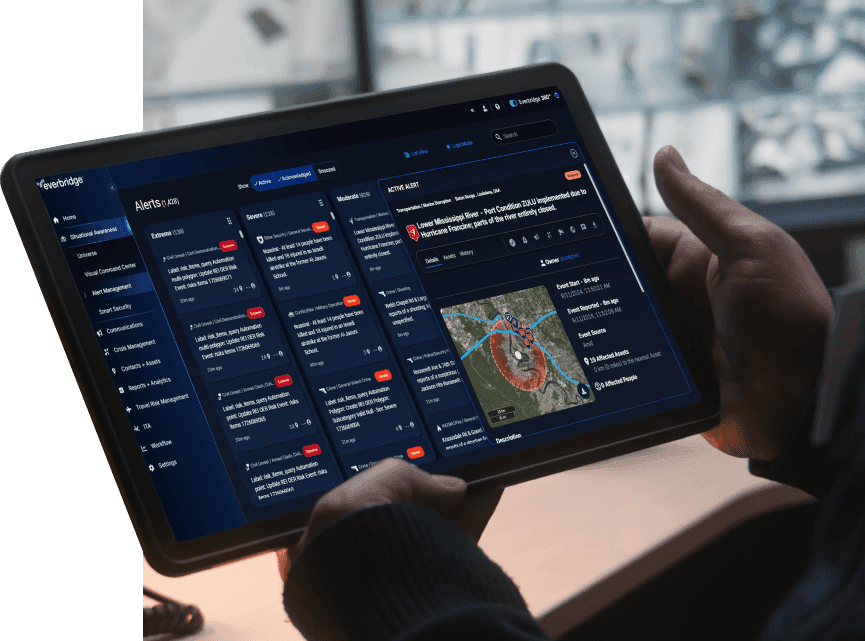
Autonomous when you want it, human-guided when you need it
AI has quickly become one of the most discussed technologies in the enterprise. But for resilience leaders, the real question is no longer whether AI matters. It’s how AI can be applied safely, practically, and usefully in the work that protects people, operations, assets, and communities.
A generic AI conversation can quickly become abstract, and operational resilience cannot afford the luxury of abstraction. When a critical event is unfolding, teams need trusted intelligence, clear context, fast coordination, and the right balance between automation and human judgment.
That’s why one of the most important principles for AI in resilience is simple:
Autonomous when you want it to be, human-guided when you need it to be.
This is the operating model for how resilience teams can move from AI theory to AI action.
Dynamically Adaptive Resilience
Read Everbridge President & CEO Dave Wagner’s post on applying AI safely across critical event workflows, balancing automation, governance, and human judgment.
AI in resilience is moving from promise to practice
Most organizations already understand the promise of AI. Across industries, AI is being applied to customer service, software development, analytics, clinical workflows, research, productivity, and operational efficiency.
But resilience teams are often in a different position all together. Many are facing more noise, more complexity, and higher expectations, while at the same time being asked to become more proactive, more precise, and more efficient, even as the risk environment becomes more unpredictable.
AI can help, but only if it’s applied to the real work of resilience. That means helping teams:
- Identify relevant risks faster
- Reduce signal fatigue
- Personalize intelligence to their organization
- Automate repetitive response workflows
- Improve communications during critical events
- Learn from past incidents
- Keep people in control where judgment is essential
The goal is not AI for its own sake. The goal is better resilience outcomes.
From more signals to better signals
One of the most immediate opportunities for AI is in risk intelligence. Resilience teams don’t need another stream of loosely relevant information; they need the confidence to know which events matter, who or what may be affected, and what action should happen next.
For Everbridge customers, applied AI and automation can help create a roughly 14x increase in confidence when assessing and acting on intelligence. The value is not more alerts or more incidents to track, but faster clarity around organizational relevance.
A risk event only matters if it matters to your organization. A distant incident may require no action, while a localized disruption near your people, facilities, supply chain, or travelers may need immediate attention. AI can help connect those dots faster by combining external risk intelligence with internal context, moving teams from awareness to action without unnecessary delay.
The control question: where should AI act?
In critical event management, not every workflow should be fully autonomous. Some tasks can and should be automated, while others require human judgment. The key is knowing where automation adds value, and where people need to stay in control.
Some use cases may be appropriate for automation, such as:
- Ingesting routine system alerts
- Translating emergency messages
- Summarizing incident context
- Routing notifications to predefined response teams
- Identifying repeated patterns in incident data
- Drafting initial communications for review
Other moments may require human guidance, such as:
- Approving sensitive communications
- Making decisions that affect safety or operations
- Escalating major incidents
- Interpreting uncertain or ambiguous conditions
- Coordinating across executive, legal, or public-sector stakeholders
This is why “human in the loop” should not be treated as a generic checkbox, but designed into the work.
The practical question for resilience leaders is not, “Should AI make decisions?” It’s, “Where can AI reduce burden, and where must human judgment remain central?”
Practical AI does not have to begin with a major transformation program
Some of the strongest AI use cases are simple. In a recent Everbridge webinar, one example discussed a hospital system where elevators were going out of service more often than desired. At first glance, elevator service may sound like a facilities issue. In a hospital, it can directly affect patient movement, care coordination, and operational continuity.
The opportunity was straightforward. We ingest an email alert from the elevator system, create an automated incident in Everbridge, give the response team situational awareness, and notify the people responsible for repair.
That’s a practical AI and automation use case. It reduces manual burden, speeds up response, and improves operational outcomes.
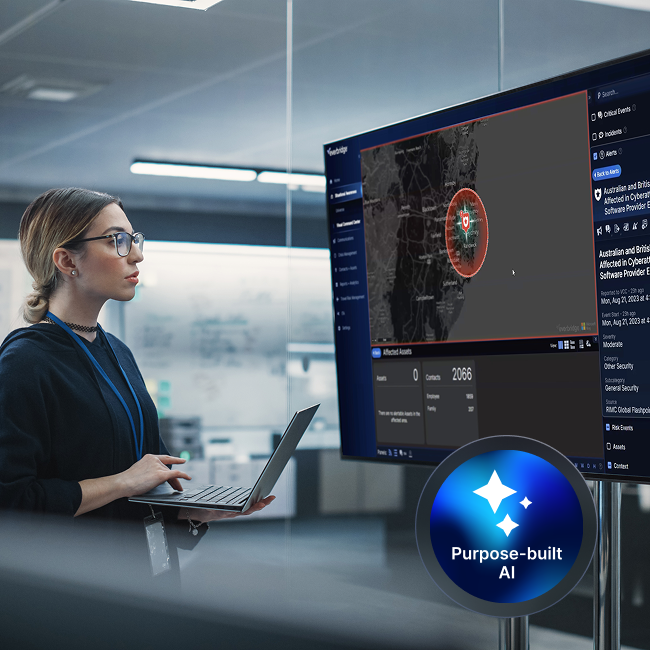
Another example involved emergency communications for FIFA World Cup host cities. In the past, multilingual emergency messaging often required prebuilt templates prepared in advance for specific scenarios. With AI-assisted translation, emergency messages can be translated into multiple languages more dynamically. The important distinction is that this is not the same as copying text into a generic AI tool. In critical communications, language must be clear, appropriate, and fit for emergency response. Purpose-built AI can be optimized for the specific task, context, and standards that resilience teams require.
Watch the on-demand webinar: The AI Ultimatum
Hear from Dave Wagner, CEO, and Alexander Nova, Director, AI Strategy & Implementation,on how resilience leaders can apply AI with the right balance of automation, governance, and human judgment. Watch The AI Ultimatum: Leading in the Age of Intelligent Resilience to move from AI theory to practical, trusted action.
Governance is the foundation for trusted AI
Trust is central to AI in operational resilience. When AI is used in critical event work, organizations need to understand how it’s being applied, what data is involved, what choices they have, and where human oversight remains in place.
This is especially important for customers in regulated industries, public-sector environments, healthcare, transportation, financial services, and other complex operating environments. In these settings, AI systems cannot operate as a black box, but need clear controls, transparent data practices, and governance that legal, privacy, security, and operational leaders can evaluate and approve.
Strong governance should answer practical questions such as:
- What data is used by AI systems?
- How are AI outputs tested and reviewed?
- What controls are available to customers?
- Where can customers opt in or opt out?
- How are privacy and legal concerns handled?
- How are responsible AI practices documented?
- How are employees and customers educated on appropriate AI use?
For AI to be trusted in resilience workflows, transparency matters. So do internal discipline, customer choice, and a culture that sees AI as a way to improve outcomes, not simply reduce costs. The organizations that succeed won’t be the ones that move fastest without controls, but the ones that move with purpose, combining speed with trust, governance, and practical value. That’s how organizations move from reactive resilience to a more dynamically adaptive model, where intelligence, action, and learning continuously reinforce one another.
AI won’t remove the need for human judgment in critical events, but will strengthen it by reducing the burden around decisions, improving the context available to decision-makers, and helping teams act with greater confidence when it matters most. That is the future of AI in operational resilience. Trusted intelligence, guided action, and continuous improvement, designed around the realities of protecting people, operations, and organizations.
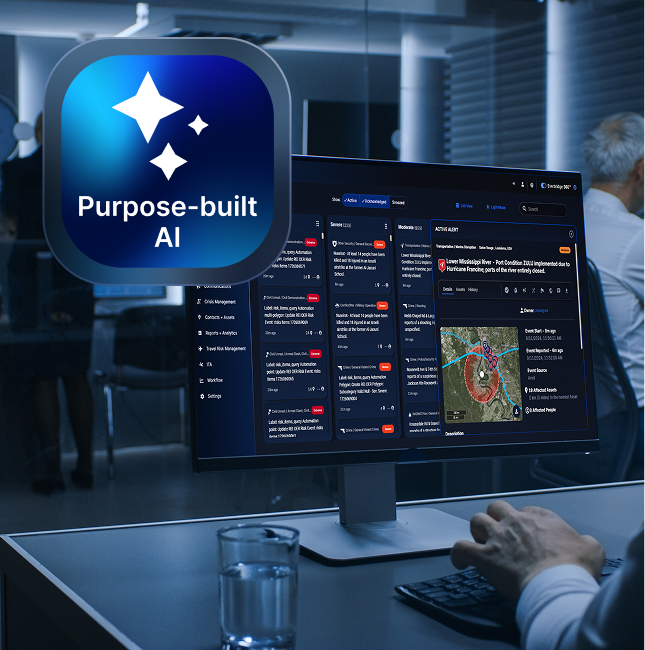
From AI theory to operational resilience
See how Purpose-built AI can help resilience teams cut through signal fatigue, personalize intelligence, automate repeatable workflows, and turn every incident into stronger future readiness – while preserving human judgment, governance, and control.