
Organizations protect executives today by integrating physical security, digital threat monitoring, real-time threat intelligence, secure communications, travel risk management, and coordinated response into one proactive program. The goal is to anticipate, mitigate, respond, recover, and adapt when critical events threaten people, assets, operations, infrastructure, stability, continuity, and executive readiness.
Context and problem framing
Today’s leaders are more exposed because digital connectivity and public visibility expand their threat surface. Executive protection now requires a strategy that addresses physical and digital threats together, because online activity can quickly influence offline risk.
Recent high-profile incidents underscore the urgency. Organizations have a duty of care to protect leaders, and security teams need programs that support organizational resilience, operational resilience, business continuity, and operational continuity.
A study undertaken by ASIS International and Everbridge identifies critical gaps and opportunities across executive protection programs. The findings show how the threat landscape is evolving, what challenges organizations face, and which strategies can strengthen protection.
Executive protection in a shifting threat environment
Executive protection has moved higher on the leadership agenda. According to the study, 42% of security professionals report a significant increase in focus on executive protection in the past 18 months.
Two major drivers are fueling this urgency:
- Rising public threats: 72% cite social media and online forums that amplify dissent, anger, and direct threats against executives.
- High-profile incidents: 69% cite events such as the assassination of a prominent CEO in 2024, which increased board-level attention.
The lesson is clear. Executive visibility, including digital presence and company communications, can increase vulnerability when organizations lack integrated risk management and coordinated response.
Where digital risk becomes physical exposure
Threats now often begin online and move into the physical world. Traditional security alone cannot address scenarios where digital behavior, public information, and physical movement intersect.
Physical threats enhanced by technology
Traditional kidnapping and assault scenarios have evolved. Attackers can use digital tools to plan incidents, analyze public routines, and bypass conventional security measures.
Publicly shared information can make executive movement more predictable. Personal technology can also compromise safety when location, travel, or communication data becomes exposed.
Escalating cybersecurity threats
Cyberattacks against executives are more frequent and sophisticated. Deepfake technology can create fake video calls and social media content that appear highly realistic.
One organization lost $25.6 million in 2024 when a finance employee joined a deepfake video call with people believed to be colleagues. Online intimidation and digital surveillance can also become precursors to real-world attacks.
Common challenges
As risks increase, many organizations struggle to turn awareness into effective executive protection capabilities. The ASIS and Everbridge research highlights gaps between concern, funding, executive participation, and action.
Budget and executive buy-in
Budget limitations are the largest reported barrier, cited by 58% of respondents. Executive non-compliance follows at 47%, creating a challenge for teams that need consistent leadership participation.
These challenges reinforce one another. Without executive support, security programs may lack funding, and without adequate resources, teams may struggle to prove value.
Security leaders can improve alignment by framing executive protection as a business enabler. Effective programs support continuity, reputation, operational continuity, and leadership confidence.
Gaps between awareness and action
The research also shows differences between how important security professionals rate specific practices and their ability to implement them.
- Online threat monitoring: 65% say it is critical, while 51% feel equipped to do it well.
- Protecting digital assets and secure communications: 57% rate it highly, while 42% feel capable.
- Behavioral threat profiling: 48% see it as important, while 33% report solid capabilities.
These gaps show that digital risks are widely recognized. Many organizations still need better tools, processes, and data to manage them effectively.
Travel risk exposure
Executive travel remains a major exposure because leaders often move through unfamiliar locations, public venues, and changing operating conditions. A piecemeal approach can leave teams with limited visibility.
The study found:
- 18% rarely or never assess travel risks in advance.
- 25% do not offer pre-travel safety briefings.
- 30% only monitor intelligence after a known threat arises.
A proactive program includes pre-trip risk assessments, executive briefings, and ongoing monitoring. Teams need to know earlier, respond faster, and improve continuously.
Everbridge solution overview
Modern executive protection depends on connected systems, real-time data, coordinated communications, and measurable program performance. Everbridge empowers organizations to bring these capabilities together through critical event management (CEM), risk intelligence, and automated response workflows.
Everbridge 360™ for integrated executive protection
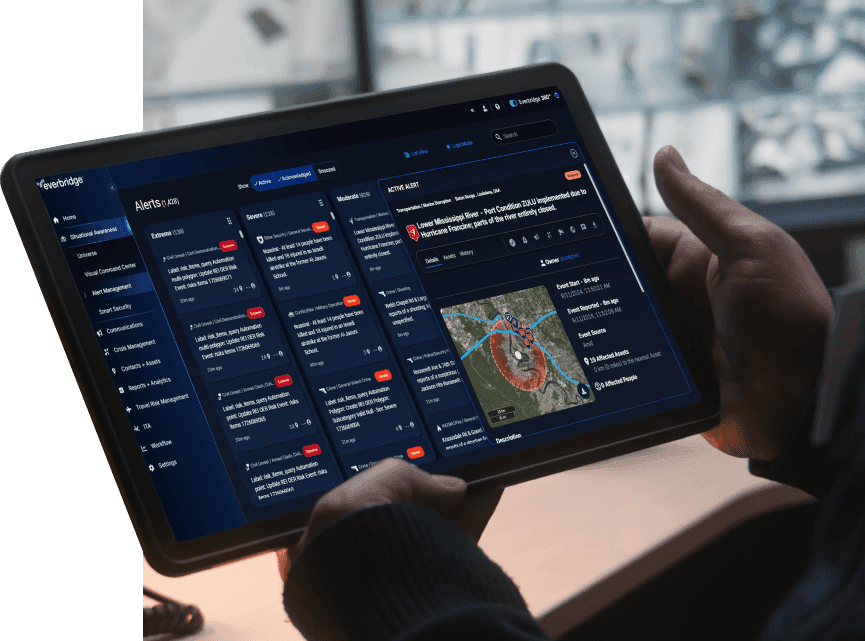
Everbridge 360™ helps organizations unify risk intelligence, communications, and response coordination across critical events. This approach supports security teams as they protect executives, safeguard employees and assets, and minimize disruptions.
For executive protection, integrated visibility matters. Teams need timely information about threats, affected locations, executive itineraries, facilities, and response resources.
High Velocity Critical Event Management™ platform for coordinated response
The High Velocity Critical Event Management™ platform helps organizations detect threats, assess impact, notify stakeholders, coordinate action, and measure outcomes. This supports faster decision-making during events that affect executives, employees, assets, operations, and infrastructure.
Purpose-built AI can help teams interpret high volumes of data and surface relevant context. That intelligence supports proactive action before a digital signal becomes a physical security issue.
The Best in Resilience™ journey for program maturity
The Best in Resilience™ journey helps organizations evaluate resilience maturity and identify gaps before disruption occurs. For executive protection teams, that means strengthening readiness, response, recovery, and continuous improvement.
A mature program connects executive protection with broader operational resilience. It also aligns leadership, security, cybersecurity, travel, communications, and business continuity stakeholders.
How it works
Organizations can protect executives from both physical and digital threats by following a connected operating model. The approach should combine prevention, detection, response, and improvement.
- Assess executive risk profiles. Identify public exposure, travel patterns, digital footprint, role-specific risks, and potential threat actors.
- Monitor digital and physical indicators. Use real-time threat intelligence to track online threats, location-based risks, and emerging critical events.
- Secure communications and digital assets. Protect executive accounts, devices, communications, and sensitive data from compromise.
- Plan travel and site protection. Conduct pre-trip assessments, brief executives, monitor routes, and coordinate physical security.
- Coordinate alerts and response. Notify the right people quickly and provide clear instructions based on verified risk.
- Measure and improve. Track incidents, response times, executive compliance, and program outcomes.
This model helps teams move from reactive security to proactive resilience. It also gives boards and executives measurable evidence of program value.
Benefits and features
Effective executive protection programs combine technology, training, governance, and culture. The strongest programs treat physical and digital security as connected disciplines.
Real-time threat intelligence for executives
Threats originating online can escalate rapidly into the physical world. Executive protection teams need intelligence that identifies credible, actionable threats and supports rapid mitigation.
The ASIS and Everbridge study found that open-source intelligence is widely used, with 82% of organizations reporting use. Many still lack tools for real-time analysis or behavioral threat detection.
A stronger approach includes:
- Social media and online threat monitoring
- Location-based intelligence
- Behavioral indicators and escalation patterns
- Threat verification and prioritization
- Alerts connected to response workflows
Coordinated physical security and critical event response
Physical protection remains essential, especially during travel, public events, and facility visits. Digital intelligence makes physical security more effective when teams can act on timely information.
Key capabilities include:
- Executive location awareness
- Secure communications
- Emergency notification
- Incident coordination
- Response task management
- Post-incident review
These capabilities help teams navigate critical events confidently and protect continuity when conditions change.
Governance, training, and executive participation
High-level support is essential for executive protection. Board oversight, adequate resources, and executive participation help embed security into daily operations.
New SEC cybersecurity rules also underline the need for C-suite involvement. Executive protection now intersects with cybersecurity, compliance, operational continuity, and reputation.
Training should go beyond basic awareness. Scenario-based exercises help test protocols and prepare leaders to respond under pressure.
Useful training areas include:
- Situational awareness
- Emergency procedures
- Secure communications
- IT security
- Travel safety
- Scenario-based response exercises
Measurable program performance
More than a third of organizations in the ASIS and Everbridge study lack a formal evaluation process for executive protection. That gap can limit funding, improvement, and executive confidence.
Security teams should track:
- Incident volume and severity
- Threat response times
- Executive compliance
- Training completion
- Travel risk assessment coverage
- Program improvements over time
Clear metrics help leaders understand progress and prioritize investment. They also support a cycle of readiness, resilience, and continuous improvement.
Industry / use-case variants
Executive protection programs should adapt to each organization’s operating model, leadership profile, and risk environment. A global enterprise, public-sector organization, healthcare system, financial institution, and technology company may face different exposure patterns.
Executive travel
Travel programs should combine pre-trip intelligence, executive briefings, route planning, and ongoing monitoring. This helps teams adapt when severe weather, civil unrest, transportation disruption, or security incidents affect an itinerary.
Public events and media visibility
Executives who appear at conferences, earnings calls, media events, or public forums may face increased visibility. Teams should monitor digital sentiment, assess venue risk, and coordinate communications before, during, and after the event.
Hybrid work and distributed operations
Hybrid operating models can increase exposure when executives move between offices, home environments, off-site meetings, and public spaces. Security teams need visibility across locations without disrupting productivity.
Cyber-enabled impersonation and fraud
Deepfakes, phishing, account compromise, and social engineering can put executives and organizations at risk. Protection programs should coordinate with cybersecurity teams to safeguard communications, accounts, devices, and decision workflows.
Facilities and workplace safety
Executive protection also connects to employee safety and facility readiness. Teams should align executive movement, access control, emergency notification, and incident response across offices and critical sites.
Proof and stories
The ASIS and Everbridge research shows that executive protection is becoming a more urgent priority. It also shows that many organizations still have gaps in capability, funding, and governance.
Key findings include:
- 42% of security professionals report a significant increase in focus on executive protection in the past 18 months.
- 72% identify rising public threats as a major driver.
- 69% identify high-profile incidents as a major driver.
- 58% cite budget limitations as the largest barrier.
- 47% cite executive non-compliance as a barrier.
- 65% say online threat monitoring is critical, while 51% feel equipped to do it well.
- 57% rate digital asset protection and secure communications highly, while 42% feel capable.
- 48% see behavioral threat profiling as important, while 33% have solid capabilities.
The deepfake fraud incident that caused a $25.6 million loss shows how digital deception can create major business impact. It also illustrates why executive protection must include digital risk management, not only physical security.
Resources and thought leadership
The full Executive Threat Environment Report provides additional data and recommendations from ASIS International and Everbridge. It can help organizations benchmark their programs and identify practical next steps.
Read the Executive Threat Environment Report
For deeper insights and practical advice, watch the on-demand webinar, Executive Protection in a Volatile World. The session provides strategies from leading experts for modern executive protection teams.
Related Everbridge resources include:
- Lone worker and employee safety software guide
- Executive protection in the field
- The technology layer of executive protection
Call to action
Executive protection is now a connected discipline that spans digital risk, physical security, travel, communications, governance, and resilience. Everbridge helps organizations strengthen readiness, coordinate response, and improve protection programs over time.
Frequently asked questions
Organizations protect executives by combining physical security, digital threat monitoring, real-time threat intelligence, secure communications, travel risk management, and coordinated response. This integrated approach helps teams identify risks earlier, act faster, and maintain continuity during critical events.
Digital threats matter because online activity can expose locations, routines, relationships, and personal information. Online intimidation, deepfakes, impersonation, and surveillance can also become precursors to physical threats.
Real-time threat intelligence helps teams monitor online and physical risk indicators, assess executive exposure, and prioritize response. It supports proactive risk management by connecting emerging threats to affected people, assets, operations, and locations.
Organizations should assess travel risks before each trip, brief executives, monitor conditions continuously, and coordinate response plans. This helps teams adapt when critical events affect routes, venues, transportation, or destination safety.
Everbridge supports executive protection through risk intelligence, critical event management, emergency communication, and coordinated response capabilities. These capabilities help organizations anticipate risk, mitigate impact, respond effectively, recover faster, and strengthen resilience.