
A strong safety culture is the cornerstone of any successful organization. It protects employees, reduces operational disruptions, and strengthens organizational resilience.
One of the most effective methods for building that culture is the consistent use of safety moments: brief, focused discussions that keep safety, preparedness, and response top of mind before work begins.
Why safety moments matter in 2026
Safety moments work because they are short, repeatable, and practical. They create a consistent forum for teams to anticipate risks, clarify procedures, and reinforce safe behavior before a critical event occurs.
For 2026, safety moments should reflect the realities organizations face: geopolitical instability, severe weather, employee fatigue, cyber threats, misinformation, and the need for rapid recovery. These topics help organizations minimize disruptions, safeguard employees and assets, and navigate critical events confidently.
This guide offers seven forward-looking safety moment topics for 2026, drawn from emerging crisis trends, to help organizations improve readiness and continuity.
Common challenges safety moments should address
Organizations often conduct safety moments, but they may lose impact when they become repetitive or disconnected from current risks. The most effective safety moments connect a timely risk to a specific action.
Common challenges include:
- Generic topics: Employees tune out when examples do not reflect their actual work environment.
- Too much information: A safety moment should focus on one or two learning objectives, not a full training session.
- Limited interaction: Safety improves when employees ask questions, share observations, and raise concerns.
- Unclear ownership: Employees need to know who to contact, what to report, and how to respond.
- Disconnected systems: Safety conversations are more effective when they align with risk intelligence, communications, and response plans.
Everbridge helps organizations connect safety moments to broader risk management, operational continuity, and the Best in Resilience journey.
1. Personal safety in volatile environments with travel risk management
Geopolitical instability is on the rise, with recent reports citing 59 active state-based wars and 122 million people forcibly displaced. This volatility can directly affect employees who travel, work abroad, or support global operations.
A safety moment with travel risk management can equip employees with practical steps for navigating unfamiliar or unpredictable environments. Everbridge supports this readiness with real-time threat intelligence and coordinated communications that help organizations locate, inform, and support people during critical events.
Key discussion points:
- Situational awareness: Discuss the importance of being aware of surroundings, understanding local customs, and identifying potential threats or safe zones.
- Emergency evacuation: Review procedures for evacuating a site or region during a crisis, including primary and secondary routes and designated assembly points.
- Digital security abroad: Remind employees to avoid public Wi-Fi for sensitive work and remain alert to tools that can intercept mobile communications.
- Check-in expectations: Clarify when traveling employees should check in, who monitors responses, and what happens if someone cannot be reached.
Action to reinforce: Before travel, employees should confirm emergency contacts, review destination risks, and know how to receive alerts or request assistance.
2. Severe weather and climate resilience with inclement weather solutions
Severe weather and inclement weather events are no longer a distant threat. They are a present and costly reality for many organizations.
Research shows that, for S&P Global 1200 companies, climate physical risks are projected to have a $1.2 trillion annual cost by the 2050s. Safety moments focused on climate resilience can help employees protect themselves, maintain readiness, and reduce disruption to physical assets and operations.
Key discussion points:
- Extreme heat protocols: Discuss symptoms of heat exhaustion and heatstroke, the importance of hydration, and schedule adjustments that avoid the hottest parts of the day.
- Flood and wildfire preparedness: Review site-specific procedures for floods or wildfires, including evacuation routes, assembly points, and protective measures.
- Backup power and utilities: Explain backup systems, such as generators or potable water stores, and clarify each team’s role during a utility outage.
- Alert response: Confirm how employees receive severe weather alerts and what actions they should take when alerts escalate.
Action to reinforce: Employees should know the nearest safe location, evacuation route, and communication channel for severe weather updates.
3. Psychological safety and fatigue management with employee safety practices
The modern work environment can place sustained pressure on employees. Constant connectivity, operational demands, and exposure to global crises through media can affect mental well-being and decision-making.
A distracted, stressed, or fatigued employee may be more prone to errors or accidents. A culture of psychological safety helps organizations maintain a healthy, productive, and secure workforce.
Key discussion points:
- Recognizing burnout: Talk about signs of burnout and chronic stress in oneself and colleagues, and emphasize that burnout is a systemic issue, not a personal failing.
- Peer support and resources: Introduce stress-first-aid concepts and remind employees about available resources, such as Employee Assistance Programs or peer-support networks.
- Decompression after incidents: Discuss the importance of decompressing after a high-stress critical event or project, and share company-approved protocols.
- Fatigue risk: Encourage employees to speak up when fatigue may affect safety, judgment, or performance.
Action to reinforce: Employees should know how to raise a fatigue or stress concern without fear of blame or retaliation.
4. AI-driven misinformation awareness with risk intelligence
The World Economic Forum has ranked misinformation and disinformation as a top global threat. AI-powered deepfakes and bot-driven campaigns can damage reputation, create confusion, and trigger real-world safety concerns.
Employees are an important first line of defense. Purpose-built AI and reliable risk intelligence can help organizations identify, assess, and communicate about emerging threats with greater speed and accuracy.
Key discussion points:
- Spotting deepfakes: Share practical signs of synthetic media, such as unnatural blinking, mismatched lip-syncing, or unusual background details.
- Verifying information sources: Reinforce the importance of verifying information before sharing it, especially if it is emotionally charged or designed to provoke an immediate reaction.
- Checking content provenance: Introduce tools and standards for checking content authenticity, such as C2PA.
- Reporting suspicious content: Outline the internal process for reporting potential disinformation campaigns that target the organization or its employees.
Action to reinforce: Employees should pause before sharing urgent or emotional content, verify the source, and report suspicious material through approved channels.
5. Zero-trust cyber hygiene with critical event management
Cyber threats, particularly ransomware, are becoming more sophisticated. According to a 2025 Sophos report, excluding any ransom paid, the average cost to recover from a ransomware attack came in at $1.53 million.
A zero-trust mindset is no longer optional. It supports operational continuity by reducing the likelihood that one compromised account, device, or system can disrupt the broader organization.
Key discussion points:
- The power of multi-factor authentication: Remind everyone why multi-factor authentication is mandatory and how it creates a barrier even if a password is stolen.
- Phishing awareness: Use recent examples of AI-generated phishing emails that are highly personalized and convincing.
- Stop, think, report: Reinforce the protocol for suspicious emails, messages, links, or attachments.
- Data segmentation: Briefly explain why sensitive data is segmented across different networks, such as separating operational technology from information technology networks.
Action to reinforce: Employees should report suspicious messages immediately and avoid forwarding them to colleagues.
6. Business continuity and rapid recovery with coordinated response
When a critical event occurs, every second matters. Advances in cloud technology have made near-instantaneous disaster recovery an achievable standard for many organizations.
Employees need to understand their specific role in the business continuity plan. Clear roles, communication paths, and recovery steps help ensure a swift and orderly response.
Key discussion points:
- Role-specific runbooks: Confirm that every team member knows where to find their role-based runbook and understands their tasks during a service outage.
- Communication cascade: Review who to contact first and how updates reach employees, customers, regulators, and other stakeholders.
- The importance of drills: Explain that regular drills build muscle memory, validate procedures, and identify gaps in the plan.
- Recovery priorities: Reinforce the order of priorities, including life safety, critical operations, customer impact, and regulatory obligations.
Action to reinforce: Employees should be able to name their first contact, backup contact, and primary responsibility during an outage.
7. Adaptive crisis leadership with Everbridge critical event management
Effective crisis management is a dynamic, learned skill. The international standard ISO 22361 emphasizes a closed-loop system of planning, training, validation, and learning.
True resilience requires leaders who can adapt based on evidence, communicate clearly, and foster empathy during high-stress situations. Everbridge critical event management capabilities support this approach by helping organizations anticipate, mitigate, respond, recover, and adapt.
Key discussion points:
- Learning from every event: Discuss the value of post-incident reviews and how the team contributes to lessons learned.
- Empathy under pressure: Share examples of how listening to concerns, acknowledging stress, and communicating transparently can improve outcomes during prolonged critical events.
- Decision-making with incomplete information: Acknowledge that leaders often must act before all facts are available.
- Life-safety priorities: Reinforce that protecting people comes first when leaders evaluate response options.
Action to reinforce: Leaders should communicate what is known, what is unknown, what actions are underway, and when the next update will be shared.
How Everbridge supports safety moments and operational resilience
Safety moments are most effective when they connect everyday behavior to a larger resilience strategy. Everbridge helps organizations align safety conversations with real-time awareness, automated communications, coordinated response, and continuous improvement.
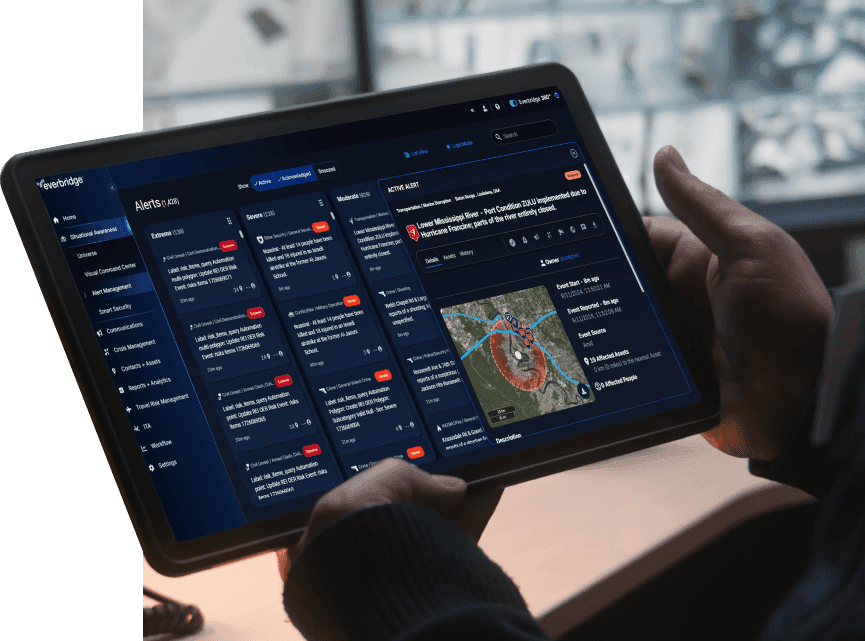
With Everbridge 360 and the High Velocity Critical Event Management platform, organizations can strengthen preparedness, response, and recovery across physical and digital risks.
Everbridge supports safety moment programs by helping organizations:
- Know earlier: Use real-time threat intelligence to identify emerging risks that may affect people, assets, operations, or infrastructure.
- Respond faster: Reach the right people through coordinated communications and confirm employee safety during critical events.
- Improve continuously: Use drills, incident reviews, and response data to identify gaps and refine procedures.
- Minimize disruptions: Coordinate response across teams, locations, and stakeholders to support operational continuity.
- Safeguard employees and assets: Connect employee safety actions to broader risk management and business continuity plans.
How to run a five-minute safety moment
A safety moment should be brief, practical, and easy to repeat. The goal is to start a workplace safety meeting with focus and clarity.
Use this simple structure:
- State the topic: Name the risk in plain language.
- Explain why it matters: Connect the topic to the team’s work, location, or current operating environment.
- Ask one question: Invite employees to share observations, concerns, or examples.
- Review the correct action: Clarify what employees should do before, during, or after the event.
- Close with one takeaway: End with a specific action employees can apply that day.
This structure keeps safety moments focused while encouraging participation and accountability.
Safety moment topic examples by workplace type
Different environments require different safety emphasis. The following examples can help organizations select safety moments that reflect real operating conditions.
| Workplace type | Effective safety moment topics |
|---|---|
| Office environments | Fire evacuation routes, ergonomic setup, phishing awareness, severe weather shelter procedures, and visitor safety |
| Healthcare settings | Workplace violence awareness, fatigue management, infection prevention, patient movement safety, and emergency communications |
| Manufacturing sites | Lockout and tagout reminders, machine guarding, heat stress, chemical handling, and incident reporting |
| Field services | Lone worker check-ins, severe weather alerts, driving safety, mobile device security, and escalation procedures |
| Travel-heavy teams | Destination risk reviews, emergency evacuation, digital security abroad, local transportation safety, and check-in protocols |
| Remote teams | Cyber hygiene, emergency contact updates, home office safety, mental well-being, and communication expectations |
Customizing safety moments for your workplace
The most effective safety moments and workplace safety talks are tailored to the specific work environment. A warehouse, hospital, corporate office, utility site, manufacturing floor, and traveling workforce will face different daily risks.
Use these tips to adapt the topics above:
- Use relevant examples: Connect the topic to a recent incident within the organization or industry while respecting privacy and confidentiality.
- Keep it brief and focused: A safety moment should last no more than five minutes and cover one or two learning objectives.
- Encourage interaction: Ask questions and invite team members to share related experiences or concerns.
- Provide actionable takeaways: End each safety moment with a clear, simple action employees can take that day.
- Align with response plans: Connect each topic to emergency procedures, business continuity plans, and communication channels.
- Refresh topics regularly: Update safety moments as risks, seasons, work locations, and organizational priorities change.
Prioritizing a culture of safety
Integrating safety moments into an organization’s daily rhythm is a strategic imperative. These brief, consistent discussions are more than a compliance activity; they embed a proactive safety mindset into company culture.
By integrating topics like severe weather resilience, cyber hygiene, misinformation defense, and crisis leadership into regular safety moments, organizations build a multi-layered defense system.
This proactive stance protects people and assets while strengthening resilience, readiness, stability, and continuity. It helps organizations navigate uncertainty with greater confidence.
Build resilience into every safety conversation
Safety moments create a simple, repeatable way to strengthen preparedness across the organization. When supported by real-time threat intelligence, clear communications, and coordinated response, they become part of a broader operational resilience strategy.
Everbridge empowers organizations to anticipate, mitigate, respond to, and recover from critical events with confidence.
Frequently asked questions
A safety moment is a brief discussion at the start of a meeting, shift, or work activity that focuses on one safety topic. It is designed to reinforce awareness, preparedness, and safe action in a practical way.
Good safety moment topics include personal safety, severe weather preparedness, fatigue management, cyber hygiene, phishing awareness, emergency evacuation, business continuity, and crisis communication. The best topic is timely, relevant, and tied to a clear action.
A safety moment should usually last no more than five minutes. It should focus on one risk, one discussion point, and one action employees can take immediately.
How often should organizations hold safety moments?
Many organizations use safety moments daily, weekly, or at the start of recurring meetings. The right frequency depends on the work environment, risk profile, and operational tempo.
Safety moments improve organizational resilience by reinforcing preparedness before critical events occur. They help employees recognize risks, follow response procedures, communicate quickly, and support recovery.
Everbridge helps organizations connect risk intelligence, employee communications, and coordinated response. This enables organizations to know earlier, respond faster, improve continuously, minimize disruptions, and safeguard employees and assets.