
Operational resilience is the ability of an organization to anticipate, prevent, adapt, respond to, recover from, and learn from disruption while continuing to deliver critical services within acceptable impact tolerances. For large enterprises, operational resilience matters because critical events can affect customers, employees, operations, infrastructure, third parties, and regulators at the same time.
In practical terms, operational resilience helps enterprises protect service delivery, maintain trust, meet regulatory expectations, and reduce the operational impact of cyber incidents, third-party failures, severe weather, geopolitical disruption, supply chain issues, and systemic shocks.
Operational resilience for large enterprises
Operational resilience focuses on keeping important business services available during disruption, not only restoring them afterward. Regulators such as the UK Financial Conduct Authority define operational resilience as the ability to prevent, adapt, respond to, recover, and learn from operational disruptions while continuing to deliver important business services within acceptable impact tolerances.
This definition emphasizes sustained service delivery, measurable outcomes, and continuous learning. Large enterprises use operational resilience to identify the services that matter most, understand dependencies across people, assets, operations, and infrastructure, and test whether those services can remain within defined thresholds under stress.
Operational resilience goes beyond traditional risk management because it connects strategy, operations, technology, communications, and third-party oversight. It gives leadership a clearer view of how disruption affects customers, markets, employees, and critical service delivery.
Context and problem framing
Modern enterprises operate across complex, interconnected ecosystems. A single critical event can move quickly across business units, technology systems, facilities, suppliers, and customer-facing channels.
Disruption is a normal operating condition for large organizations. Cyber threats, geopolitical uncertainty, third-party failures, supply chain disruption, severe weather, and infrastructure outages can all affect service continuity.
Operational resilience provides a structured way to anticipate disruption and mitigate its impact. It helps organizations move from reactive recovery toward proactive operational continuity.
Beyond financial loss, service disruption can affect customer confidence, employee safety, vendor relationships, and regulatory standing. Preparedness helps organizations maintain control when conditions change quickly.
Common challenges that make operational resilience difficult
Large enterprises often understand the importance of resilience, but they may struggle to operationalize it across scale, geography, and business complexity. The most common challenges include:
- Siloed ownership: Risk, information technology, operations, security, facilities, and communications teams may manage related risks separately.
- Limited service visibility: Teams may understand individual systems but lack a clear view of end-to-end important business services.
- Complex dependencies: Critical services often rely on people, applications, data, facilities, infrastructure, and third parties.
- Third-party concentration risk: Enterprises may depend on a limited number of technology, logistics, cloud, or managed service providers.
- Inconsistent communications: Response teams may lose time when stakeholders, employees, vendors, and leaders receive fragmented updates.
- Manual escalation: Delayed decision-making can increase disruption when teams rely on spreadsheets, email chains, or disconnected tools.
- Changing regulatory expectations: Financial services, healthcare, energy, telecom, and other critical sectors face growing resilience requirements.
Operational resilience addresses these challenges by creating a common operating model. It connects risk intelligence, service mapping, scenario testing, response coordination, and executive reporting.
Operational resilience vs business continuity
Operational resilience and business continuity are closely related, but they serve distinct roles. Business continuity focuses on restoring operations after a disruption, while operational resilience focuses on keeping critical services within acceptable impact tolerances during disruption.
| Category | Operational resilience | Business continuity |
|---|---|---|
| Scope | End-to-end service delivery (important business services) | Processes, systems, and recovery plans |
| Trigger | Proactive and continuous | Often activated after disruption |
| Primary metrics | Impact tolerance and service outcomes | Recovery Time Objective (RTO) and Recovery Point Objective (RPO) |
| Accountable owners | Executive leadership and board-level oversight | Information technology, risk, and operations teams |
| Core outputs | Important business service mapping, dependency mapping, scenario testing, and tolerances | Business continuity plans and disaster recovery procedures |
The practical takeaway is clear: organizations use operational resilience to ensure critical services remain within acceptable impact thresholds, and they use business continuity to restore operations when disruption occurs.
Everbridge solutions for operational resilience
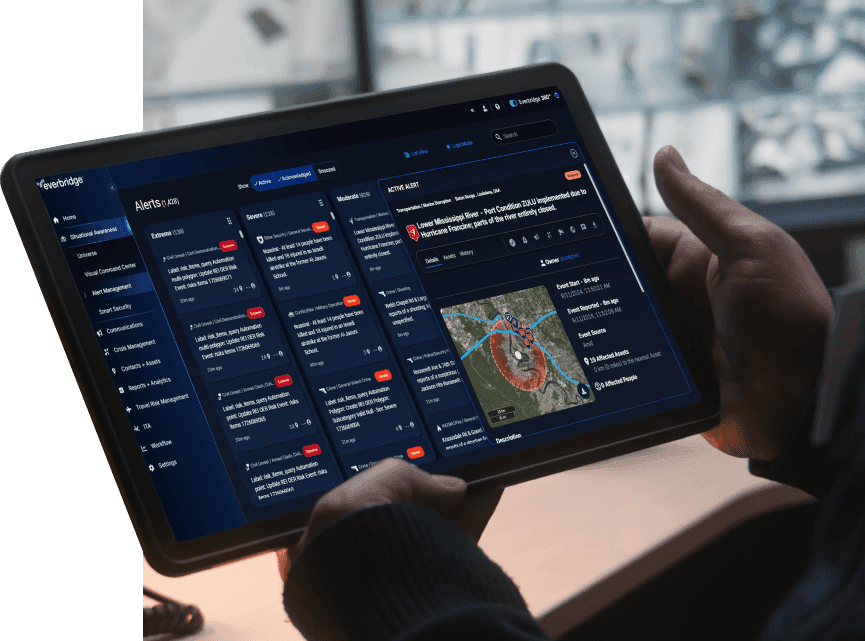
Everbridge helps organizations strengthen operational resilience by connecting risk intelligence, critical event management (CEM), communications, and response coordination in a unified approach. Everbridge 360, Powered by Purpose-built AI, supports faster identification, assessment, and response to critical events that may affect people, assets, operations, and infrastructure.
The High Velocity Critical Event Management platform helps enterprises correlate real-time threat intelligence with operational context. This enables teams to understand who and what may be affected, communicate with the right stakeholders, and coordinate response across business functions.
Everbridge also supports the Best in Resilience journey by helping organizations assess resilience maturity and improve preparedness over time. This approach aligns resilience strategy with measurable outcomes, operational continuity, and executive visibility.
How to build operational resilience
Building operational resilience requires a structured, outcomes-driven approach. Organizations need to identify critical services, define acceptable levels of disruption, and continuously test their ability to remain within those thresholds.
- Identify important business services: Create an important business services register that documents services whose disruption could significantly affect customers, markets, employees, or operations.
- Define impact tolerances: Establish measurable thresholds for each service, such as maximum downtime, transaction delay, customer impact, or operational degradation.
- Map dependencies: Document the people, processes, technology, facilities, data, infrastructure, and third parties that support each critical service.
- Assess third-party criticality: Build a third-party criticality matrix that identifies providers essential to service delivery.
- Conduct scenario testing: Use scenario testing and tabletop exercises to evaluate realistic disruption scenarios.
- Develop response strategies: Create communications playbooks, escalation paths, decision workflows, and coordinated response procedures.
- Embed monitoring and reporting: Use key performance indicators, dashboards, and executive reporting to track resilience performance.
- Establish continuous improvement cycles: Review lessons learned, update plans, refine tolerances, and repeat testing on a defined cadence.
This framework helps organizations connect regulatory expectations with operational execution. It also gives leadership measurable evidence that critical services can withstand disruption.
Benefits and outcomes of operational resilience
Operational resilience gives large enterprises a practical model for protecting service delivery under stress. It also helps leaders make faster, more informed decisions during critical events.
Key benefits include:
- Greater service continuity: Critical services continue within defined impact tolerances during disruption.
- Improved customer trust: Organizations reduce avoidable service disruption and maintain customer-facing commitments.
- Stronger regulatory alignment: Resilience programs support expectations from financial, critical infrastructure, cybersecurity, and continuity frameworks.
- Faster response coordination: Teams can identify affected people, assets, operations, and infrastructure more quickly.
- Better executive visibility: Leaders gain a clearer view of service risk, dependencies, and resilience gaps.
- More effective third-party oversight: Organizations understand which vendors, systems, and providers create critical dependencies.
- Continuous improvement: Scenario testing and post-event reviews help teams adapt and improve resilience maturity.
Industry-specific examples
Operational resilience is not one-size-fits-all. Each industry faces unique risks, dependencies, and regulatory expectations.
Financial services
- Important business service: Digital payments processing
- Impact tolerance: No more than 2 hours of disruption
- Key dependency: Core banking platform
Financial institutions use operational resilience to protect customer access, payment processing, market confidence, and regulatory compliance. They also use scenario testing to understand whether important business services can remain within impact tolerances.
Healthcare
- Important business service: Patient record access
- Impact tolerance: Less than 1 hour of downtime
- Key dependency: Electronic health record systems
Healthcare organizations use operational resilience to support care continuity, coordinated communications, and timely access to patient information. Resilience planning helps care teams maintain essential services when technology, staffing, facilities, or third-party systems face disruption.
Energy and utilities
- Important business service: Power distribution
- Impact tolerance: Less than 4 hours of outage
- Key dependency: Grid infrastructure
Energy and utility organizations use operational resilience to protect infrastructure, field operations, workforce safety, and service reliability. Coordinated communications and real-time risk intelligence help teams respond to critical events across distributed sites.
Telecom
- Important business service: Network connectivity
- Impact tolerance: Less than 2 hours of downtime
- Key dependency: Network operations center
Telecom providers use operational resilience to maintain connectivity, support emergency communications, and reduce customer impact. Dependency mapping helps teams understand the operational effect of network, facility, equipment, and supplier disruption.
Manufacturing
- Important business service: Production line operations
- Impact tolerance: Less than 6 hours of downtime
- Key dependency: Supply chain inputs
Manufacturers use operational resilience to protect production schedules, workforce safety, supplier continuity, and customer commitments. Resilience planning helps teams adapt when materials, logistics, facilities, or equipment face disruption.
Jurisdictional snapshot
Regulatory expectations for operational resilience continue to evolve globally. Many frameworks now emphasize critical services, impact tolerances, technology resilience, third-party risk, incident reporting, and scenario testing.
UK financial services
- Who: Financial institutions
- What: Identify important business services, set impact tolerances, and complete scenario testing
- When: Fully enforced in 2025
- Source: FCA operational resilience guidance
EU digital operational resilience
- Who: Financial entities and information and communications technology providers
- What: Information and communications technology risk management, incident reporting, resilience testing, and third-party oversight
- When: Effective January 2025
- Source: Everbridge guide to operationalizing DORA
US banking and financial institutions
- Who: Banks and financial institutions
- What: Business continuity, operational resilience, and technology resilience guidance
- When: Ongoing supervisory expectations
- Source: FFIEC Business Continuity Management booklet
ISO 22301
- Who: Global organizations
- What: Business continuity management systems
- When: Voluntary standard
- Source: ISO 22301 overview
NIST Cybersecurity Framework 2.0
- Who: Organizations across sectors
- What: Cybersecurity risk management and resilience framework
- When: Updated in 2024
- Source: NIST Cybersecurity Framework
Proof and stories: Operational resilience in action with Everbridge
Real-world examples show how operational resilience improves visibility, coordination, and response during disruption. The following organizations used Everbridge capabilities to strengthen resilience outcomes.
Santander
Santander improved operational resilience by automating risk monitoring and response coordination on a single platform. The organization reduced irrelevant risk alerts by 95%, which helped teams focus on high-priority events.
Santander also reduced notification times by 10–15 minutes per alert, and by up to 30 minutes across the lifecycle. This accelerated response and helped teams maintain control during disruption.
Brigham and Women’s Hospital
Brigham and Women’s Hospital strengthened resilience by enabling real-time, coordinated communication across care teams. This supported continuity of critical services beyond traditional hospital settings.
The organization improved care delivery and helped ensure essential services remained accessible during disruption. Coordinated communication supported faster response across distributed care environments.
Colbún
Colbún enhanced operational resilience by implementing a unified, multi-channel critical communications platform. The organization can respond faster and more effectively to critical events across sites.
The Everbridge platform helps Colbún support business continuity, employee safety, traceability, and control. These capabilities strengthen overall resilience and emergency preparedness.
A strategic imperative
Operational resilience has become a strategic imperative, not only a regulatory requirement. Organizations that define critical services, set measurable impact tolerances, and test their capabilities can better withstand disruption and maintain customer trust.
By aligning resilience strategies with industry practices and regulatory expectations, enterprises can move from reactive recovery to proactive continuity. Everbridge helps organizations anticipate, mitigate, respond, recover, and adapt when critical events affect the services that matter most.
Glossary
The ability to maintain critical services during disruption within defined tolerances.
Services whose disruption would significantly impact customers or markets.
The maximum acceptable level of disruption to a service.
Maximum tolerable period of disruption before unacceptable harm occurs.
Target time to restore service after disruption.
Maximum acceptable data loss measured in time.
External providers essential to delivering IBS.
Risk from over-reliance on a small number of technology providers.
Simulating disruptions to assess resilience.
Validating ability to remain within tolerances.
Identifying relationships between services and supporting resources.
Frequently asked questions
Operational resilience is the ability of an organization to prevent, adapt, respond to, recover from, and learn from disruption while continuing to deliver critical services within acceptable impact tolerances. It focuses on sustained service delivery during critical events, not only recovery after disruption.
Operational resilience matters because large enterprises depend on complex networks of people, systems, facilities, suppliers, and infrastructure. A disruption in one area can affect customers, employees, operations, regulators, and markets, so enterprises need a coordinated way to maintain critical services.
Operational resilience focuses on keeping important business services within acceptable impact tolerances during disruption. Business continuity focuses on restoring processes, systems, and operations after disruption occurs.
Impact tolerances define the maximum acceptable disruption to an important business service. They may include measurable thresholds such as downtime, transaction delays, customer impact, data loss, or operational degradation.
An operational resilience program should include important business service identification, impact tolerances, dependency mapping, third-party criticality assessments, scenario testing, communications playbooks, monitoring, reporting, and continuous improvement.
Financial services, healthcare, energy, utilities, telecom, manufacturing, government, and other critical infrastructure sectors have strong operational resilience needs. Any large enterprise that delivers essential services to customers, communities, or markets can benefit from a structured resilience program.
Everbridge supports operational resilience through real-time threat intelligence, critical event management, automated communications, response coordination, and operational visibility. Everbridge 360 helps organizations identify critical events, understand impact, and coordinate response across people, assets, operations, and infrastructure.