Employers in public and private sectors should put proactive winter safety precautions in place before severe weather arrives. A strong winter safety plan includes real-time weather monitoring, automated alerts, multi-modal communication, power outage planning, employee training, emergency notification, clear message templates, defined response roles, and recovery steps that help safeguard employees and assets.
Public sector organizations also need coordinated community warning, interagency communication, road and shelter updates, resident outreach, and accessible alerting options. Private sector organizations should focus on employee safety, business continuity, customer and stakeholder communication, facility readiness, and resilient operations.
Winter safety precautions employers should put in place
A winter safety plan should help organizations anticipate, mitigate, respond, recover, and adapt during critical events. The following precautions apply across private businesses, government agencies, schools, utilities, healthcare organizations, transportation teams, and other public-facing operations:
- Monitor severe weather in real time and define alert thresholds for snow, ice, extreme cold, blizzards, and freezing rain.
- Maintain current contact information for employees, contractors, residents, customers, suppliers, and other stakeholders.
- Use multi-modal communication, including SMS, email, voice calls, mobile app alerts, social media, and local media where appropriate.
- Implement an emergency notification system that can reach people across locations quickly.
- Automate severe weather alerts so decision-makers and affected people receive relevant updates without delay.
- Prepare for power outages, including backup communication methods and contingency plans if a sender or response team is in an impacted area.
- Train employees on winter safety, including frostbite, hypothermia, slips and falls, travel risks, and cold-weather work practices.
- Create winter message templates for closures, delayed openings, travel restrictions, sheltering, road conditions, and recovery updates.
- Define roles and responsibilities so teams understand who assesses risk, sends alerts, escalates incidents, and coordinates response.
- Review plans after each event to improve communication, response, and organizational resilience.
Winter weather context for public and private sectors
Winter storms can significantly impact people, operations, assets, and critical infrastructure. Severe weather may disrupt transportation, close facilities, damage utilities, delay emergency services, and reduce access to essential resources.
The NOAA stated that, in 2024 alone, the total cost of winter storms in the United States was 182.7 billion dollars. According to the European Environment Agency:
Between 1980 and 2024, weather- and climate-related extremes caused economic losses of assets estimated at EUR 822 billion in the EU Member States, with over EUR 208 billion (25%) between 2021 and 2024— European Environment Agency
Whether an organization is responsible for employee safety, public safety, essential services, or operational continuity, winter weather preparedness is a measurable part of resilience.
Common winter safety challenges for employers
Winter storms create communication and operational challenges that can change quickly. Employers should plan for these common risks before severe weather affects people and infrastructure:
- Limited visibility into which employees, facilities, or communities are in the impact area.
- Power outages that interrupt standard communication channels.
- Road closures, delayed transit, and unsafe commutes.
- Slips, falls, frostbite, hypothermia, and other cold-weather hazards.
- Inconsistent messages across departments, agencies, or locations.
- Delayed decisions about closures, remote work, shifts, or public services.
- Limited access to residents, employees, or stakeholders who rely on different communication channels.
- Coordination gaps between operations, safety, communications, human resources, facilities, and emergency management teams.
A coordinated winter safety strategy helps organizations know earlier, respond faster, and improve continuously during inclement weather.
Everbridge solution overview for winter safety
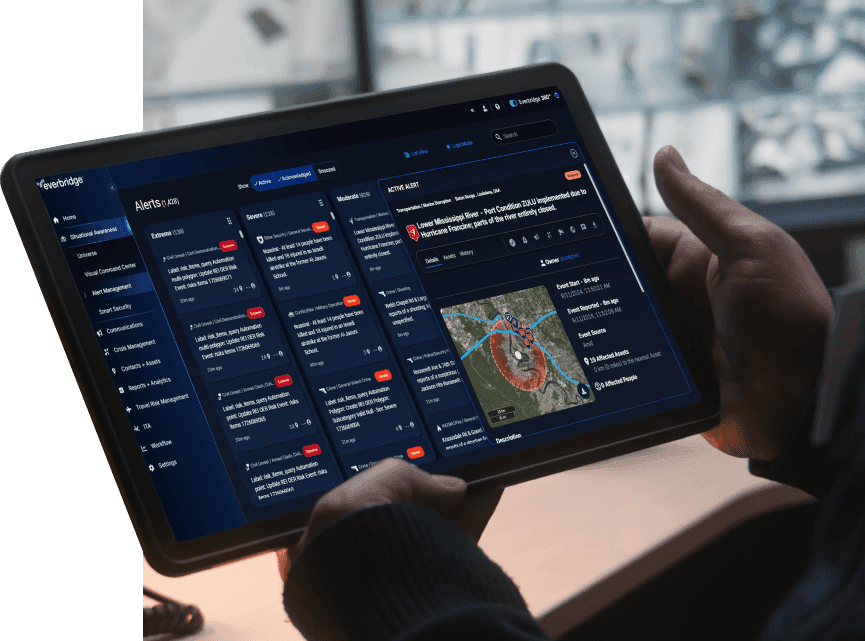
Everbridge empowers organizations to navigate critical events confidently by connecting real-time threat intelligence, automated alerting, and coordinated response workflows. Everbridge 360 helps organizations anticipate severe weather impacts, communicate with affected people, and manage response actions from a unified platform.
During winter storms, organizations can use Everbridge capabilities to:
- Identify people, facilities, and operations in the path of severe weather.
- Send automated alerts through multiple communication channels.
- Confirm employee safety and gather status updates.
- Share instructions for closures, travel, sheltering, and recovery.
- Coordinate response across teams, agencies, and stakeholders.
- Use Purpose-built AI to support faster decision-making and improve situational awareness.
These capabilities help organizations minimize disruptions, safeguard employees and assets, and maintain a proactive approach to critical events.
How winter storm communication should work
Winter storm communication should follow a defined sequence so employees, residents, and stakeholders receive the right message at the right time. A structured workflow can reduce confusion and improve response.
- Anticipate the event: Monitor weather conditions, forecasts, and local alerts before the storm develops.
- Assess the impact: Identify which people, facilities, routes, operations, and infrastructure may be affected.
- Activate the plan: Assign roles, open communication channels, and prepare approved messages.
- Notify affected people: Send automated alerts through SMS, email, voice, mobile app, and other channels.
- Confirm receipt and safety: Use polling, response options, or check-ins to understand who needs support.
- Coordinate response: Share updates with internal teams, public agencies, emergency services, and leadership.
- Support recovery: Communicate reopening plans, service restoration, road updates, and post-event resources.
- Improve the plan: Review event data, response timing, and communication outcomes after the storm.
Private sector winter safety checklist
Private sector employers should prioritize employee safety while keeping operations, customer service, facilities, and supply chains as resilient as possible. The checklist below can help businesses prepare for severe winter weather.
Use multi-modal communication for employees and stakeholders
Develop a plan to stay in touch with affected individuals before, during, and after a winter storm. Use channels such as email, SMS, voice calls, mobile app notifications, intranet updates, and social media to keep employees and stakeholders informed.
Employers should also follow OSHA winter weather guidance when advising employees on proper winter safety. Training should address frostbite, hypothermia, cold stress, slips and falls, and other dangers related to extreme cold.
Prepare for power outages and communication disruption
Power outages can limit access to email, phones, facility systems, and work locations. Employers should maintain current contact information for employees, customers, and stakeholders so they can coordinate response and send updates through alternate channels.
Organizations should also develop contingency plans if the message sender, leadership team, or primary operations center is in an impacted area. Backup senders and predefined escalation paths help maintain communication when conditions change.
Use Everbridge emergency notification solutions for employee alerts
An emergency notification system helps organizations quickly send critical information to large groups of people. This may include automated alerts, mass messaging, voice calls, and targeted notifications by location, role, facility, or business unit.
Everbridge mass notification and incident communications can help organizations reach employees across different locations and communication preferences. This supports faster response during closures, outages, travel disruptions, and other winter weather impacts.
Automate severe weather alerts for faster response
Automated severe weather alerts help organizations respond before conditions create wider disruption. By integrating weather monitoring and alerting capabilities, organizations can receive real-time notifications about blizzards, heavy snowfall, freezing rain, and extreme cold.
These alerts allow teams to adjust schedules, close facilities, pause travel, or provide safety guidance before conditions worsen. Automated communication also helps affected people take necessary precautions and make informed decisions.
Train employees on winter safety procedures
Employee training should be part of winter preparation, not a one-time reminder during a storm. Employers should provide regular safety talks during the winter months and make instructions easy to access.
Training topics should include:
- Recognizing symptoms of frostbite and hypothermia.
- Preventing slips, trips, and falls in icy conditions.
- Reporting unsafe conditions at facilities or job sites.
- Understanding closure, remote work, and delayed opening procedures.
- Following travel guidance during severe weather.
- Knowing how to confirm safety after an alert.
Protect operations, facilities, and assets
Winter storms can affect buildings, equipment, vehicles, technology systems, and supply chains. Employers should define how teams will protect assets, maintain essential operations, and recover after disruption.
Operational precautions may include:
- Reviewing facility access and snow removal plans.
- Preparing backup power or alternate work locations.
- Communicating with suppliers and service providers.
- Coordinating shift changes around road and transit conditions.
- Documenting reopening and recovery procedures.
Public sector winter safety checklist
Public sector organizations must protect residents, employees, infrastructure, and essential services during severe winter weather. Government agencies, emergency managers, transportation departments, utilities, schools, and public safety teams should coordinate plans before storms affect the community.
Review emergency operations plans
Emergency operations plans should reflect lessons learned from past events and known local risks. Plans should outline procedures for assessing hazards, activating emergency operations centers, coordinating with authorities, and maintaining essential services.
A winter weather plan should also assign roles and responsibilities for key personnel. Defined ownership helps public authorities respond in a coordinated way during large-scale events.
Use Everbridge public warning solutions to alert residents
Public agencies should use an emergency notification system to alert residents about winter storms, evacuation procedures, shelter locations, road closures, utility disruptions, and other critical information.
Everbridge public warning solutions help public authorities know about risk earlier, respond faster, and reach more people. This supports a coordinated approach so no one is left behind during critical events.
Conduct safety drills for winter storm scenarios
Emergency managers should conduct regular safety drills to familiarize staff with emergency procedures and identify preparedness gaps. Drills should simulate winter storm scenarios such as power outages, icy roads, heavy snowfall, delayed emergency response, and facility closures.
These exercises help test communication systems, validate response roles, and improve emergency operations plans before severe weather occurs.
Use resident connection solutions for outreach and education
Community outreach helps residents understand how to prepare for winter storms and where to find trusted information. Public authorities should share guidance on emergency supplies, heating safety, travel precautions, shelter options, and how to subscribe to alerts.
Everbridge resident connection solutions are developed to help public authorities reach more people in their jurisdiction before, during, and after an incident. This supports proactive communication and stronger community resilience.
Maintain clear communication channels
Public communication must be timely, accurate, and coordinated during winter storms. Agencies should establish communication channels before severe weather arrives and use them consistently throughout the event.
Channels may include:
- Emergency alert systems.
- Social media platforms.
- Local news outlets.
- Agency websites.
- SMS, voice, and email alerts.
- Mobile applications.
- Community partner networks.
Updates should cover weather conditions, road closures, emergency shelters, service disruptions, warming centers, and safety precautions.
Create a winter message library
Public authorities should create winter-based templates and message cadences before storms occur. Pre-approved templates help reduce errors, save time, and keep messaging consistent across agencies and channels.
Templates can include:
- Weather updates.
- Safety instructions.
- Road and transit conditions.
- Facility closures.
- Shelter and warming center information.
- Utility disruption updates.
- Emergency contact details.
- Recovery and reopening guidance.
Message libraries also allow alerting authorities to tailor communications based on storm severity and audience needs.
Automate severe weather alerts for the public
Automated severe weather alert systems help public agencies notify residents, employees, and stakeholders as conditions change. These systems can monitor weather conditions in real time and send alerts through email, SMS, voice, or mobile applications.
Public authorities should also provide options for residents to control when and how they receive alerts. Communication preferences improve reach and help ensure critical information arrives through trusted channels.
Collaborate with other agencies
Winter storm response often requires cooperation across public entities, non-profit organizations, emergency services, utilities, transportation teams, and neighboring communities. Public agencies should share resources, information, and response plans before severe weather occurs.
Collaboration improves situational awareness and helps communities maintain a unified response during winter storms.
Benefits of proactive winter safety planning
A proactive winter safety program helps public and private sector organizations reduce uncertainty and protect people during severe weather. The benefits include:
- Faster identification of people and assets in impacted areas.
- Automated communication across multiple channels.
- Coordinated decision-making across departments or agencies.
- Reduced disruption to operations and essential services.
- Improved employee and resident confidence.
- Clearer instructions during closures, outages, and travel disruptions.
- Stronger documentation for post-event review.
- Measurable improvements in organizational resilience.
Resources and thought leadership
Winter storms are one type of critical event that can disrupt people, operations, assets, and infrastructure. Organizations can strengthen readiness by aligning severe weather planning with broader resilience programs.
Explore related resources:
- How to build organizational resilience: Six proven steps
- Inclement weather solutions
- Mass notification and incident communications
- Public warning
Whether responsible for a private business or a public entity, winter storm preparation helps minimize disruptions and protect people within an organization’s sphere of influence. By implementing proactive measures and coordinated communication, organizations can navigate severe winter weather with greater confidence and strengthen resilience for future critical events.
Frequently asked questions
Employers should put a winter safety plan in place that includes real-time weather monitoring, employee training, automated alerts, multi-modal communication, power outage planning, closure procedures, travel guidance, emergency notification, and recovery steps. Public sector organizations should also include resident alerts, road and shelter updates, and interagency coordination.
Employers should use multi-modal communication, including SMS, email, voice calls, mobile app notifications, intranet updates, and other available channels. Using multiple channels helps reach employees even if power outages, travel disruption, or local infrastructure issues affect one method.
Employees should follow employer instructions, monitor official updates, avoid unnecessary travel, dress for extreme cold, report unsafe conditions, and confirm their safety when requested. Employees should also understand symptoms of frostbite, hypothermia, and cold stress before severe weather occurs.
An emergency notification system helps organizations send critical updates quickly to affected people across locations. It can support automated alerts, targeted messaging, safety check-ins, and coordinated response during closures, outages, road disruptions, and other winter weather impacts.
Public sector organizations can improve preparedness by reviewing emergency operations plans, conducting safety drills, automating public alerts, creating message templates, coordinating with other agencies, and educating residents before winter storms occur.
Private sector employers can reduce disruption by preparing power outage plans, validating employee contact data, setting closure and remote work procedures, monitoring severe weather, automating alerts, and communicating with employees, customers, suppliers, and stakeholders throughout the event.